

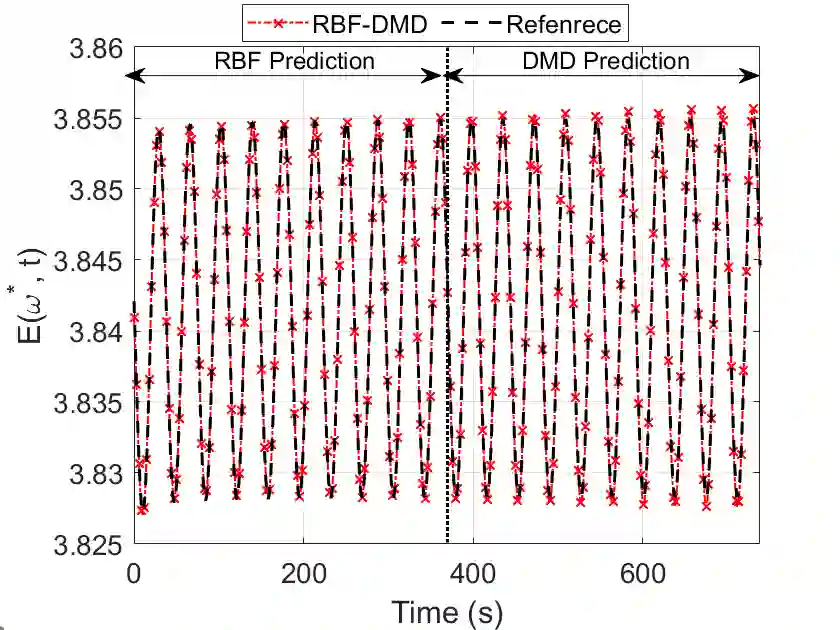
A non-intrusive model order reduction (MOR) method that combines features of the dynamic mode decomposition (DMD) and the radial basis function (RBF) network is proposed to predict the dynamics of parametric nonlinear systems. In many applications, we have limited access to the information of the whole system, which motivates non-intrusive model reduction. One bottleneck is capturing the dynamics of the solution without knowing the physics inside the "black-box" system. DMD is a powerful tool to mimic the dynamics of the system and give a reliable approximation of the solution in the time domain using only the dominant DMD modes. However, DMD cannot reproduce the parametric behavior of the dynamics. Our contribution focuses on extending DMD to parametric DMD by RBF interpolation. Specifically, a RBF network is first trained using snapshot matrices at limited parameter samples. The snapshot matrix at any new parameter sample can be quickly learned from the RBF network. DMD will use the newly generated snapshot matrix at the online stage to predict the time patterns of the dynamics corresponding to the new parameter sample. The proposed framework and algorithm are tested and validated by numerical examples including models with parametrized and time-varying inputs.
翻译:提出了一种结合动态模态分解(DMD)与径向基函数(RBF)网络特征的非侵入式模型降阶(MOR)方法,用于预测参数化非线性系统的动力学行为。在许多应用中,我们仅能获取整个系统的有限信息,这推动了非侵入式模型降阶的发展。其关键瓶颈在于:无需了解"黑箱"系统内部物理机制,即可捕捉解的动力学行为。DMD是一种强大的工具,通过仅利用主导DMD模态即可在时域中模拟系统动力学并给出解的可靠近似。然而,DMD无法复现动力学行为的参数化特征。本研究的贡献在于通过RBF插值将DMD拓展为参数化DMD。具体而言,首先利用有限参数样本下的快照矩阵训练RBF网络,随后可通过该网络快速获取任意新参数样本下的快照矩阵。在在线阶段,DMD将利用新生成的快照矩阵预测该新参数样本对应的动力学时间模式。通过包含参数化输入与时变输入模型的数值算例对所提框架与算法进行了测试与验证。






相关内容




 微信扫码咨询专知VIP会员