

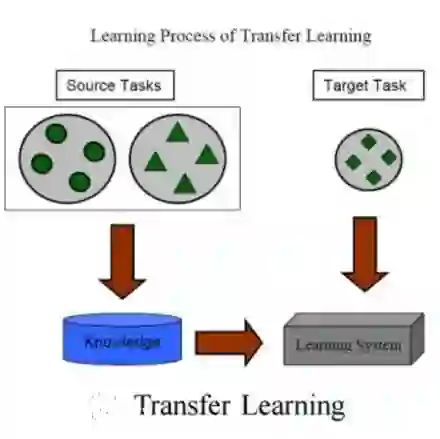
Machine learning, and representation learning in particular, has the potential to facilitate drug discovery by screening billions of compounds. For example, a successful approach is representing the molecules as a graph and utilizing graph neural networks (GNN). Yet, these approaches still require experimental measurements of thousands of compounds to construct a proper training set. While in some domains it is easier to acquire experimental data, in others it might be more limited. For example, it is easier to test the compounds on bacteria than perform in-vivo experiments. Thus, a key question is how to utilize information from a large available dataset together with a small subset of compounds where both domains are measured to predict compounds' effect on the second, experimentally less available domain. Current transfer learning approaches for drug discovery, including training of pre-trained modules or meta-learning, have limited success. In this work, we develop a novel method, named Symbiotic Message Passing Neural Network (SMPNN), for merging graph-neural-network models from different domains. Using routing new message passing lanes between them, our approach resolves some of the potential conflicts between the different domains, and implicit constraints induced by the larger datasets. By collecting public data and performing additional high-throughput experiments, we demonstrate the advantage of our approach by predicting anti-fungal activity from anti-bacterial activity. We compare our method to the standard transfer learning approach and show that SMPNN provided better and less variable performances. Our approach is general and can be used to facilitate information transfer between any two domains such as different organisms, different organelles, or different environments.
翻译:机器学习,特别是表示学习,有望通过筛选数十亿种化合物来促进药物发现。例如,一种成功的方法是将分子表示为图,并利用图神经网络(GNN)。然而,这些方法仍需要数千种化合物的实验测量来构建合适的训练集。在某些领域,获取实验数据较为容易,而在其他领域则可能更加受限。例如,在细菌上测试化合物比进行体内实验更容易。因此,一个关键问题是如何利用来自大型可用数据集的信息,以及来自两个领域均被测量的少量化合物子集,来预测化合物在第二个实验数据较少的领域中的效果。当前的迁移学习方法,包括预训练模块或元学习训练,在药物发现中成效有限。在本工作中,我们开发了一种名为共生消息传递神经网络(SMPNN)的新方法,用于融合不同领域的图神经网络模型。通过在其间路由新的消息传递通道,我们的方法解决了不同领域之间的一些潜在冲突,以及大型数据集所隐含的约束。通过收集公开数据并进行额外的高通量实验,我们通过从抗细菌活性预测抗真菌活性,展示了我们方法的优势。我们将我们的方法与标准迁移学习方法进行比较,结果表明SMPNN提供了更好且变异性更小的性能。我们的方法具有通用性,可用于促进任何两个领域之间的信息迁移,例如不同生物体、不同细胞器或不同环境。




相关内容


 微信扫码咨询专知VIP会员