

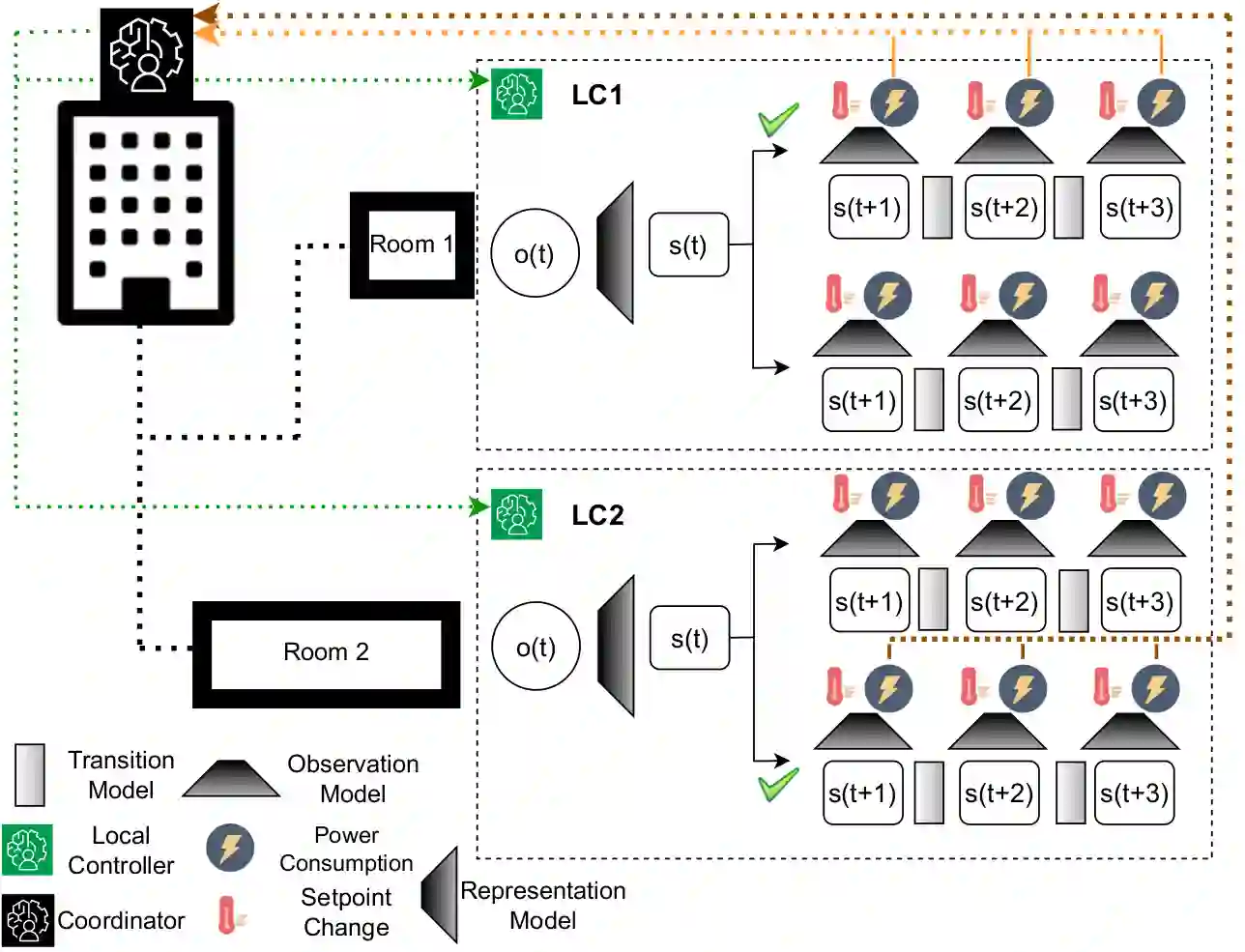
The surge in electricity use, coupled with the dependency on intermittent renewable energy sources, poses significant hurdles to effectively managing power grids, particularly during times of peak demand. Demand Response programs and energy conservation measures are essential to operate energy grids while ensuring a responsible use of our resources This research combines distributed optimization using ADMM with Deep Learning models to plan indoor temperature setpoints effectively. A two-layer hierarchical structure is used, with a central building coordinator at the upper layer and local controllers at the thermal zone layer. The coordinator must limit the building's maximum power by translating the building's total power to local power targets for each zone. Local controllers can modify the temperature setpoints to meet the local power targets. The resulting control algorithm, called Distributed Planning Networks, is designed to be both adaptable and scalable to many types of buildings, tackling two of the main challenges in the development of such systems. The proposed approach is tested on an 18-zone building modeled in EnergyPlus. The algorithm successfully manages Demand Response peak events.
翻译:电力使用量的激增,加上对间歇性可再生能源的依赖,给有效管理电网带来了重大挑战,尤其是在用电高峰期。需求响应计划和节能措施对于在确保负责任地使用资源的同时运行能源电网至关重要。本研究将使用ADMM的分布式优化与深度学习模型相结合,以有效规划室内温度设定点。采用两层分层结构,上层为中央建筑协调器,下层为热区域局部控制器。协调器必须通过将建筑的总功率转换为每个区域的局部功率目标来限制建筑的最大功率。局部控制器可以调整温度设定点以满足局部功率目标。由此产生的控制算法称为分布式规划网络,旨在适应多种建筑类型并具有可扩展性,解决了此类系统开发中的两个主要挑战。所提出的方法在EnergyPlus中建模的18区域建筑上进行了测试。该算法成功管理了需求响应峰值事件。




相关内容




 微信扫码咨询专知VIP会员