

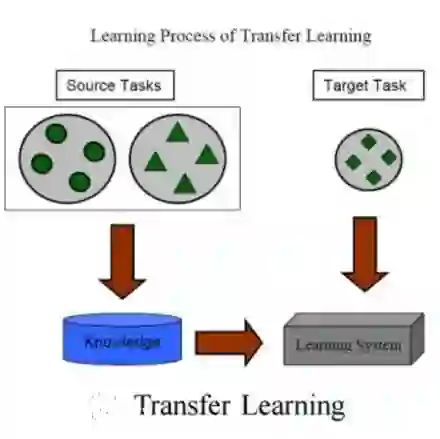
A fundamental problem in manifold learning is to approximate a functional relationship in a data chosen randomly from a probability distribution supported on a low dimensional sub-manifold of a high dimensional ambient Euclidean space. The manifold is essentially defined by the data set itself and, typically, designed so that the data is dense on the manifold in some sense. The notion of a data space is an abstraction of a manifold encapsulating the essential properties that allow for function approximation. The problem of transfer learning (meta-learning) is to use the learning of a function on one data set to learn a similar function on a new data set. In terms of function approximation, this means lifting a function on one data space (the base data space) to another (the target data space). This viewpoint enables us to connect some inverse problems in applied mathematics (such as inverse Radon transform) with transfer learning. In this paper we examine the question of such lifting when the data is assumed to be known only on a part of the base data space. We are interested in determining subsets of the target data space on which the lifting can be defined, and how the local smoothness of the function and its lifting are related.
翻译:流形学习中的一个基本问题是近似从高维欧几里得空间的低维子流形上按概率分布随机选取的数据中的函数关系。流形本质上由数据集本身定义,并通常设计使得数据在某种意义下在该流形上密集分布。数据空间的概念是对流形的抽象,它封装了允许函数逼近的基本属性。迁移学习(元学习)问题旨在利用在一个数据集上学习的函数来学习新数据集上的相似函数。从函数逼近的角度来看,这意味着将一个数据空间(基数据空间)上的函数提升到另一个数据空间(目标数据空间)上。这一观点使得我们能够将应用数学中的某些逆问题(如逆拉东变换)与迁移学习联系起来。本文研究当仅已知基数据空间部分区域上的数据时此类提升问题。我们关注确定目标数据空间中可定义提升的子集,以及函数及其提升的局部光滑性之间的关联。




相关内容



 微信扫码咨询专知VIP会员