

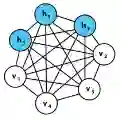
In various verification systems, Restricted Boltzmann Machines (RBMs) have demonstrated their efficacy in both front-end and back-end processes. In this work, we propose the use of RBMs to the image clustering tasks. RBMs are trained to convert images into image embeddings. We employ the conventional bottom-up Agglomerative Hierarchical Clustering (AHC) technique. To address the challenge of limited test face image data, we introduce Agglomerative Hierarchical Clustering based Method for Image Clustering using Restricted Boltzmann Machine (AHC-RBM) with two major steps. Initially, a universal RBM model is trained using all available training dataset. Subsequently, we train an adapted RBM model using the data from each test image. Finally, RBM vectors which is the embedding vector is generated by concatenating the visible-to-hidden weight matrices of these adapted models, and the bias vectors. These vectors effectively preserve class-specific information and are utilized in image clustering tasks. Our experimental results, conducted on two benchmark image datasets (MS-Celeb-1M and DeepFashion), demonstrate that our proposed approach surpasses well-known clustering algorithms such as k-means, spectral clustering, and approximate Rank-order.
翻译:在各种验证系统中,受限玻尔兹曼机(RBM)在前端和后端处理中均展现出卓越效能。本研究提出将RBM应用于图像聚类任务,通过训练RBM将图像转换为图像嵌入表征。我们采用传统的自底向上凝聚层次聚类(AHC)技术。针对测试人脸图像数据有限的问题,我们提出基于凝聚层次聚类的受限玻尔兹曼机图像聚类方法(AHC-RBM),该方法包含两个主要阶段:首先利用全部可用训练数据集训练通用RBM模型,随后使用每个测试图像的数据训练自适应RBM模型。最终通过拼接这些自适应模型的可见-隐藏层权重矩阵与偏置向量,生成嵌入向量形式的RBM向量。这些向量有效保留了类别特异性信息,并应用于图像聚类任务。我们在两个基准图像数据集(MS-Celeb-1M和DeepFashion)上的实验结果表明,该方法优于k-means、谱聚类和近似排序等经典聚类算法。




相关内容


 微信扫码咨询专知VIP会员