

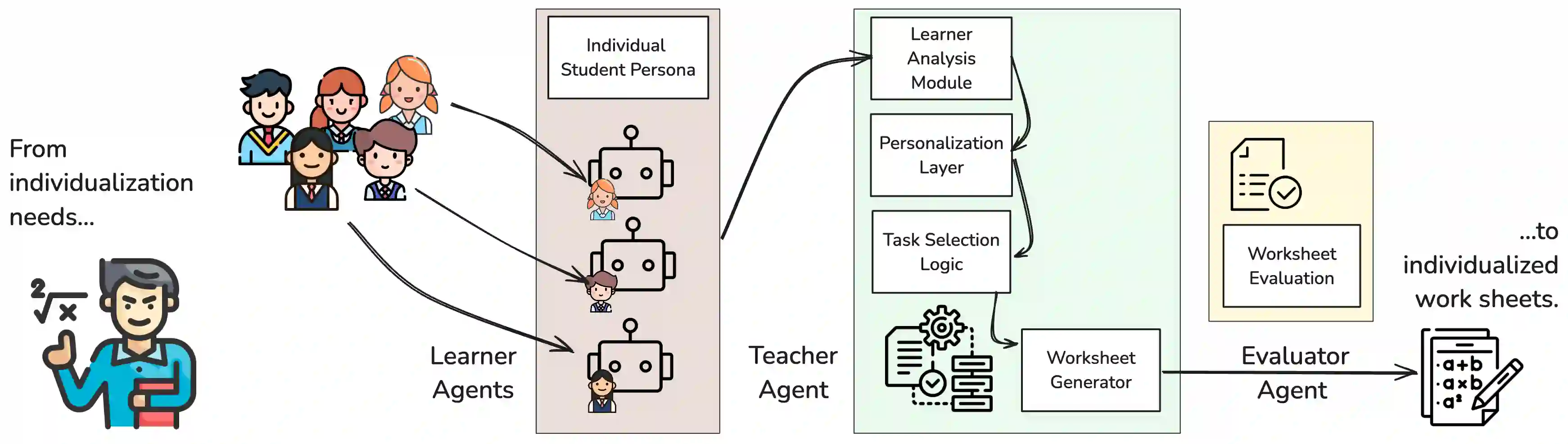
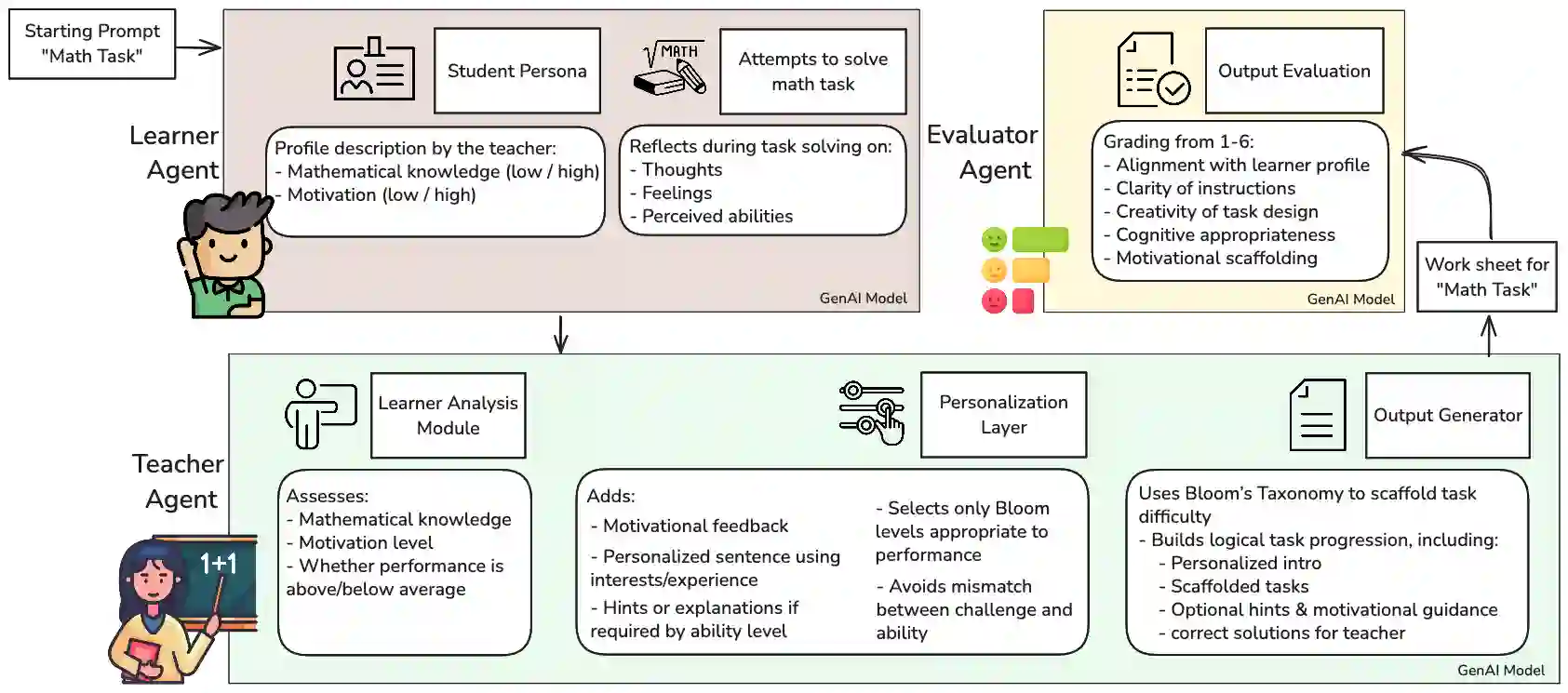
The increasing heterogeneity of student populations poses significant challenges for teachers, particularly in mathematics education, where cognitive, motivational, and emotional differences strongly influence learning outcomes. While AI-driven personalization tools have emerged, most remain performance-focused, offering limited support for teachers and neglecting broader pedagogical needs. This paper presents the FACET framework, a teacher-facing, large language model (LLM)-based multi-agent system designed to generate individualized classroom materials that integrate both cognitive and motivational dimensions of learner profiles. The framework comprises three specialized agents: (1) learner agents that simulate diverse profiles incorporating topic proficiency and intrinsic motivation, (2) a teacher agent that adapts instructional content according to didactical principles, and (3) an evaluator agent that provides automated quality assurance. We tested the system using authentic grade 8 mathematics curriculum content and evaluated its feasibility through a) automated agent-based assessment of output quality and b) exploratory feedback from K-12 in-service teachers. Results from ten internal evaluations highlighted high stability and alignment between generated materials and learner profiles, and teacher feedback particularly highlighted structure and suitability of tasks. The findings demonstrate the potential of multi-agent LLM architectures to provide scalable, context-aware personalization in heterogeneous classroom settings, and outline directions for extending the framework to richer learner profiles and real-world classroom trials.
翻译:学生群体的日益异质性给教师带来了重大挑战,尤其在数学教育领域,认知、动机和情感方面的差异强烈影响着学习成果。尽管人工智能驱动的个性化工具已经出现,但大多数仍以表现为中心,为教师提供的支持有限,且忽视了更广泛的教学需求。本文提出了FACET框架,这是一个面向教师的、基于大型语言模型的多智能体系统,旨在生成整合学习者画像认知与动机维度的个性化课堂材料。该框架包含三个专门智能体:(1)模拟包含主题熟练度和内在动机的多样化画像的学习者智能体,(2)根据教学原则调整教学内容的教师智能体,以及(3)提供自动化质量保证的评估者智能体。我们使用真实的八年级数学课程内容测试了该系统,并通过以下方式评估其可行性:a) 基于智能体的输出质量自动化评估,以及b) 来自K-12在职教师的探索性反馈。十次内部评估的结果突显了生成材料的高稳定性及其与学习者画像的高度契合,教师的反馈则特别强调了任务的结构和适宜性。研究结果证明了多智能体LLM架构在异质性课堂环境中提供可扩展、情境感知的个性化支持的潜力,并概述了将该框架扩展到更丰富的学习者画像和真实课堂试验的方向。




相关内容



 微信扫码咨询专知VIP会员