

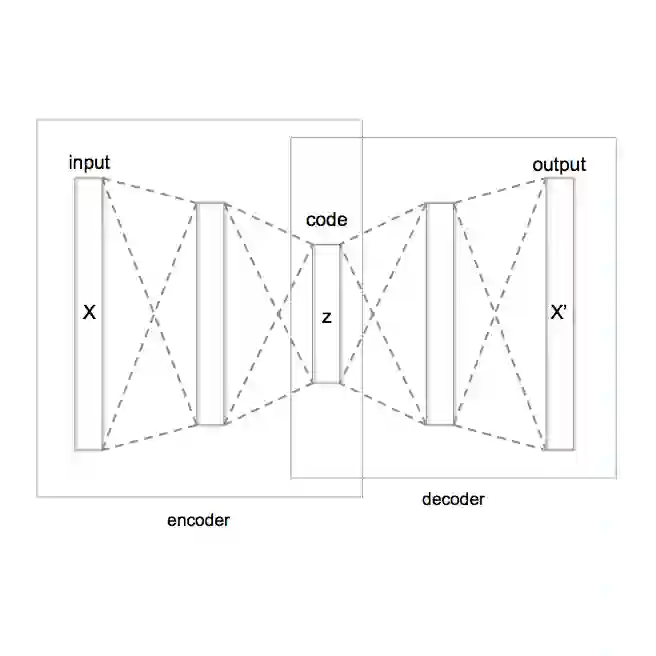
This paper demonstrates the learning of the underlying device physics by mapping device structure images to their corresponding Current-Voltage (IV) characteristics using a novel framework based on variational autoencoders (VAE). Since VAE is used, domain expertise is not required and the framework can be quickly deployed on any new device and measurement. This is expected to be useful in the compact modeling of novel devices when only device cross-sectional images and electrical characteristics are available (e.g. novel emerging memory). Technology Computer-Aided Design (TCAD) generated and hand-drawn Metal-Oxide-Semiconductor (MOS) device images and noisy drain-current-gate-voltage curves (IDVG) are used for the demonstration. The framework is formed by stacking two VAEs (one for image manifold learning and one for IDVG manifold learning) which communicate with each other through the latent variables. Five independent variables with different strengths are used. It is shown that it can perform inverse design (generate a design structure for a given IDVG) and forward prediction (predict IDVG for a given structure image, which can be used for compact modeling if the image is treated as device parameters) successfully. Since manifold learning is used, the machine is shown to be robust against noise in the inputs (i.e. using hand-drawn images and noisy IDVG curves) and not confused by weak and irrelevant independent variables.
翻译:本文通过基于变分自编码器(VAE)的新型框架,将器件结构图像映射至其对应的电流-电压特性,展示了底层器件物理的学习过程。由于采用VAE方法,该框架无需特定领域专业知识,可快速部署于任意新型器件及测量场景。当仅获得器件横截面图像与电学特性时(如新型新兴存储器),该方法有望应用于新型器件的紧凑建模。研究中采用技术计算机辅助设计(TCAD)生成及手绘的金属-氧化物-半导体(MOS)器件图像,以及含噪声的漏极电流-栅极电压曲线(IDVG)进行验证。该框架通过堆叠两个VAE(一个用于图像流形学习,另一个用于IDVG流形学习)构成,两者通过潜变量相互通信,共采用五个不同强度的独立变量。实验证明,该框架可成功实现逆向设计(针对给定IDVG生成设计结构)与正向预测(针对给定结构图像预测IDVG,若将图像视为器件参数则可应用于紧凑建模)。由于采用流形学习方法,该模型对输入噪声(如使用手绘图像与含噪IDVG曲线)具有鲁棒性,且不会因弱相关或无关独立变量而产生混淆。




相关内容


 微信扫码咨询专知VIP会员