

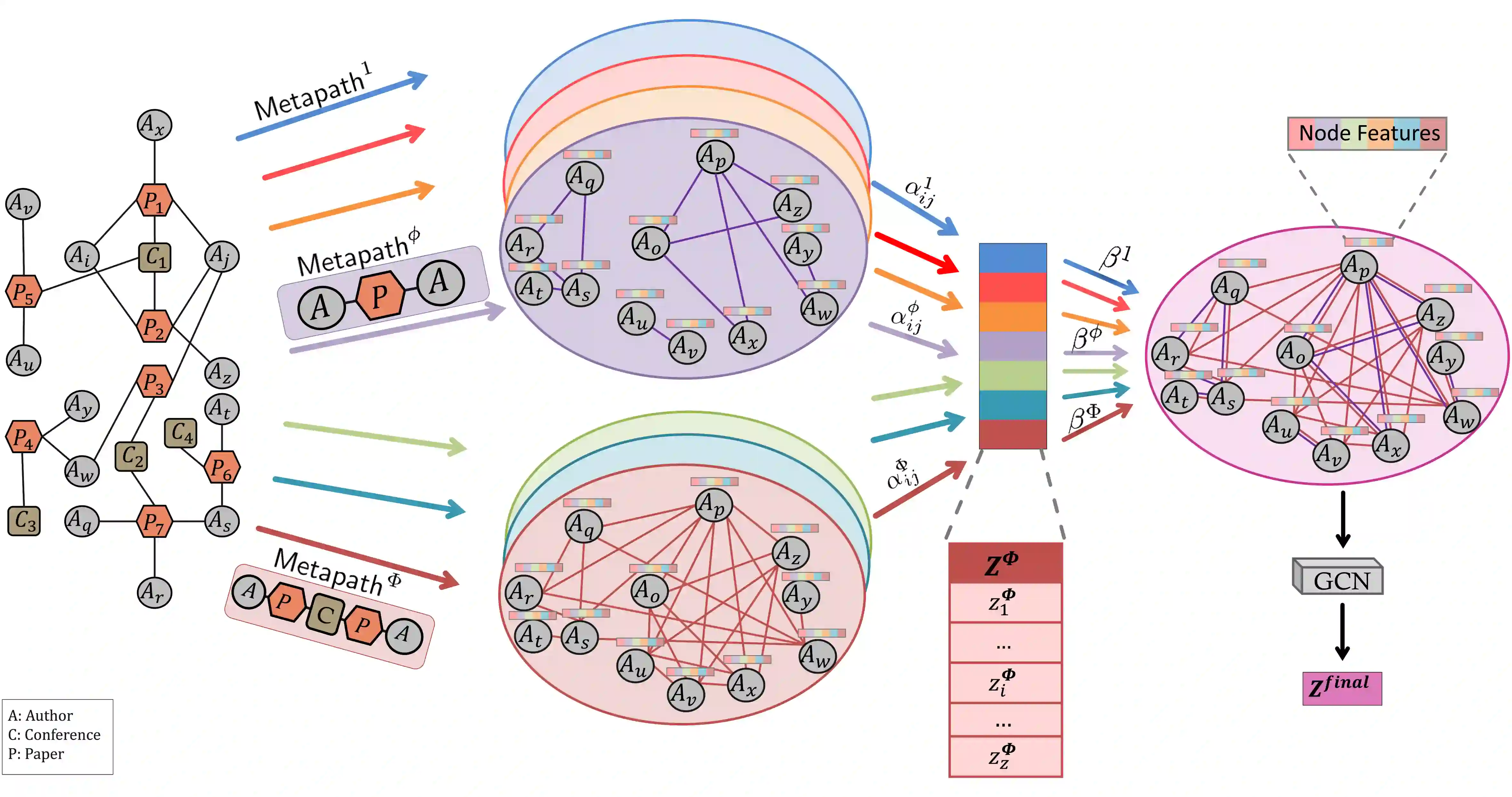
A large number of real-world networks include multiple types of nodes and edges. Graph Neural Network (GNN) emerged as a deep learning framework to utilize node features on graph-structured data showing superior performance. However, popular GNN-based architectures operate on one homogeneous network. Enabling them to work on multiple networks brings additional challenges due to the heterogeneity of the networks and the multiplicity of the existing associations. In this study, we present a computational approach named GRAF utilizing GNN-based approaches on multiple networks with the help of attention mechanisms and network fusion. Using attention-based neighborhood aggregation, GRAF learns the importance of each neighbor per node (called node-level attention) followed by the importance of association (called association-level attention) in a hierarchical way. Then, GRAF processes a network fusion step weighing each edge according to learned node- and association-level attention, which results in a fused enriched network. Considering that the fused network could be a highly dense network with many weak edges depending on the given input networks, we included an edge elimination step with respect to edges' weights. Finally, GRAF utilizes Graph Convolutional Network (GCN) on the fused network and incorporates the node features on the graph-structured data for the prediction task or any other downstream analysis. Our extensive evaluations of prediction tasks from different domains showed that GRAF outperformed the state-of-the-art methods. Utilization of learned node-level and association-level attention allowed us to prioritize the edges properly. The source code for our tool is publicly available at https://github.com/bozdaglab/GRAF.
翻译:现实世界中的大量网络包含多种类型的节点和边。图神经网络(GNN)作为一种利用图结构数据中节点特征的深度学习框架,展现了卓越的性能。然而,主流的基于GNN的架构仅适用于单一同构网络。将其扩展到处理多网络场景时,由于网络的异构性以及现有关联的多样性,会带来额外挑战。在本研究中,我们提出一种名为GRAF的计算方法,利用注意力机制和网络融合在多网络上部署基于GNN的方法。通过基于注意力的邻域聚合,GRAF以层级方式学习每个节点邻域的重要性(称为节点级注意力),随后学习关联的重要性(称为关联级注意力)。接着,GRAF执行网络融合步骤,根据学习到的节点级和关联级注意力对每条边进行加权,从而生成一个融合后的增强网络。考虑到融合后网络可能因输入网络的特性而成为包含许多弱边的高密度网络,我们引入了一个基于边权重的边消除步骤。最后,GRAF在融合网络上使用图卷积网络(GCN),并结合图结构数据中的节点特征进行预测任务或其他下游分析。我们在不同领域的预测任务上的广泛评估表明,GRAF优于现有最先进方法。利用学习到的节点级和关联级注意力使我们能够合理地对边进行优先级排序。本工具的源代码已公开在https://github.com/bozdaglab/GRAF。




相关内容


 微信扫码咨询专知VIP会员