

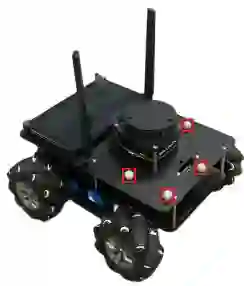
Motion planning is the soul of robot decision making. Classical planning algorithms like graph search and reaction-based algorithms face challenges in cases of dense and dynamic obstacles. Deep learning algorithms generate suboptimal one-step predictions that cause many collisions. Reinforcement learning algorithms generate optimal or near-optimal time-sequential predictions. However, they suffer from slow convergence, suboptimal converged results, and overfittings. This paper introduces a hybrid algorithm for robotic motion planning: long short-term memory (LSTM) pooling and skip connection for attention-based discrete soft actor critic (LSA-DSAC). First, graph network (relational graph) and attention network (attention weight) interpret the environmental state for the learning of the discrete soft actor critic algorithm. The expressive power of attention network outperforms that of graph in our task by difference analysis of these two representation methods. However, attention based DSAC faces the overfitting problem in training. Second, the skip connection method is integrated to attention based DSAC to mitigate overfitting and improve convergence speed. Third, LSTM pooling is taken to replace the sum operator of attention weigh and eliminate overfitting by slightly sacrificing convergence speed at early-stage training. Experiments show that LSA-DSAC outperforms the state-of-the-art in training and most evaluations. The physical robot is also implemented and tested in the real world.
翻译:运动规划是机器人决策的灵魂。图搜索和反应式算法等经典规划算法在密集动态障碍物场景中面临挑战。深度学习算法生成次优的单步预测,导致大量碰撞。强化学习算法生成最优或接近最优的时间序列预测,但存在收敛慢、收敛结果次优及过拟合问题。本文提出一种混合机器人运动规划算法:基于长短期记忆池化与跳跃连接的注意力离散软演员-评论家算法(LSA-DSAC)。首先,图网络(关系图)和注意力网络(注意力权重)为离散软演员-评论家算法的学习解释环境状态。通过两种表征方法的差异分析,注意力网络的表达能力在本任务中优于图网络。然而,基于注意力的DSAC在训练中面临过拟合问题。其次,将跳跃连接方法集成到基于注意力的DSAC中,以缓解过拟合并提升收敛速度。第三,采用LSTM池化替代注意力权重的求和算子,通过早期训练阶段略微牺牲收敛速度来消除过拟合。实验表明,LSA-DSAC在训练和多数评估中均优于当前最优方法。物理机器人实现及真实世界测试也已开展。








相关内容




 微信扫码咨询专知VIP会员