

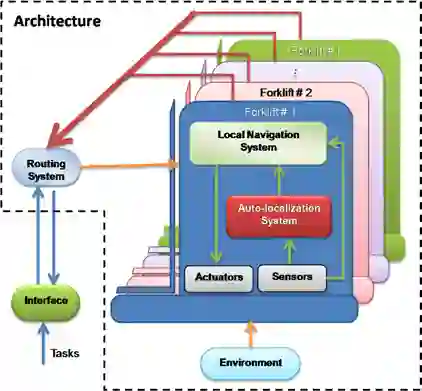
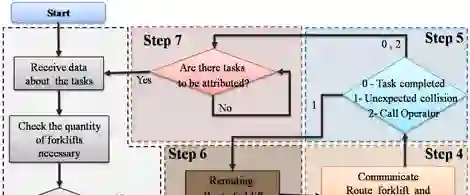
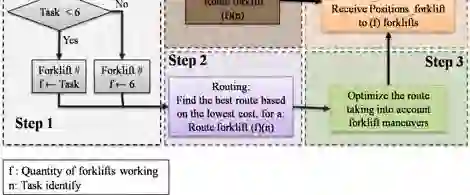
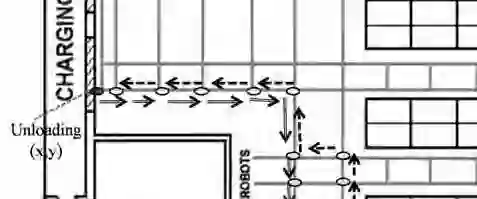
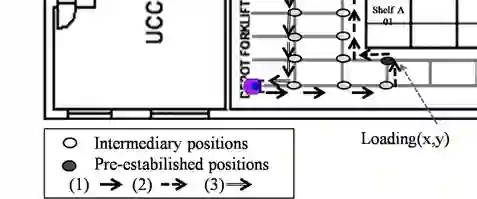
Automation of logistic processes is essential to improve productivity and reduce costs. In this context, intelligent warehouses are becoming a key to logistic systems thanks to their ability of optimizing transportation tasks and, consequently, reducing costs. This paper initially presents briefly routing systems applied on intelligent warehouses. Then, we present the approach used to develop our router system. This router system is able to solve traffic jams and collisions, generate conflict-free and optimized paths before sending the final paths to the robotic forklifts. It also verifies the progress of all tasks. When a problem occurs, the router system can change the task priorities, routes, etc. in order to avoid new conflicts. In the routing simulations, each vehicle executes its tasks starting from a predefined initial pose, moving to the desired position. Our algorithm is based on Dijkstra's shortest path and the time window approaches and it was implemented in C language. Computer simulation tests were used to validate the algorithm efficiency under different working conditions. Several simulations were carried out using the Player/Stage Simulator to test the algorithms. Thanks to the simulations, we could solve many faults and refine the algorithms before embedding them in real robots.
翻译:物流流程自动化对于提升生产效率与降低运营成本至关重要。在此背景下,智能仓库凭借其优化运输任务的能力,正成为物流系统的关键环节,并显著降低相关成本。本文首先简要介绍应用于智能仓库的路径规划系统,随后阐述我们研发的路径规划系统所采用的方法。该系统能够解决交通拥堵与碰撞问题,生成无冲突且优化的路径,并将最终路径发送至自动叉车。系统同时监控所有任务的执行进度。当异常发生时,路径规划系统可动态调整任务优先级与行驶路线,以避免新冲突的产生。在路径模拟中,每台车辆从预设初始位姿出发执行任务,并移动至目标位置。我们的算法基于迪杰斯特拉最短路径法与时间窗方法,采用C语言实现。通过计算机仿真测试验证了算法在不同工况下的性能。利用Player/Stage仿真器开展多项仿真实验以调试算法。得益于仿真测试,我们在算法嵌入实体机器人前修正了大量缺陷并优化了算法。




相关内容




 微信扫码咨询专知VIP会员