

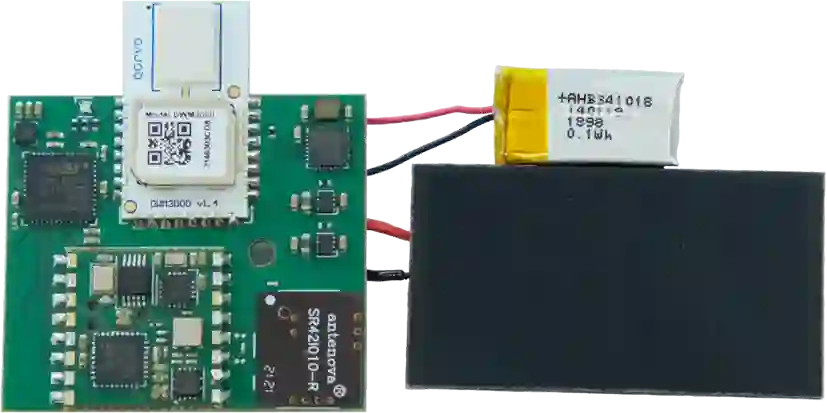
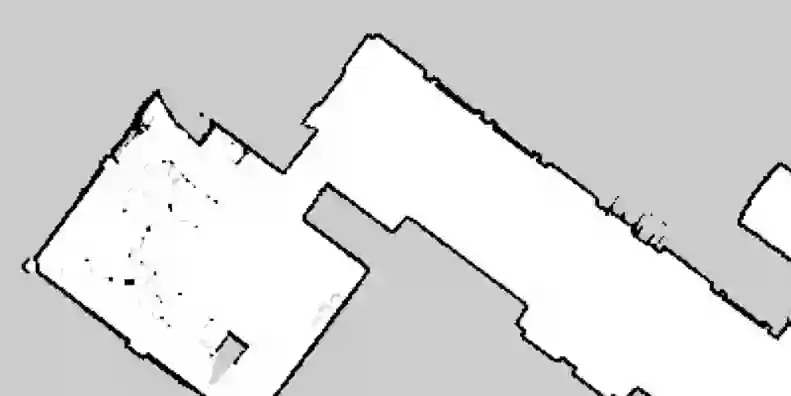
Indoor localization systems face a fundamental trade-off between efficiency and responsiveness, which is especially important for emerging use cases such as mobile robots operating in GPS-denied environments. Traditional RTLS either require continuously powered infrastructure, limiting their scalability, or are limited by their responsiveness. This work presents Eco-WakeLoc, designed to achieve centimeter-level UWB localization while remaining energy-neutral by combining ultra-low power wake-up radios (WuRs) with solar energy harvesting. By activating anchor nodes only on demand, the proposed system eliminates constant energy consumption while achieving centimeter-level positioning accuracy. To reduce coordination overhead and improve scalability, Eco-WakeLoc employs cooperative localization where active tags initiate ranging exchanges (trilateration), while passive tags opportunistically reuse these messages for TDOA positioning. An additive-increase/multiplicative-decrease (AIMD)-based energy-aware scheduler adapts localization rates according to the harvested energy, thereby maximizing the overall performance of the sensor network while ensuring long-term energy neutrality. The measured energy consumption is only 3.22mJ per localization for active tags, 951uJ for passive tags, and 353uJ for anchors. Real-world deployment on a quadruped robot with nine anchors confirms the practical feasibility, achieving an average accuracy of 43cm in dynamic indoor environments. Year-long simulations show that tags achieve an average of 2031 localizations per day, retaining over 7% battery capacity after one year -- demonstrating that the RTLS achieves sustained energy-neutral operation. Eco-WakeLoc demonstrates that high-accuracy indoor localization can be achieved at scale without continuous infrastructure operation, combining energy neutrality, cooperative positioning, and adaptive scheduling.
翻译:室内定位系统面临着效率与响应性之间的根本权衡,这对于诸如在GPS拒止环境中运行的移动机器人等新兴应用场景尤为重要。传统的实时定位系统(RTLS)要么需要持续供电的基础设施,限制了其可扩展性,要么受限于其响应能力。本文提出的Eco-WakeLoc,旨在通过将超低功耗唤醒无线电(WuR)与太阳能采集相结合,在实现厘米级UWB定位的同时保持能量自持。通过仅在需要时激活锚节点,所提出的系统消除了持续的能量消耗,同时实现了厘米级的定位精度。为了减少协调开销并提高可扩展性,Eco-WakeLoc采用协作定位机制:主动标签发起测距交换(三边定位),而被动标签则机会性地复用这些消息进行到达时间差(TDOA)定位。一种基于加性增/乘性减(AIMD)的能量感知调度器根据采集到的能量自适应调整定位频率,从而在确保长期能量自持的同时,最大化传感器网络的整体性能。实测能耗为:主动标签每次定位仅消耗3.22mJ,被动标签为951μJ,锚节点为353μJ。在配备九个锚节点的四足机器人上进行实际部署,验证了其可行性,在动态室内环境中实现了平均43厘米的定位精度。为期一年的仿真表明,标签平均每天可完成2031次定位,一年后电池容量仍保持在7%以上——这证明了该RTLS能够实现持续的能量自持运行。Eco-WakeLoc表明,无需基础设施持续运行,通过结合能量自持、协作定位和自适应调度,即可实现大规模、高精度的室内定位。






相关内容

 微信扫码咨询专知VIP会员