

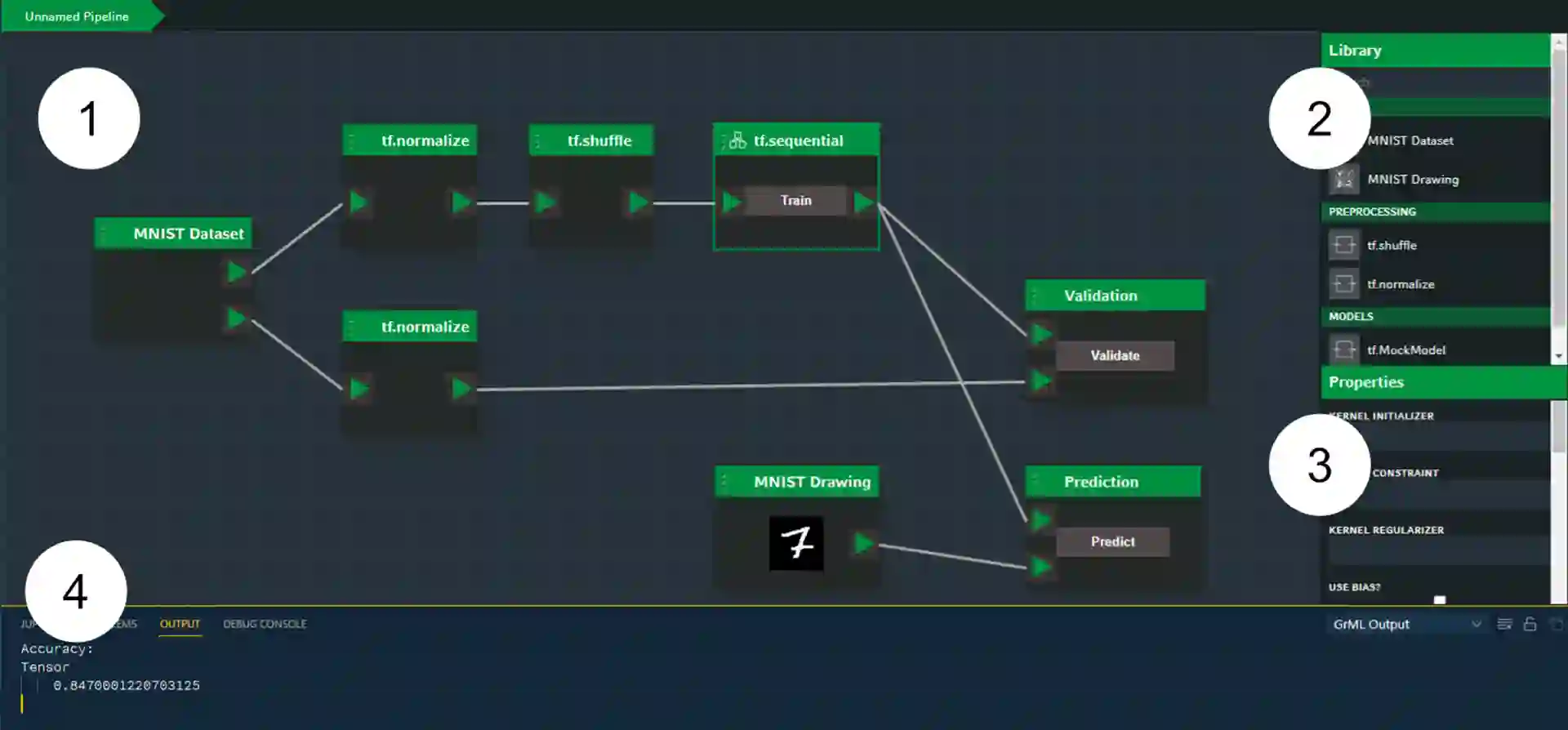
Software development of modern, data-driven applications still relies on tools that use interaction paradigms that have remained mostly unchanged for decades. While rich forms of interactions exist as an alternative to textual command input, they find little adoption in professional software creation. In this work, we compare graphical programming using direct manipulation to the traditional, textual way of creating data-driven applications to determine the benefits and drawbacks of each. In a between-subjects user study (N=18), we compared developing a machine learning architecture with a graphical editor to traditional code-based development. While qualitative and quantitative measures show general benefits of graphical direct manipulation, the user's subjective perception does not always match this. Participants were aware of the possible benefits of such tools but were still biased in their perception. Our findings highlight that alternative software creation tools cannot just rely on good usability but must emphasize the demands of their specific target group, e.g. user control and flexibility, if they want long-term benefits and adoption.
翻译:现代数据驱动型应用的软件开发仍依赖于数十年未变的交互范式工具。尽管存在丰富的交互形式可作为文本指令输入的替代方案,但其在专业软件开发中应用甚少。本研究通过对比基于直接操作的图形化编程与传统文本式数据驱动应用开发方式,探究两种方法的优劣。我们开展了一项受试者间用户研究(N=18),比较了使用图形化编辑器与基于传统代码开发机器学习架构的差异。定性与定量测量虽显示图形化直接操作具有普遍优势,但用户主观感知并不总与之相符。参与者虽认识到此类工具的潜在优势,但认知仍存在偏差。研究结果强调:若期望获得长期效益与广泛采纳,替代性软件开发工具不能仅依赖良好的可用性,还需突出其特定目标群体(如用户控制权与灵活性)的需求。




相关内容




 微信扫码咨询专知VIP会员