

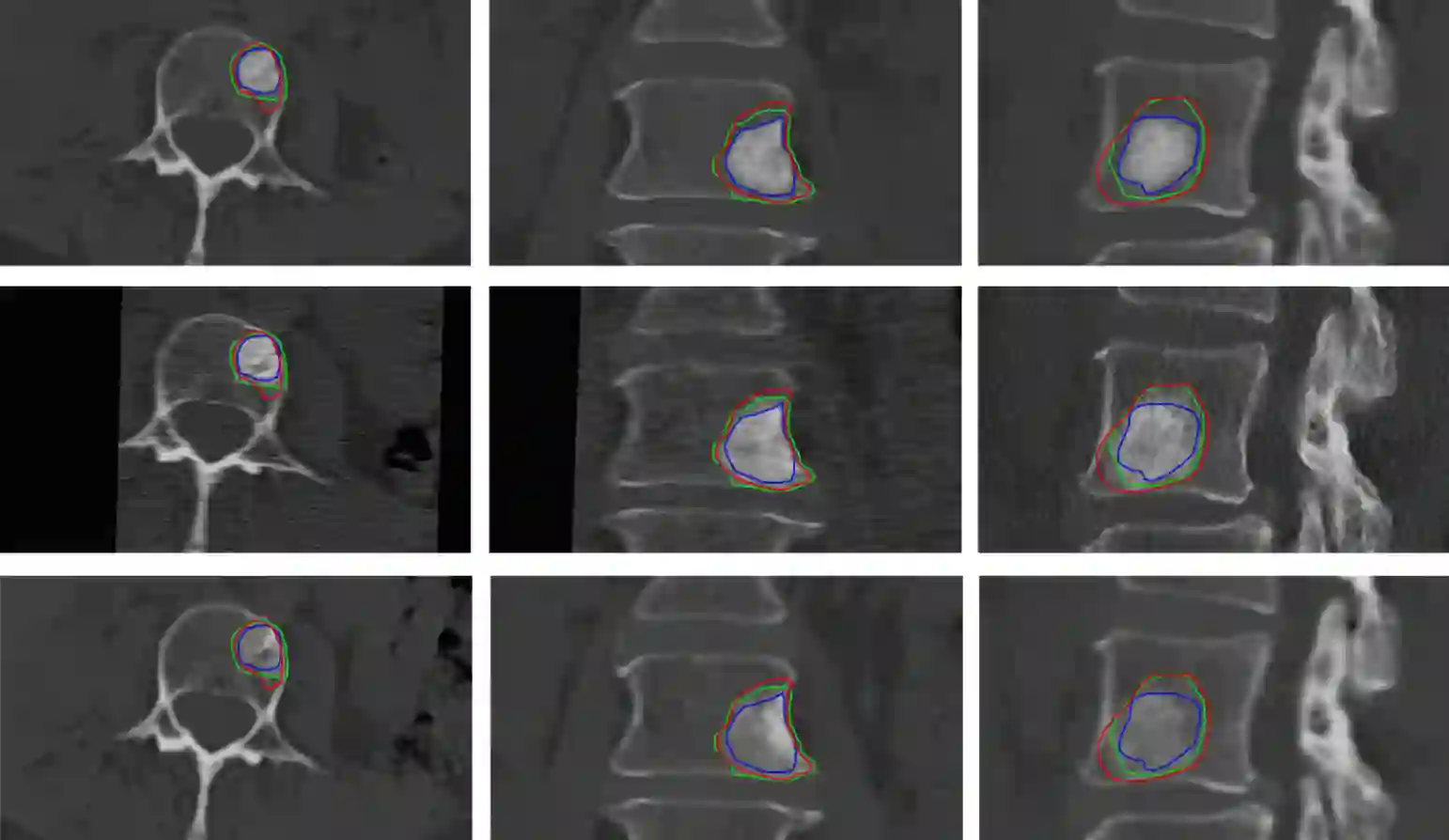
Accurate and reliable registration of longitudinal spine images is essential for assessment of disease progression and surgical outcome. Implementing a fully automatic and robust registration is crucial for clinical use, however, it is challenging due to substantial change in shape and appearance due to lesions. In this paper we present a novel method to automatically align longitudinal spine CTs and accurately assess lesion progression. Our method follows a two-step pipeline where vertebrae are first automatically localized, labeled and 3D surfaces are generated using a deep learning model, then longitudinally aligned using a Gaussian mixture model surface registration. We tested our approach on 37 vertebrae, from 5 patients, with baseline CTs and 3, 6, and 12 months follow-ups leading to 111 registrations. Our experiment showed accurate registration with an average Hausdorff distance of 0.65 mm and average Dice score of 0.92.
翻译:准确的纵向脊柱图像配准对于评估疾病进展和手术结果至关重要。实现全自动且鲁棒的配准是临床应用的必需条件,然而由于病变造成的形状和外观显著变化,这一任务极具挑战性。本文提出一种新颖方法,可自动对齐纵向脊柱CT图像并精确评估病变进展。该方法采用两阶段流程:首先利用深度学习模型自动定位并标记椎骨,生成三维表面;随后通过高斯混合模型表面配准实现纵向对齐。我们基于5名患者的37个椎骨进行测试,包含基线CT及3个月、6个月、12个月随访数据,共计111次配准。实验结果表明配准精度优异,平均豪斯多夫距离为0.65毫米,平均Dice系数达0.92。





相关内容



 微信扫码咨询专知VIP会员