

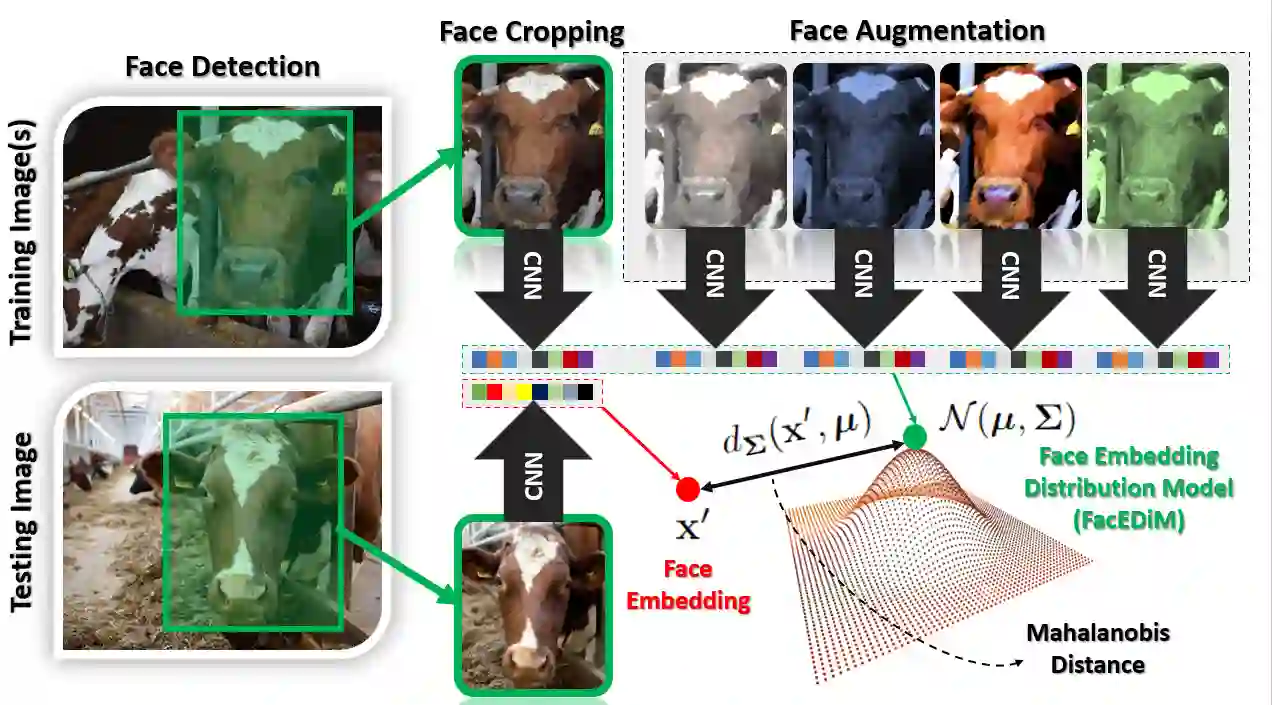
This work proposes to solve the problem of few-shot biometric authentication by computing the Mahalanobis distance between testing embeddings and a multivariate Gaussian distribution of training embeddings obtained using pre-trained CNNs. Experimental results show that models pre-trained on the ImageNet dataset significantly outperform models pre-trained on human faces. With a VGG16 model, we obtain a FRR of 1.18% for a FAR of 1.25% on a dataset of 20 cattle identities.
翻译:本研究提出通过计算测试嵌入与预训练CNN获取的训练嵌入多元高斯分布之间的马氏距离,来解决少样本生物特征认证问题。实验结果表明,在ImageNet数据集上预训练的模型显著优于在人脸数据集上预训练的模型。采用VGG16模型时,在包含20个牛只身份的数据集上,当错误接受率为1.25%时,错误拒绝率达1.18%。




相关内容

ACM/IEEE第23届模型驱动工程语言和系统国际会议,是模型驱动软件和系统工程的首要会议系列,由ACM-SIGSOFT和IEEE-TCSE支持组织。自1998年以来,模型涵盖了建模的各个方面,从语言和方法到工具和应用程序。模特的参加者来自不同的背景,包括研究人员、学者、工程师和工业专业人士。MODELS 2019是一个论坛,参与者可以围绕建模和模型驱动的软件和系统交流前沿研究成果和创新实践经验。今年的版本将为建模社区提供进一步推进建模基础的机会,并在网络物理系统、嵌入式系统、社会技术系统、云计算、大数据、机器学习、安全、开源等新兴领域提出建模的创新应用以及可持续性。
官网链接:http://www.modelsconference.org/
专知会员服务
78+阅读 · 2022年3月15日
专知会员服务
19+阅读 · 2019年10月22日
专知会员服务
84+阅读 · 2019年10月18日
Arxiv
21+阅读 · 2022年9月21日
Arxiv
11+阅读 · 2021年9月3日
Arxiv
18+阅读 · 2021年7月16日
Arxiv
28+阅读 · 2021年6月16日
Arxiv
13+阅读 · 2021年3月10日


最新内容
相关VIP内容
专知会员服务
78+阅读 · 2022年3月15日
专知会员服务
19+阅读 · 2019年10月22日
专知会员服务
84+阅读 · 2019年10月18日
相关资讯
相关论文
Arxiv
21+阅读 · 2022年9月21日
Arxiv
11+阅读 · 2021年9月3日
Arxiv
18+阅读 · 2021年7月16日
Arxiv
28+阅读 · 2021年6月16日
Arxiv
13+阅读 · 2021年3月10日
 微信扫码咨询专知VIP会员