

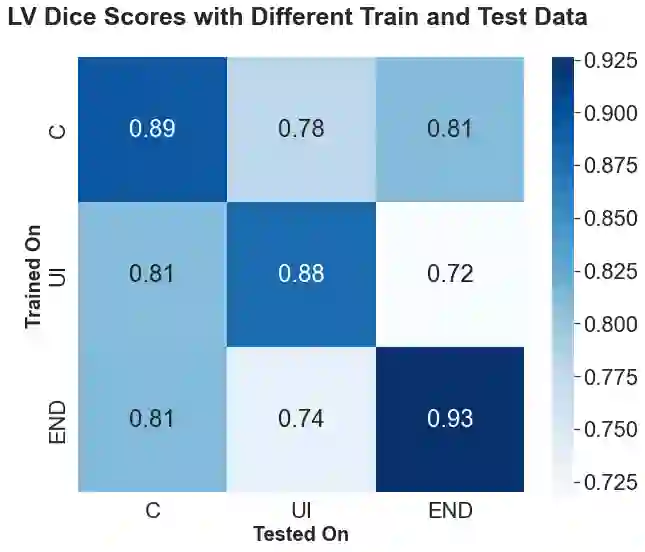
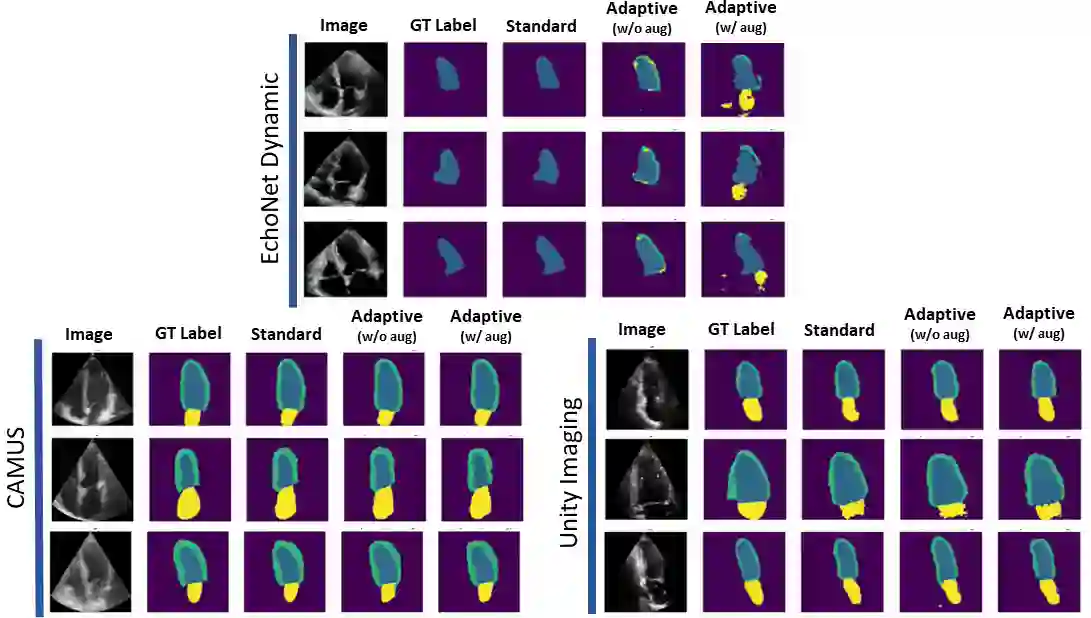
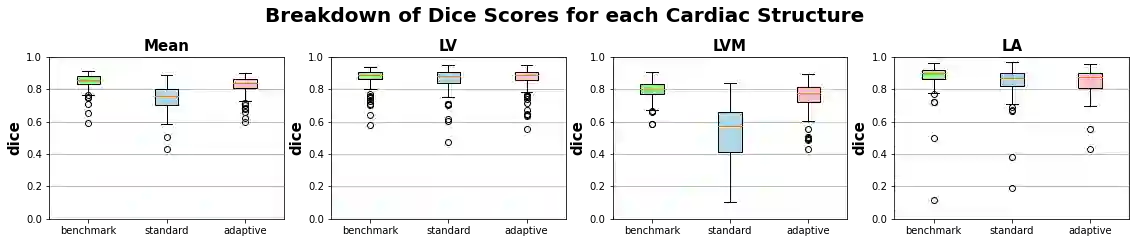
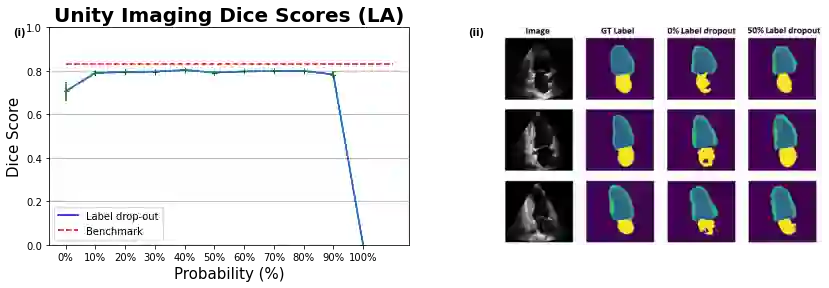
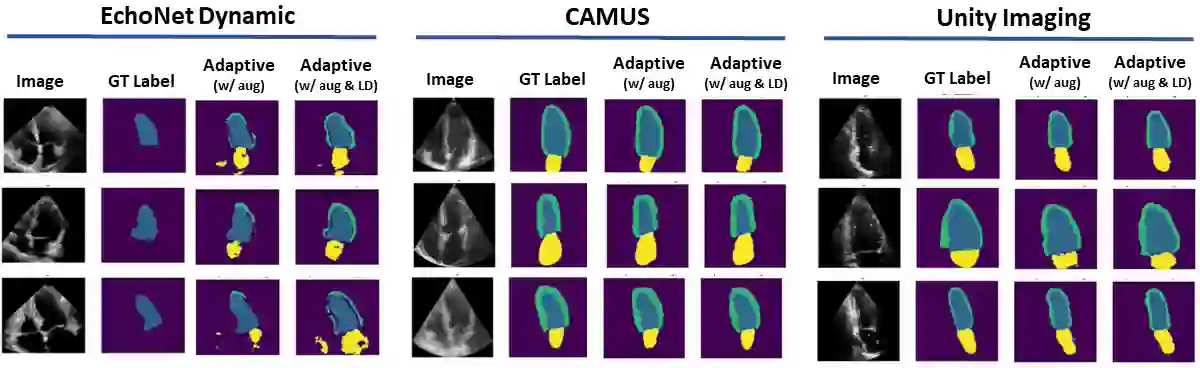
Echocardiography (echo) is the first imaging modality used when assessing cardiac function. The measurement of functional biomarkers from echo relies upon the segmentation of cardiac structures and deep learning models have been proposed to automate the segmentation process. However, in order to translate these tools to widespread clinical use it is important that the segmentation models are robust to a wide variety of images (e.g. acquired from different scanners, by operators with different levels of expertise etc.). To achieve this level of robustness it is necessary that the models are trained with multiple diverse datasets. A significant challenge faced when training with multiple diverse datasets is the variation in label presence, i.e. the combined data are often partially-labelled. Adaptations of the cross entropy loss function have been proposed to deal with partially labelled data. In this paper we show that training naively with such a loss function and multiple diverse datasets can lead to a form of shortcut learning, where the model associates label presence with domain characteristics, leading to a drop in performance. To address this problem, we propose a novel label dropout scheme to break the link between domain characteristics and the presence or absence of labels. We demonstrate that label dropout improves echo segmentation Dice score by 62% and 25% on two cardiac structures when training using multiple diverse partially labelled datasets.
翻译:超声心动图是评估心脏功能时首先使用的成像模态。从超声心动图中测量功能生物标志物依赖于心脏结构的分割,深度学习模型已被提出用于自动化分割过程。然而,为了使这些工具转化为广泛的临床应用,分割模型必须对多种图像(例如,来自不同扫描仪、由不同经验水平的操作者获取的图像等)具有鲁棒性。为实现这一鲁棒性水平,模型需要使用多个多样的数据集进行训练。使用多个多样数据集训练时面临的一个重大挑战是标签存在的变异性,即合并后的数据通常是部分标注的。交叉熵损失函数的改进版本已被提出用于处理部分标注数据。本文中,我们展示了对这种损失函数和多个多样数据集进行简单训练会导致一种捷径学习形式,即模型将标签存在与域特征相关联,从而导致性能下降。为解决这一问题,我们提出了一种新颖的标签丢弃方案,以打破域特征与标签存在与否之间的关联。我们证明,在使用多个多样部分标注数据集训练时,标签丢弃方案在两个心脏结构上的超声心动图分割Dice评分分别提升了62%和25%。




相关内容


 微信扫码咨询专知VIP会员