

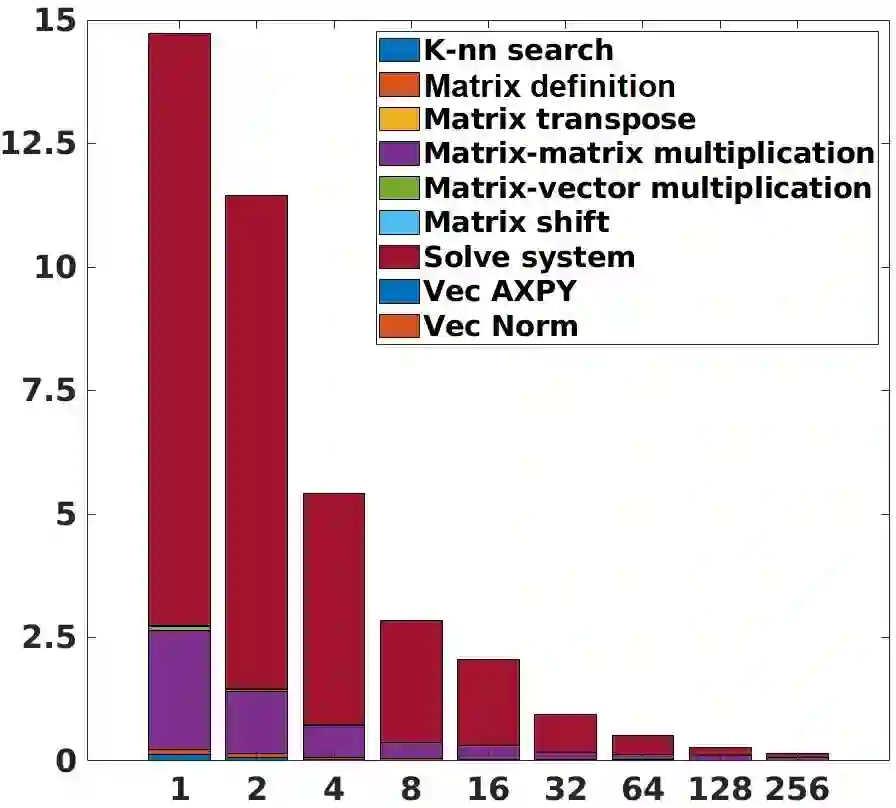
Several physics and engineering applications involve the solution of a minimisation problem to compute an approximation of the input signal. Modern computing hardware and software apply high-performance computing to solve and considerably reduce the execution time. We compare and analyse different minimisation methods in terms of functional computation, convergence, execution time, and scalability properties, for the solution of two minimisation problems (i.e., approximation and denoising) with different constraints that involve computationally expensive operations. These problems are attractive due to their numerical and analytical properties, and our general analysis can be extended to most signal-processing problems. We perform our tests on the Cineca Marconi100 cluster, at the 26th position in the top500 list. Our experimental results show that PRAXIS is the best optimiser in terms of minima computation: the efficiency of the approximation is 38% with 256 processes, while the denoising has 46% with 32 processes.
翻译:多个物理学和工程应用涉及求解最小化问题以计算输入信号的近似值。现代计算硬件与软件采用高性能计算来求解此类问题并显著缩短执行时间。我们针对两个具有不同约束条件(涉及高计算开销操作)的最小化问题(即逼近与去噪),从函数计算、收敛性、执行时间和可扩展性等方面比较并分析了多种最小化方法。这些问题因其数值与分析特性而具有吸引力,且我们的通用分析可推广至大多数信号处理问题。我们在Cineca Marconi100集群上执行测试(该集群位列top500榜单第26位)。实验结果表明,PRAXIS在最小值计算方面表现最佳:采用256个进程时,逼近效率为38%;采用32个进程时,去噪效率为46%。





相关内容



 微信扫码咨询专知VIP会员