

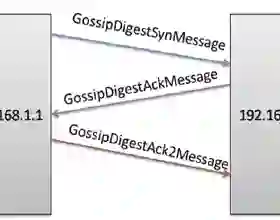
The lack of centralized control, combined with highly dynamic adversarial behaviors, makes data durability a challenge in decentralized storage systems. In this work, we introduce a new storage system, Vault, that offers strong data durability guarantees in a fully decentralized, permission-less setting. Vault leverages the rateless property of erasure code to encode each data object into an infinite stream of encoding fragments. To ensure durability in the presence of dynamic Byzantine behaviors and targeted attacks, an infinite sequence of storage nodes are randomly selected to store encoding fragments. Encoding generation and candidate selection are fully decentralized: When necessary, Vault nodes use a gossip protocol and a publically verifiable selection proof to determine new fragments. Simulations and large-scale EC2 experiments demonstrate that Vault provides close-to-ideal mean-time-to-data-loss (MTTDL) with low storage redundancy, scales to more than 10,000 nodes, and attains performance comparable to IPFS
翻译:在缺乏集中化控制且面临高度动态对抗行为的背景下,数据持久性成为去中心化存储系统面临的挑战。本文提出一种新型存储系统Vault,可在完全去中心化、无需许可的环境中提供强数据持久性保障。Vault利用纠删码的无速率特性,将每个数据对象编码为无限长的编码片段流。为应对动态拜占庭行为和定向攻击下的持久性需求,系统通过随机选择无限序列的存储节点来保存编码片段。编码生成与候选节点选择完全去中心化:必要时,Vault节点通过gossip协议和可公开验证的选择证明来确定新片段。仿真实验与大规模EC2实验表明,Vault能以低存储冗余实现接近理想的平均数据丢失时间(MTTDL),可扩展至超过10000个节点,并达到与IPFS相当的性能水平。




相关内容



 微信扫码咨询专知VIP会员