

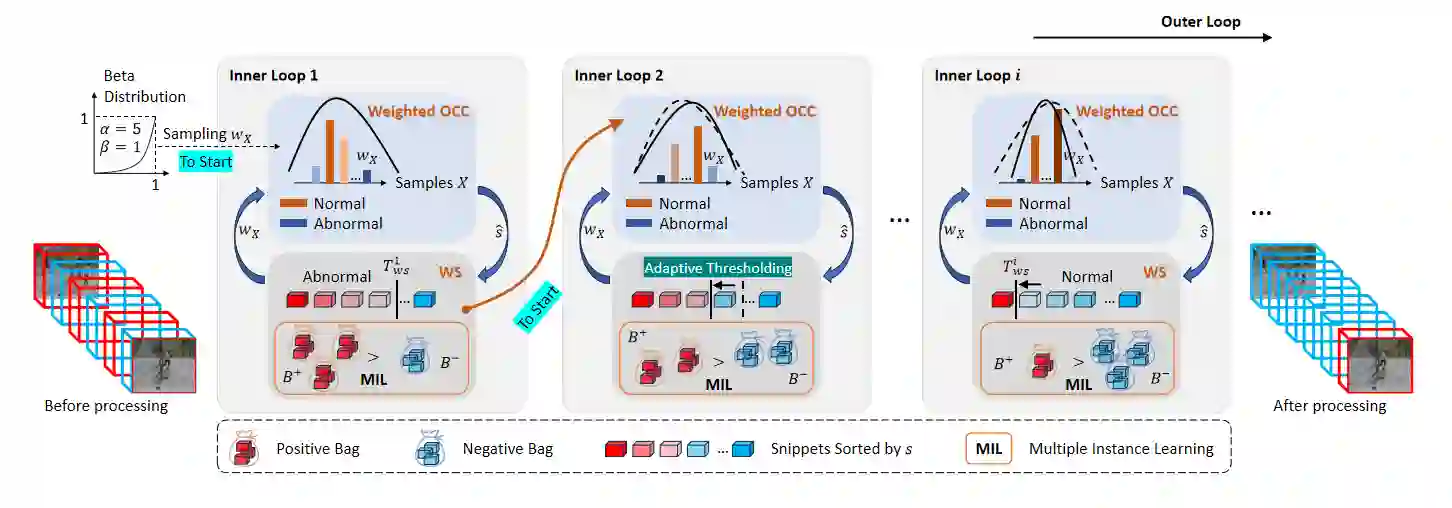
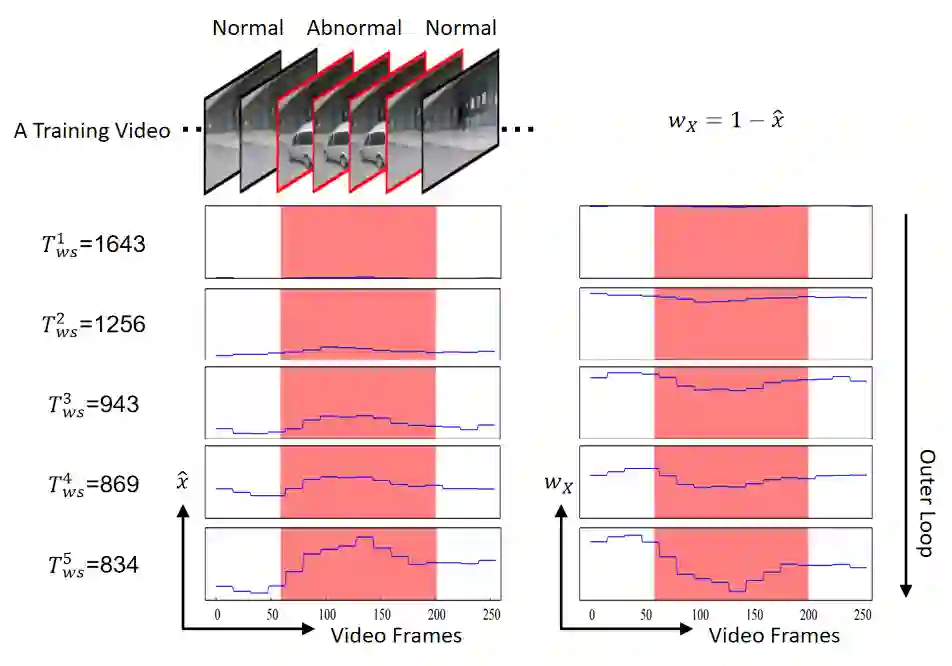
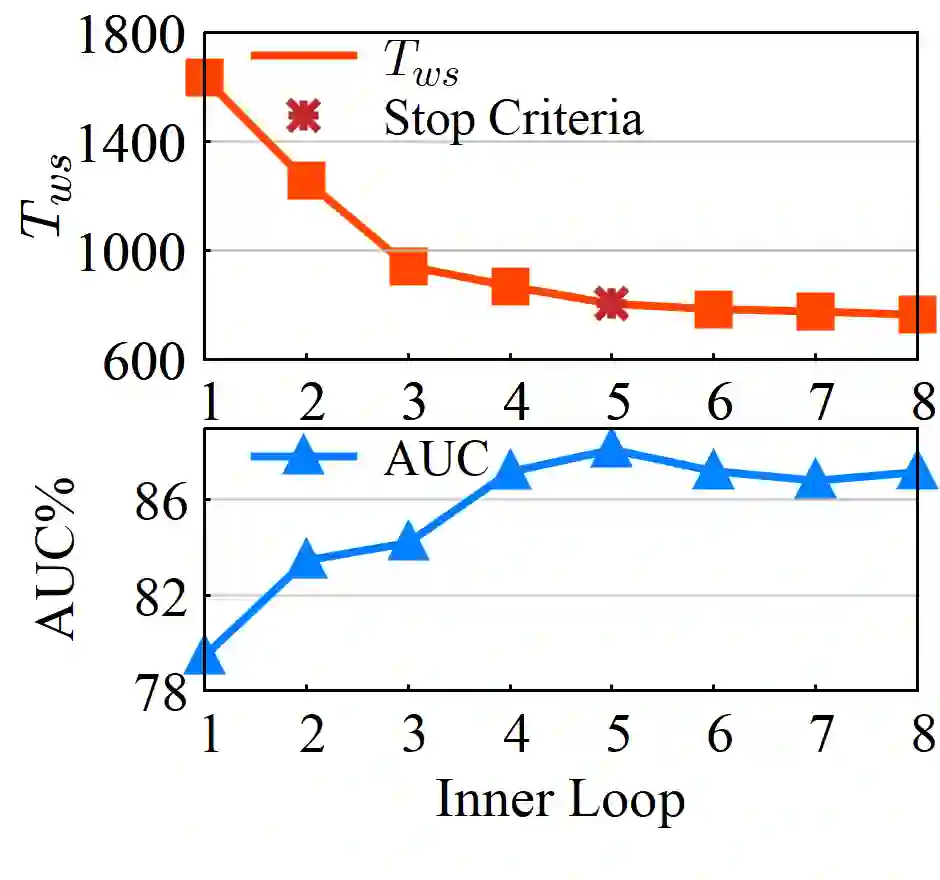
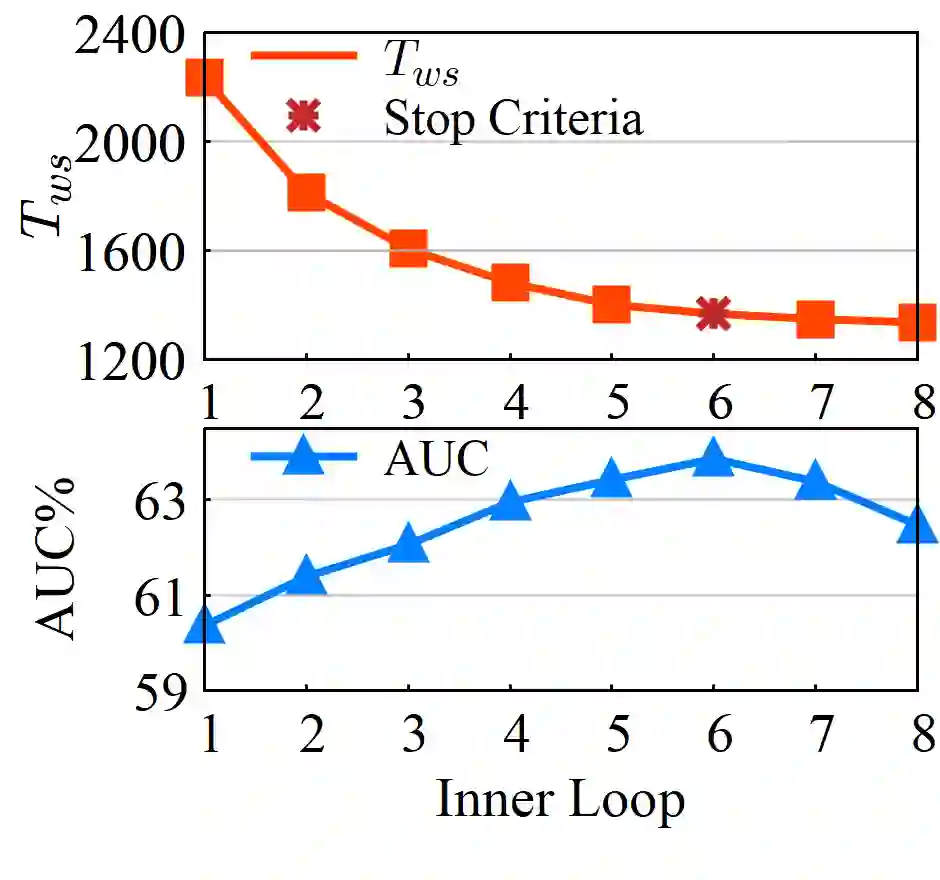
Without human annotations, a typical Unsupervised Video Anomaly Detection (UVAD) method needs to train two models that generate pseudo labels for each other. In previous work, the two models are closely entangled with each other, and it is not known how to upgrade their method without modifying their training framework significantly. Second, previous work usually adopts fixed thresholding to obtain pseudo labels, however the user-specified threshold is not reliable which inevitably introduces errors into the training process. To alleviate these two problems, we propose a novel interleaved framework that alternately trains a One-Class Classification (OCC) model and a Weakly-Supervised (WS) model for UVAD. The OCC or WS models in our method can be easily replaced with other OCC or WS models, which facilitates our method to upgrade with the most recent developments in both fields. For handling the fixed thresholding problem, we break through the conventional cognitive boundary and propose a weighted OCC model that can be trained on both normal and abnormal data. We also propose an adaptive mechanism for automatically finding the optimal threshold for the WS model in a loose to strict manner. Experiments demonstrate that the proposed UVAD method outperforms previous approaches.
翻译:无人工标注情况下,典型的无监督视频异常检测方法需训练两个模型相互生成伪标签。先前工作中,两个模型紧密耦合,且难以在不显著修改训练框架的情况下升级其方法。其次,先前工作通常采用固定阈值获取伪标签,但用户指定的阈值不可靠,不可避免地会在训练过程中引入误差。为解决这两个问题,我们提出一种新型交织式框架,交替训练单类分类模型与弱监督模型进行无监督视频异常检测。本方法中的单类分类或弱监督模型可便捷替换为其他同类模型,便于融合两个领域的最新进展。针对固定阈值问题,我们突破传统认知边界,提出可在正常与异常数据上训练的加权单类分类模型。同时设计自适应机制,以由松至严的方式自动寻找弱监督模型的最优阈值。实验表明,所提无监督视频异常检测方法优于现有方案。




相关内容


 微信扫码咨询专知VIP会员