

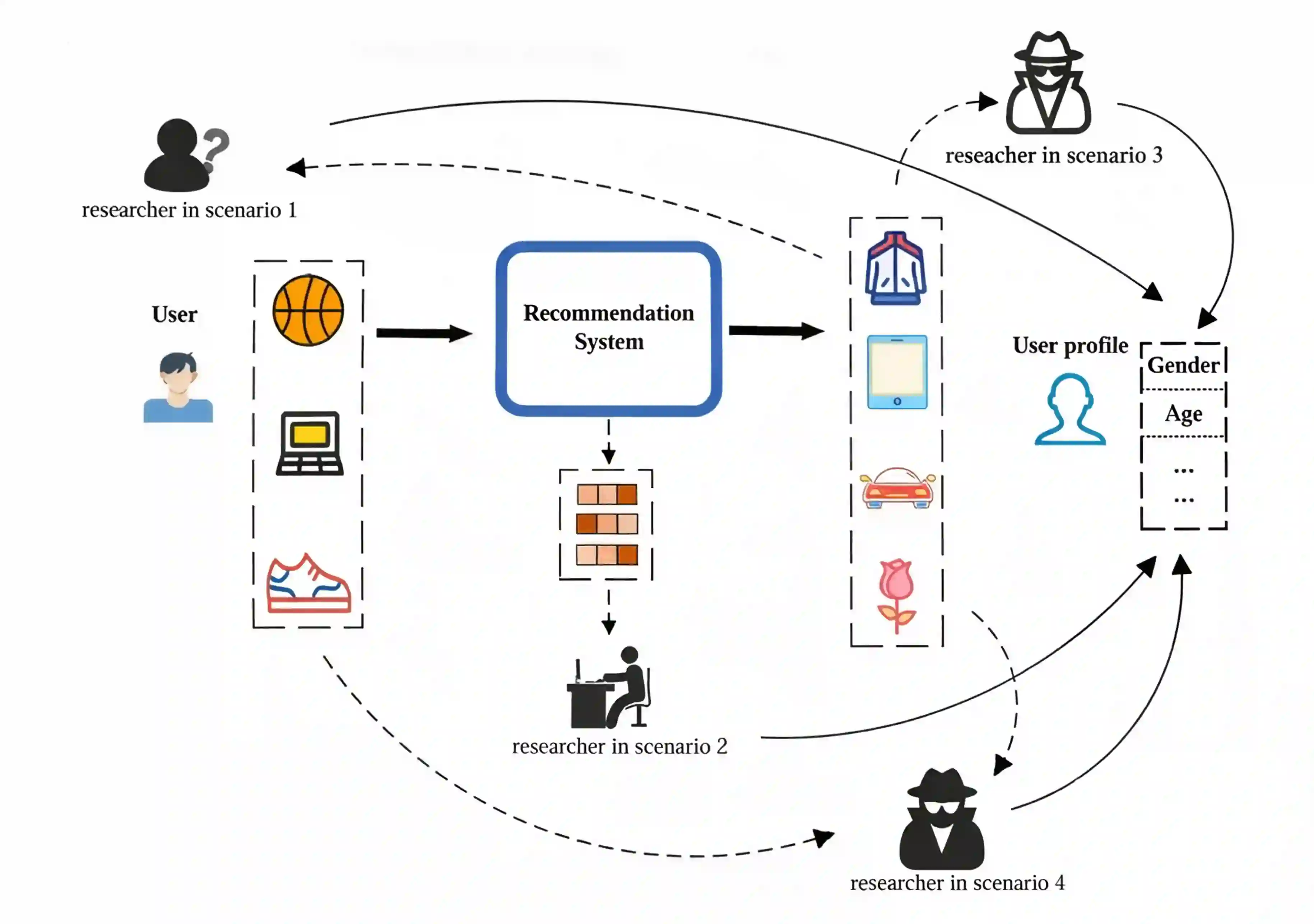
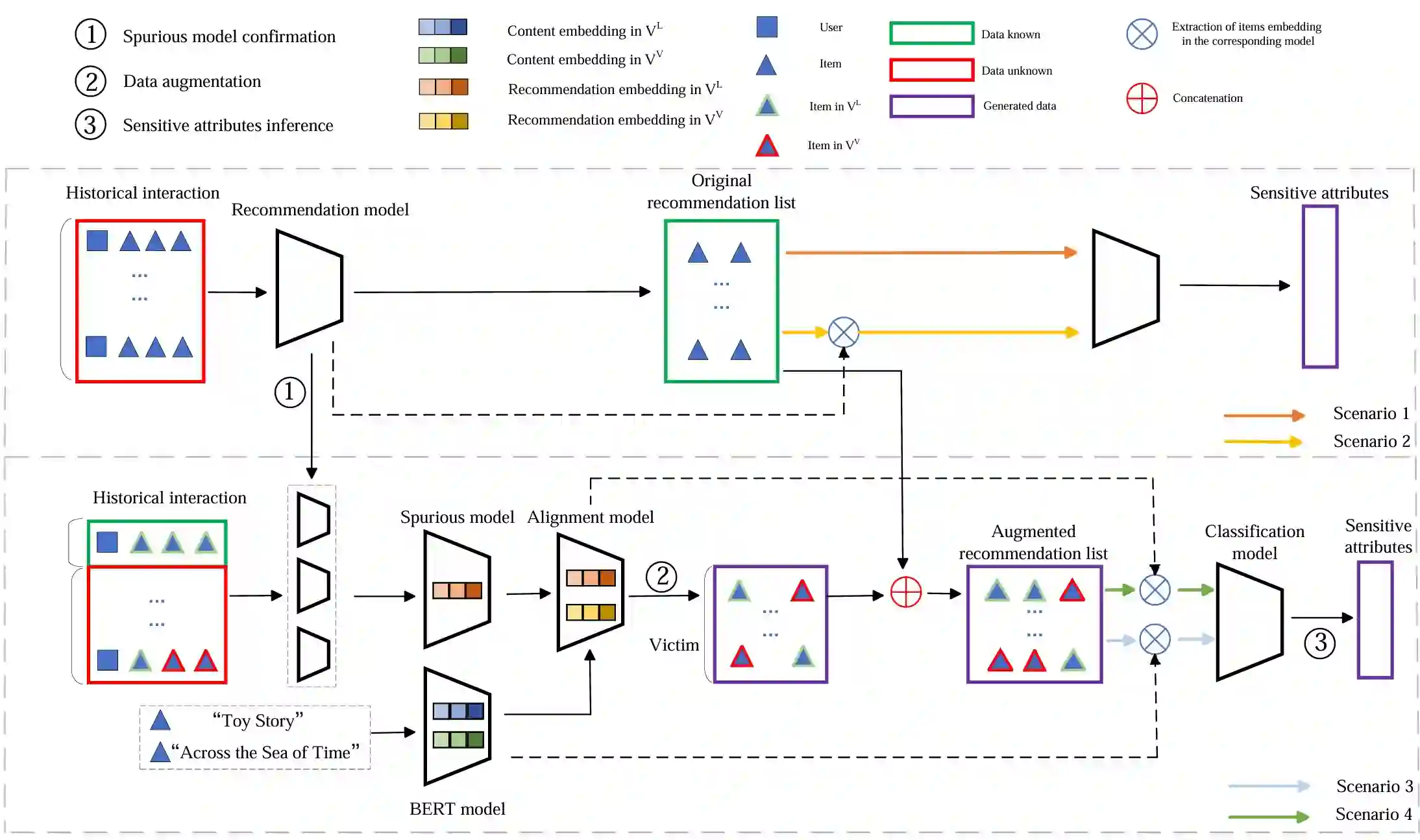
Recommender systems (RS) play a core role in various domains, including business analytics, helping users and companies make appropriate decisions. To optimize service quality, related technologies focus on constructing user profiles by analyzing users' historical behavior information. This paper considers four analytical scenarios to evaluate user profiling capabilities under different information conditions. A generic user attribute analysis framework named RAPI is proposed, which infers users' personal characteristics by exploiting easily accessible recommendation lists. Specifically, a surrogate recommendation model is established to simulate the original model, leveraging content embedding from a pre-trained BERT model to obtain item embeddings. A sample augmentation module generates extended recommendation lists by considering similarity between model outputs and item embeddings. Finally, an adaptive weight classification model assigns dynamic weights to facilitate user characteristic inference. Experiments on four collections show that RAPI achieves inference accuracy of 0.764 and 0.6477, respectively.
翻译:推荐系统(RS)在包括商业分析在内的多个领域中发挥着核心作用,帮助用户和企业做出恰当决策。为优化服务质量,相关技术侧重于通过分析用户历史行为信息来构建用户画像。本文考虑四种分析场景,以评估不同信息条件下用户画像构建的能力。提出了一种名为RAPI的通用用户属性分析框架,该框架通过利用易于获取的推荐列表来推断用户的个人特征。具体而言,建立了一个替代推荐模型来模拟原始模型,利用预训练BERT模型的内容嵌入来获取项目嵌入。样本增强模块通过考虑模型输出与项目嵌入之间的相似性来生成扩展推荐列表。最后,自适应权重分类模型分配动态权重以促进用户特征推断。在四个数据集上的实验表明,RAPI分别达到了0.764和0.6477的推断准确率。




相关内容


 微信扫码咨询专知VIP会员