

We develop new techniques for proving lower bounds on the least singular value of random matrices with limited randomness. The matrices we consider have entries that are given by polynomials of a few underlying base random variables. This setting captures a core technical challenge for obtaining smoothed analysis guarantees in many algorithmic settings. Least singular value bounds often involve showing strong anti-concentration inequalities that are intricate and much less understood compared to concentration (or large deviation) bounds. First, we introduce a general technique involving a hierarchical $\epsilon$-nets to prove least singular value bounds. Our second tool is a new statement about least singular values to reason about higher-order lifts of smoothed matrices, and the action of linear operators on them. Apart from getting simpler proofs of existing smoothed analysis results, we use these tools to now handle more general families of random matrices. This allows us to produce smoothed analysis guarantees in several previously open settings. These include new smoothed analysis guarantees for power sum decompositions, subspace clustering and certifying robust entanglement of subspaces, where prior work could only establish least singular value bounds for fully random instances or only show non-robust genericity guarantees.
翻译:我们开发了用于证明随机矩阵(仅具有限随机性)最小奇异值下界的新技术。所考虑的矩阵元素由少数基础随机变量的多项式给出。这一设定抓住了许多算法场景中获得平滑分析保证的核心技术挑战。最小奇异值下界通常需要证明强反集中不等式,这类不等式相较于集中(或大偏差)界限更为复杂且理解程度远逊。首先,我们引入一项通用技术——通过分层ε-网证明最小奇异值下界。第二个工具是关于最小奇异值的新结论,用于推理平滑矩阵的高阶提升以及线性算子对其的作用。除了为现有平滑分析结果提供更简洁的证明外,我们利用这些工具处理了更广泛的随机矩阵族,在若干此前未解决的设定中获得了平滑分析保证。这些新结果包括:幂和分解、子空间聚类以及子空间鲁棒纠缠认证的平滑分析保证——此前研究仅能为完全随机实例建立最小奇异值下界,或仅能证明非鲁棒的泛型保证。
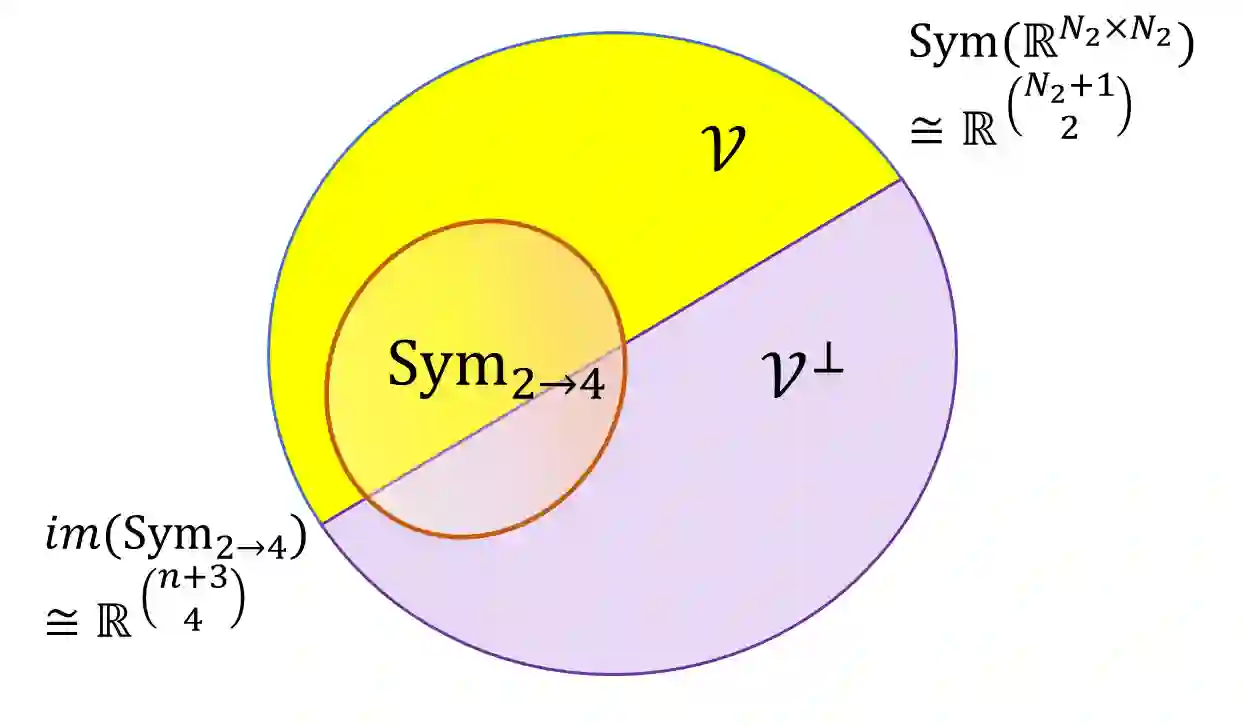




相关内容



 微信扫码咨询专知VIP会员