

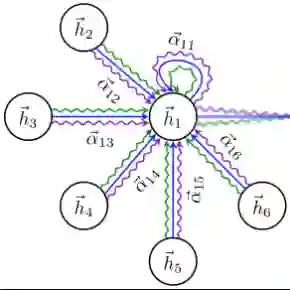
Urban region embedding is an important and yet highly challenging issue due to the complexity and constantly changing nature of urban data. To address the challenges, we propose a Region-Wise Multi-View Representation Learning (ROMER) to capture multi-view dependencies and learn expressive representations of urban regions without the constraints of rigid neighbourhood region conditions. Our model focus on learn urban region representation from multi-source urban data. First, we capture the multi-view correlations from mobility flow patterns, POI semantics and check-in dynamics. Then, we adopt global graph attention networks to learn similarity of any two vertices in graphs. To comprehensively consider and share features of multiple views, a two-stage fusion module is further proposed to learn weights with external attention to fuse multi-view embeddings. Extensive experiments for two downstream tasks on real-world datasets demonstrate that our model outperforms state-of-the-art methods by up to 17\% improvement.
翻译:城市区域嵌入是一项重要且极具挑战性的任务,这源于城市数据的复杂性和持续动态变化特性。为解决这些挑战,我们提出了一种区域级多视角表示学习方法(ROMER),该方法能够在不受严格邻域区域条件约束的情况下,捕捉多视角依赖关系并学习城市区域的可表达性表示。本模型聚焦于从多源城市数据中学习城市区域表示。首先,我们从移动流模式、POI语义和签到动态中捕获多视角相关性。随后,采用全局图注意力网络学习图中任意两个顶点的相似性。为全面考量并共享多视角特征,进一步提出一种两阶段融合模块,该模块利用外部注意力学习权重以融合多视角嵌入。在真实数据集上针对两个下游任务的大规模实验表明,我们的模型相较于最先进方法实现了最高17%的性能提升。




相关内容



 微信扫码咨询专知VIP会员