

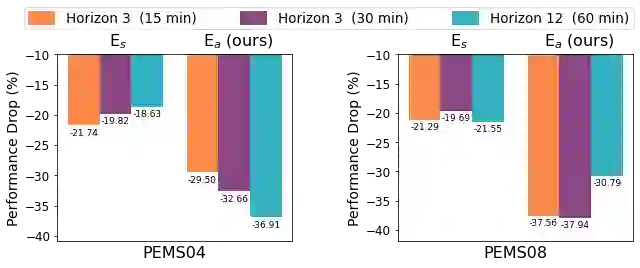
With the rapid development of the Intelligent Transportation System (ITS), accurate traffic forecasting has emerged as a critical challenge. The key bottleneck lies in capturing the intricate spatio-temporal traffic patterns. In recent years, numerous neural networks with complicated architectures have been proposed to address this issue. However, the advancements in network architectures have encountered diminishing performance gains. In this study, we present a novel component called spatio-temporal adaptive embedding that can yield outstanding results with vanilla transformers. Our proposed Spatio-Temporal Adaptive Embedding transformer (STAEformer) achieves state-of-the-art performance on five real-world traffic forecasting datasets. Further experiments demonstrate that spatio-temporal adaptive embedding plays a crucial role in traffic forecasting by effectively capturing intrinsic spatio-temporal relations and chronological information in traffic time series.
翻译:随着智能交通系统(ITS)的快速发展,交通流精准预测已成为一项关键挑战。其核心瓶颈在于捕获复杂的时空交通模式。近年来,众多具有复杂架构的神经网络被提出以解决这一问题。然而,网络架构的改进已遭遇性能增益递减的瓶颈。本研究提出一种名为"时空自适应嵌入"的新型组件,该组件可使朴素Transformer模型取得卓越性能。我们提出的时空自适应嵌入Transformer(STAEformer)在五个真实交通流预测数据集上达到了最先进水平。进一步实验表明,时空自适应嵌入通过有效捕获交通时序中的内在时空关联与时间信息,在交通预测中发挥着关键作用。




相关内容



 微信扫码咨询专知VIP会员