

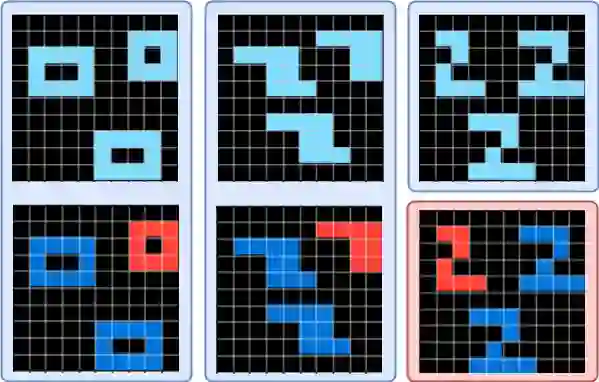
While Artificial Intelligence (AI) models have achieved human or even superhuman performance in narrowly defined applications, they still struggle to show signs of broader and more flexible intelligence. The Abstraction and Reasoning Corpus (ARC), introduced by Fran\c{c}ois Chollet, aims to assess how close AI systems are to human-like cognitive abilities. Most current approaches rely on carefully handcrafted domain-specific languages (DSLs), which are used to brute-force solutions to the tasks present in ARC. In this work, we propose a general framework for solving ARC based on natural language descriptions of the tasks. While not yet beating state-of-the-art DSL models on ARC, we demonstrate the immense potential of our approach hinted at by the ability to solve previously unsolved tasks.
翻译:尽管人工智能(AI)模型在狭窄定义的应用中已达到人类甚至超人的表现,但它们仍然难以展现出更广泛和灵活智能的迹象。由François Chollet提出的抽象与推理语料库(ARC)旨在评估AI系统与人类认知能力的接近程度。当前大多数方法依赖于精心手工设计的领域特定语言(DSL),这些语言被用于暴力破解ARC中的任务解决方案。在这项工作中,我们提出了一个基于任务自然语言描述的通用ARC求解框架。尽管尚未在ARC上超越最先进的DSL模型,但我们通过解决此前未解决的任务的能力,展示了本方法的巨大潜力。





相关内容




 微信扫码咨询专知VIP会员