

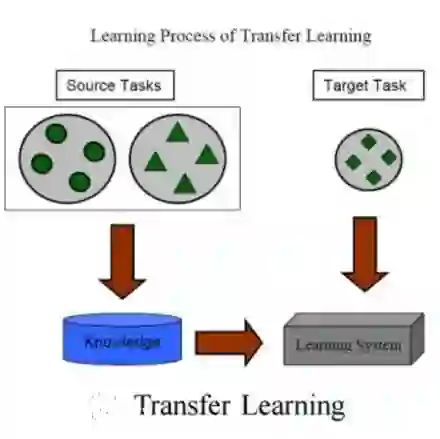
Physics-informed neural network (PINN) is a data-driven solver for partial and ordinary differential equations(ODEs/PDEs). It provides a unified framework to address both forward and inverse problems. However, the complexity of the objective function often leads to training failures. This issue is particularly prominent when solving high-frequency and multi-scale problems. We proposed using transfer learning to boost the robustness and convergence of training PINN, starting training from low-frequency problems and gradually approaching high-frequency problems. Through two case studies, we discovered that transfer learning can effectively train PINN to approximate solutions from low-frequency problems to high-frequency problems without increasing network parameters. Furthermore, it requires fewer data points and less training time. We elaborately described our training strategy, including optimizer selection, and suggested guidelines for using transfer learning to train neural networks for solving more complex problems.
翻译:物理信息神经网络(PINN)是一种数据驱动型偏微分方程与常微分方程求解器,为正向与逆向问题提供了统一的计算框架。然而,目标函数的复杂性常导致训练失败,这一问题在求解高频与多尺度问题时尤为突出。我们提出采用迁移学习提升PINN训练的鲁棒性与收敛性,即从低频问题开始训练,逐步逼近高频问题。通过两个案例研究发现:迁移学习可在不增加网络参数的前提下,有效训练PINN实现从低频到高频问题的近似求解,同时所需数据点更少、训练时间更短。我们详细阐述了训练策略(包括优化器选择),并提出了利用迁移学习训练神经网络求解更复杂问题的指导性建议。




相关内容




 微信扫码咨询专知VIP会员