

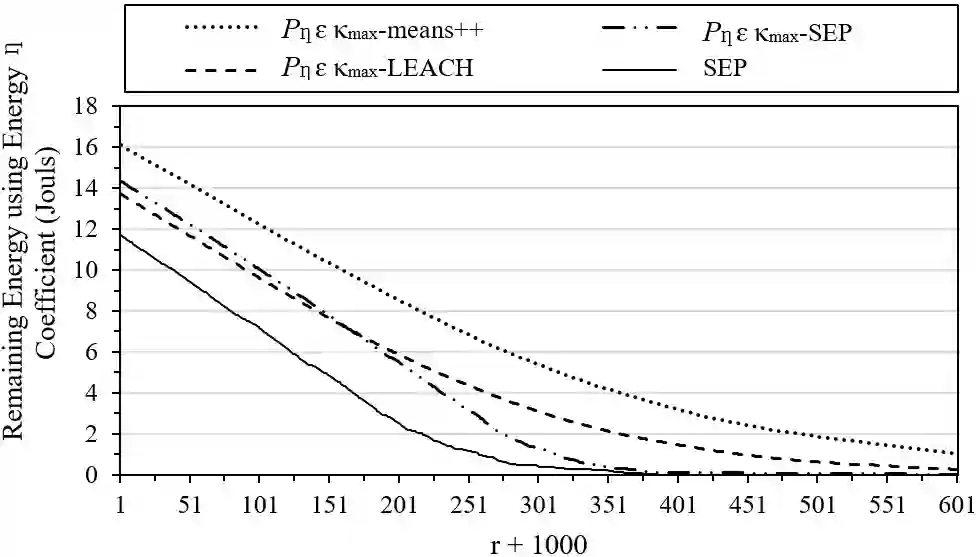
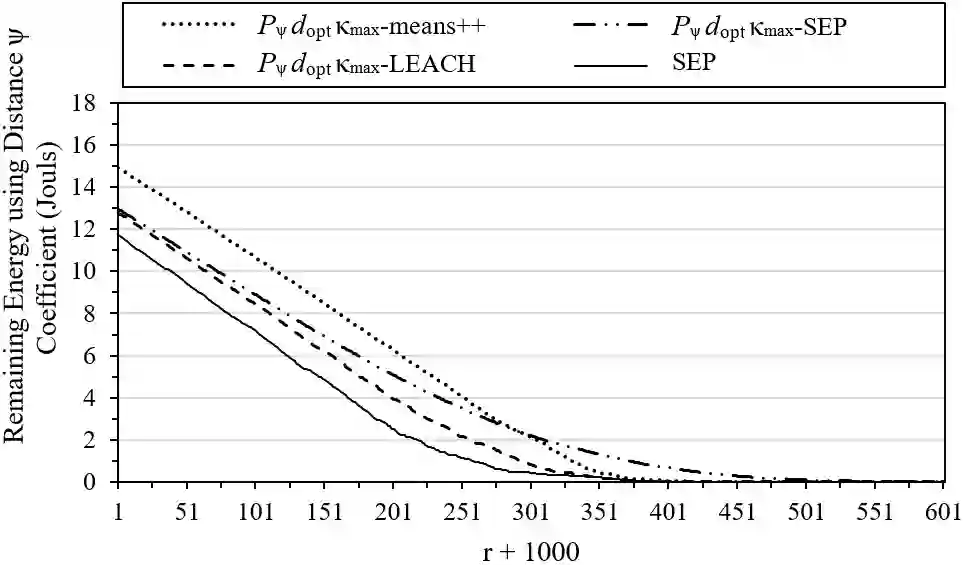
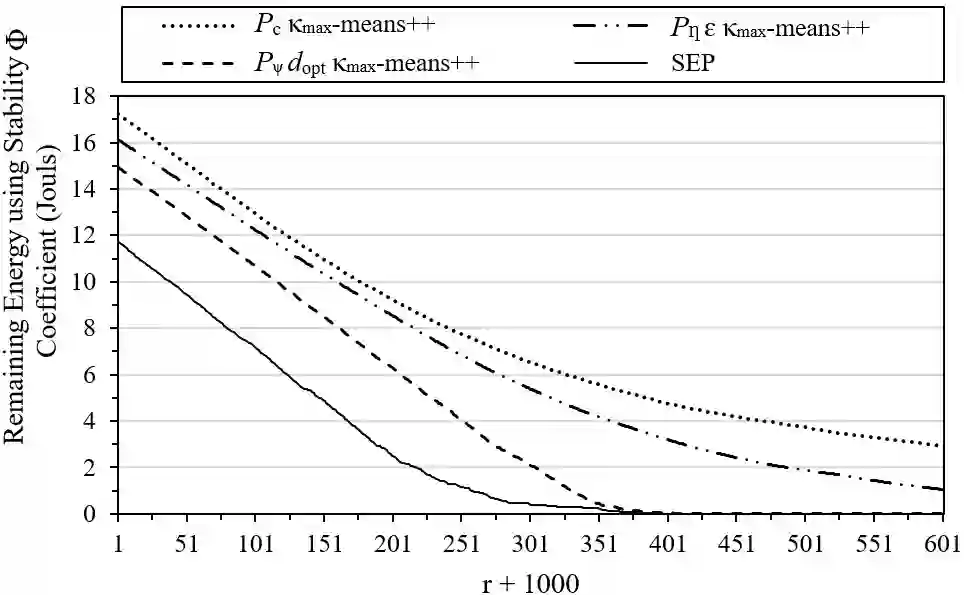
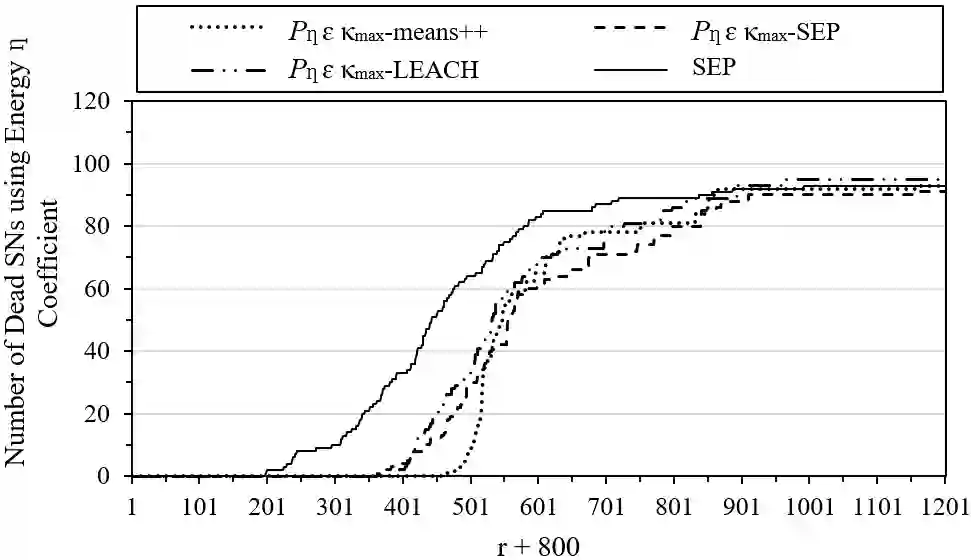
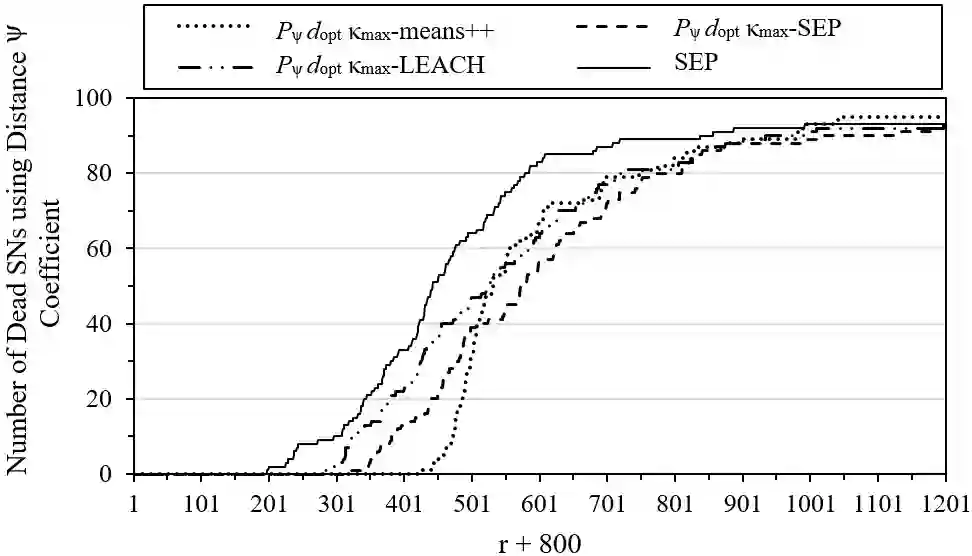
The adaptive probability $P_{\text{\tiny{adp}}}$ formalized in Adapt-$P$ is developed based on the remaining number of SNs $\zeta$ and optimal clustering $\kappa_{\text{\tiny{max}}}$, yet $P_{\text{\tiny{adp}}}$ does not implement the probabilistic ratios of energy and distance factors in the network. Furthermore, Adapt-$P$ does not localize cluster-heads in the first round properly because of its reliance on distance computations defined in LEACH, that might result in uneven distribution of cluster-heads in the WSN area and hence might at some rounds yield inefficient consumption of energy. This paper utilizes \nolinebreak{$k$\small{-}means\small{++}} and Adapt-$P$ to propose \nolinebreak{$P_{\text{c}} \kappa_{\text{\tiny{max}}}$\small{-}means\small{++}} clustering algorithm that better manages the distribution of cluster-heads and produces an enhanced performance. The algorithm employs an optimized cluster-head election probability $P_\text{c}$ developed based on energy-based $P_{\eta(j,i)}$ and distance-based $P\!\!\!_{\psi(j,i)}$ quality probabilities along with the adaptive probability $P_{\text{\tiny{adp}}}$, utilizing the energy $\varepsilon$ and distance optimality $d\!_{\text{\tiny{opt}}}$ factors. Furthermore, the algorithm utilizes the optimal clustering $\kappa_{\text{\tiny{max}}}$ derived in Adapt-$P$ to perform adaptive clustering through \nolinebreak{$\kappa_{\text{\tiny{max}}}$\small{-}means\small{++}}. The proposed \nolinebreak{$P_{\text{c}} \kappa_{\text{\tiny{max}}}${\small{-}}means{\small{++}}} is compared with the energy-based algorithm \nolinebreak{$P_\eta \varepsilon \kappa_{\text{\tiny{max}}}${\small{-}}means{\small{++}}} and distance-based \nolinebreak{$P_\psi d_{\text{\tiny{opt}}} \kappa_{\text{\tiny{max}}}${\small{-}}means{\small{++}}} algorithm, and has shown an optimized performance in term of residual energy and stability period of the network.
翻译:Adapt-$P$中形式化的自适应概率$P_{\text{\tiny{adp}}}$基于剩余SN数量$\zeta$和最优聚类数$\kappa_{\text{\tiny{max}}}$开发,但$P_{\text{\tiny{adp}}}$并未实现网络中能量和距离因子的概率比率。此外,Adapt-$P$由于依赖LEACH中定义的距离计算,无法在第一轮中正确定位簇头,可能导致无线传感器网络(WSN)区域内簇头分布不均,进而在某些轮次中产生低效的能量消耗。本文利用\nolinebreak{$k$\small{-}means\small{++}}和Adapt-$P$提出\nolinebreak{$P_{\text{c}} \kappa_{\text{\tiny{max}}}$\small{-}means\small{++}}聚类算法,该算法能更好地管理簇头分布并提升性能。该算法采用基于能量质量概率$P_{\eta(j,i)}$和距离质量概率$P\!\!\!_{\psi(j,i)}$以及自适应概率$P_{\text{\tiny{adp}}}$优化的簇头选举概率$P_\text{c}$,并利用能量$\varepsilon$和距离最优性$d\!_{\text{\tiny{opt}}}$因子。此外,算法利用Adapt-$P$中推导的最优聚类数$\kappa_{\text{\tiny{max}}}$,通过\nolinebreak{$\kappa_{\text{\tiny{max}}}$\small{-}means\small{++}}执行自适应聚类。将所提出的\nolinebreak{$P_{\text{c}} \kappa_{\text{\tiny{max}}}${\small{-}}means{\small{++}}}与基于能量的算法\nolinebreak{$P_\eta \varepsilon \kappa_{\text{\tiny{max}}}${\small{-}}means{\small{++}}}和基于距离的\nolinebreak{$P_\psi d_{\text{\tiny{opt}}} \kappa_{\text{\tiny{max}}}${\small{-}}means{\small{++}}}算法进行比较,结果显示该方法在网络剩余能量和稳定周期方面具有优化性能。




相关内容




 微信扫码咨询专知VIP会员