

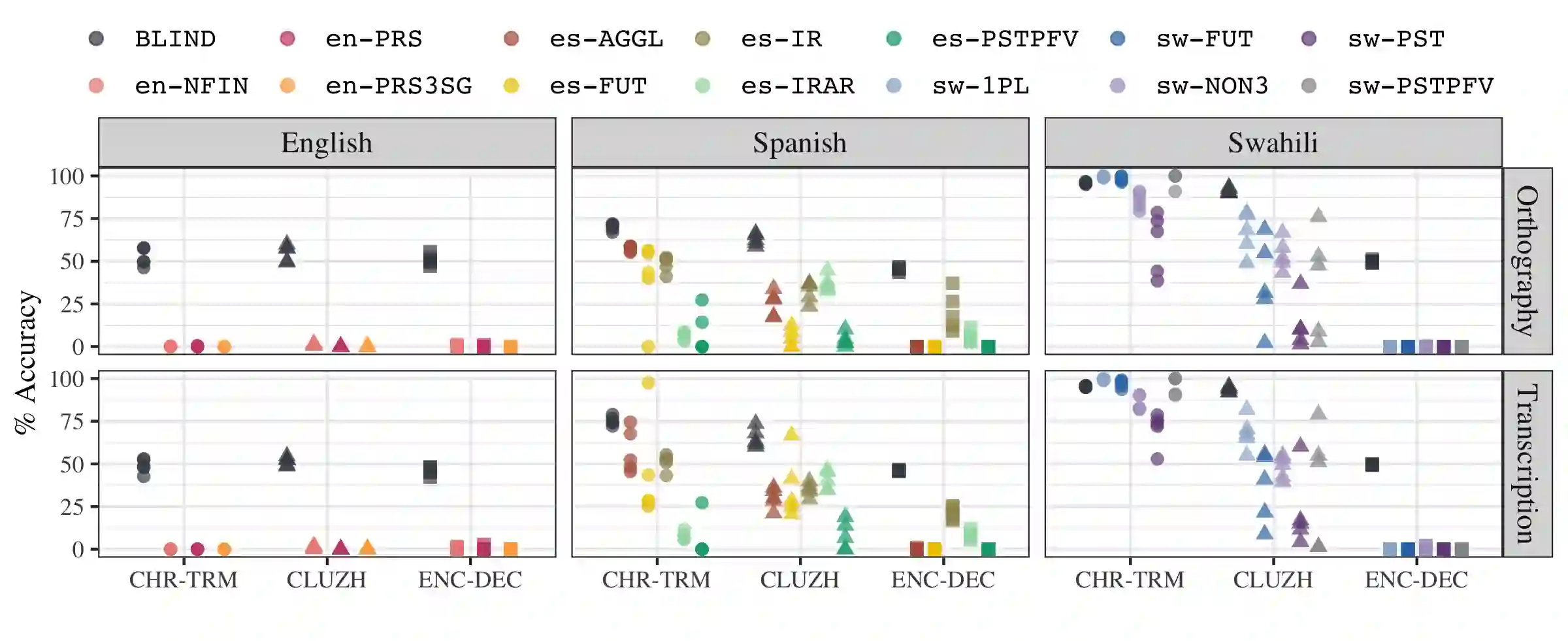
Modern work on the cross-linguistic computational modeling of morphological inflection has typically employed language-independent data splitting algorithms. In this paper, we supplement that approach with language-specific probes designed to test aspects of morphological generalization. Testing these probes on three morphologically distinct languages, English, Spanish, and Swahili, we find evidence that three leading morphological inflection systems employ distinct generalization strategies over conjugational classes and feature sets on both orthographic and phonologically transcribed inputs.
翻译:现代关于跨语言形态屈折计算建模的研究通常采用与语言无关的数据分割算法。本文通过设计针对特定语言的探测方法,以检验形态泛化的不同维度,对该方法进行补充。我们在三种形态类型迥异的语言(英语、西班牙语和斯瓦希里语)上测试了这些探测方法,发现三种主流形态屈折系统在正字法与音系转写两种输入条件下,对变位类别和特征集采用了不同的泛化策略。




相关内容



 微信扫码咨询专知VIP会员