

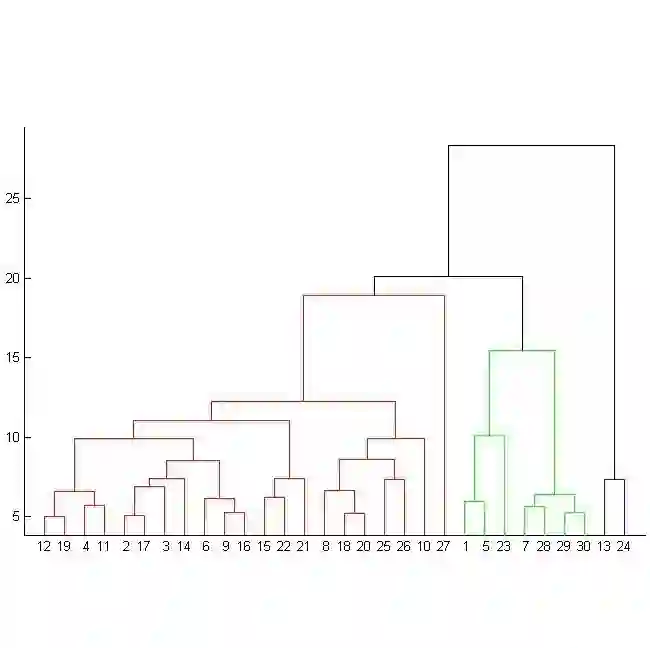
Conceptual and simulation models can function as useful pedagogical tools, however it is important to categorize different outcomes when evaluating them in order to more meaningfully interpret results. VERA is a ecology-based conceptual modeling software that enables users to simulate interactions between biotics and abiotics in an ecosystem, allowing users to form and then verify hypothesis through observing a time series of the species populations. In this paper, we classify this time series into common patterns found in the domain of ecological modeling through two methods, hierarchical clustering and curve fitting, illustrating a general methodology for showing content validity when combining different pedagogical tools. When applied to a diverse sample of 263 models containing 971 time series collected from three different VERA user categories: a Georgia Tech (GATECH), North Georgia Technical College (NGTC), and ``Self Directed Learners'', results showed agreement between both classification methods on 89.38\% of the sample curves in the test set. This serves as a good indication that our methodology for determining content validity was successful.
翻译:概念模型和仿真模型可作为有效的教学工具,但在评估它们时,为了更有意义地解释结果,对不同结果进行分类至关重要。VERA是一款基于生态学的概念建模软件,使用户能够模拟生态系统中生物与非生物之间的相互作用,并通过观察物种种群的时间序列来形成并验证假设。本文通过两种方法(层次聚类和曲线拟合)将该时间序列归类为生态建模领域的常见模式,阐述了在结合不同教学工具时展示内容有效性的通用方法论。对来自三个不同VERA用户类别(佐治亚理工学院、北佐治亚技术学院及“自主学习者”)的263个模型(包含971条时间序列)的多样化样本应用后,结果显示测试集中两种分类方法对89.38%的样本曲线具有一致性。这充分表明我们用于确定内容有效性的方法论取得了成功。




相关内容




 微信扫码咨询专知VIP会员