

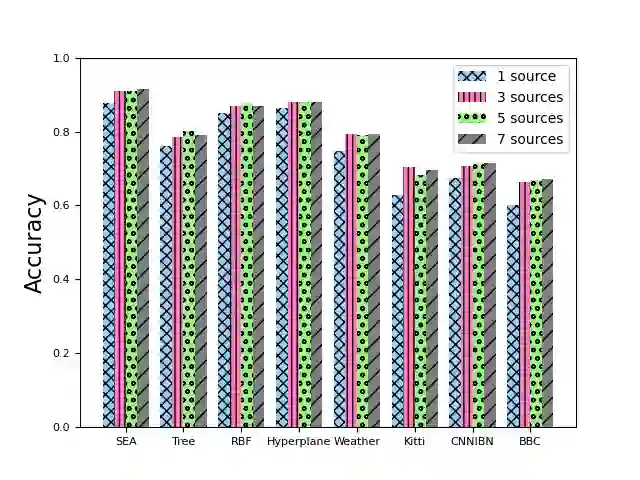
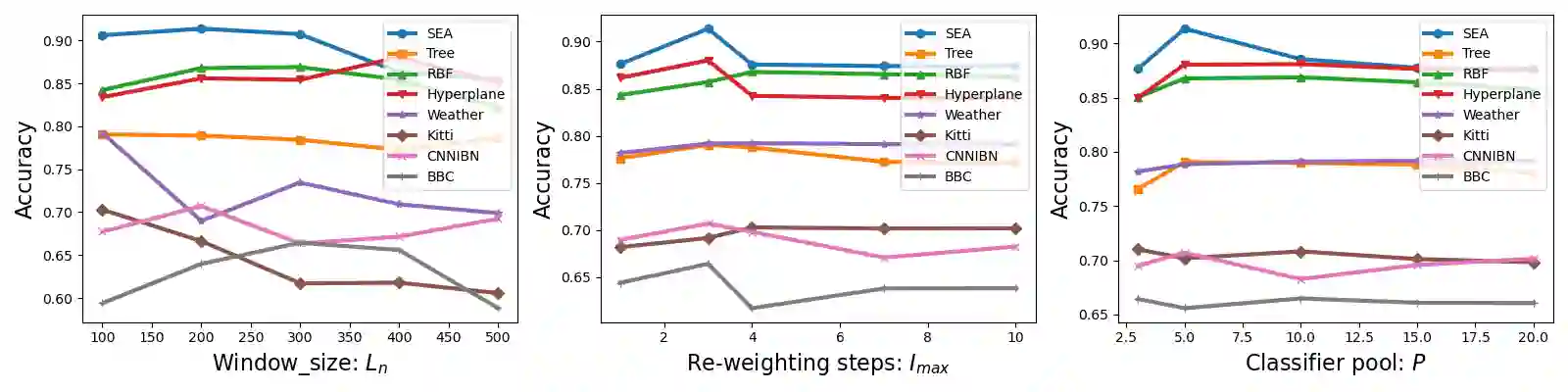
Multistream classification poses significant challenges due to the necessity for rapid adaptation in dynamic streaming processes with concept drift. Despite the growing research outcomes in this area, there has been a notable oversight regarding the temporal dynamic relationships between these streams, leading to the issue of negative transfer arising from irrelevant data. In this paper, we propose a novel Online Boosting Adaptive Learning (OBAL) method that effectively addresses this limitation by adaptively learning the dynamic correlation among different streams. Specifically, OBAL operates in a dual-phase mechanism, in the first of which we design an Adaptive COvariate Shift Adaptation (AdaCOSA) algorithm to construct an initialized ensemble model using archived data from various source streams, thus mitigating the covariate shift while learning the dynamic correlations via an adaptive re-weighting strategy. During the online process, we employ a Gaussian Mixture Model-based weighting mechanism, which is seamlessly integrated with the acquired correlations via AdaCOSA to effectively handle asynchronous drift. This approach significantly improves the predictive performance and stability of the target stream. We conduct comprehensive experiments on several synthetic and real-world data streams, encompassing various drifting scenarios and types. The results clearly demonstrate that OBAL achieves remarkable advancements in addressing multistream classification problems by effectively leveraging positive knowledge derived from multiple sources.
翻译:多流分类因需要在动态流式过程中快速适应概念漂移而面临重大挑战。尽管该领域的研究成果日益增多,但普遍忽视了不同流之间的时间动态关系,导致无关数据引发负迁移问题。本文提出一种新颖的在线提升自适应学习方法(OBAL),通过自适应学习不同流之间的动态相关性,有效解决了这一局限。具体而言,OBAL采用双阶段机制:第一阶段设计自适应协变量偏移适应算法(AdaCOSA),利用多个源流的存档数据构建初始集成模型,通过自适应重加权策略在学习动态相关性的同时缓解协变量偏移;在线过程中,我们引入基于高斯混合模型的加权机制,该机制与AdaCOSA获取的相关性无缝集成,有效处理异步漂移。该方法显著提升了目标流的预测性能与稳定性。我们在多个合成与真实数据流上开展全面实验,涵盖多种漂移场景与类型。结果表明,OBAL通过有效利用多源正知识,在解决多流分类问题上取得了显著进展。




相关内容



 微信扫码咨询专知VIP会员