

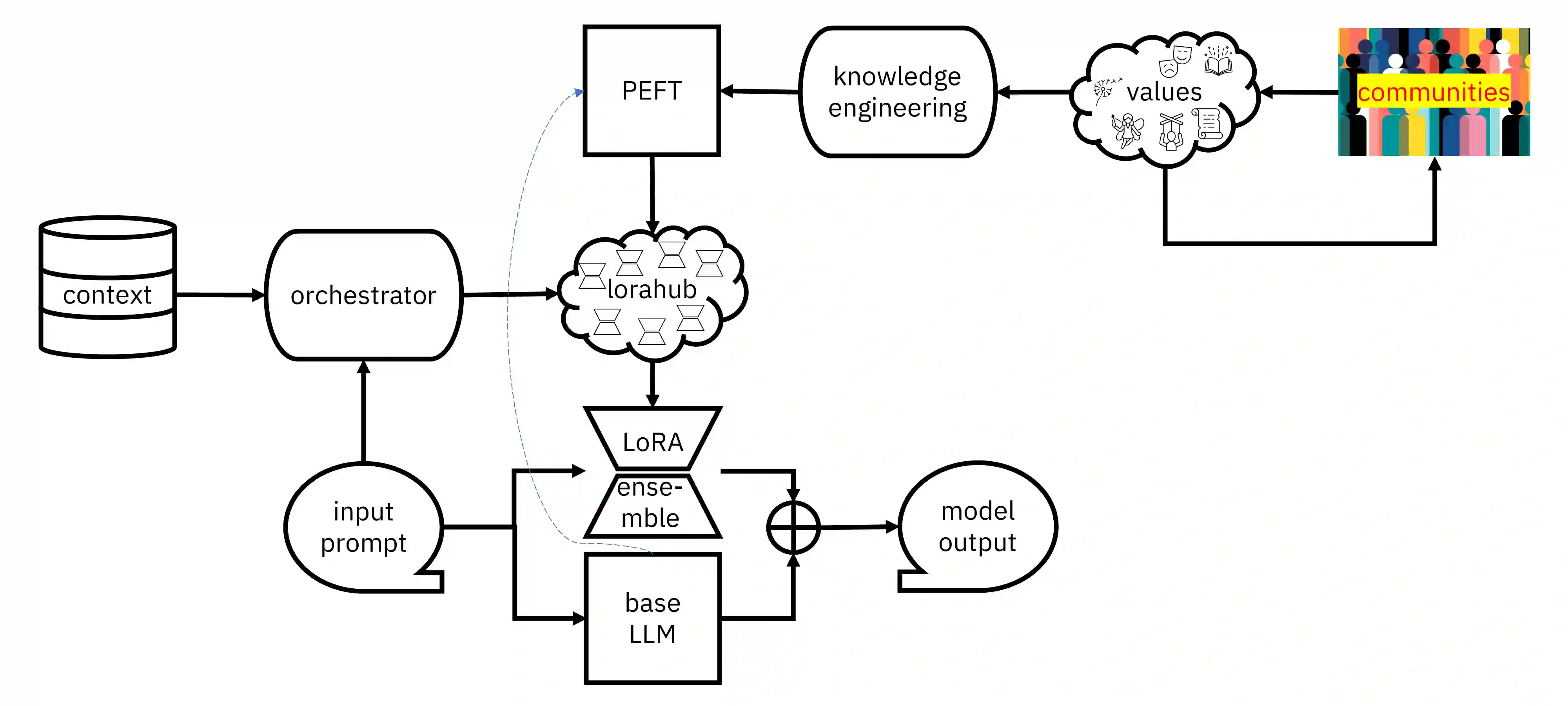
Prior work has explicated the coloniality of artificial intelligence (AI) development and deployment through mechanisms such as extractivism, automation, sociological essentialism, surveillance, and containment. However, that work has not engaged much with alignment: teaching behaviors to a large language model (LLM) in line with desired values, and has not considered a mechanism that arises within that process: moral absolutism -- a part of the coloniality of knowledge. Colonialism has a history of altering the beliefs and values of colonized peoples; in this paper, I argue that this history is recapitulated in current LLM alignment practices and technologies. Furthermore, I suggest that AI alignment be decolonialized using three forms of openness: openness of models, openness to society, and openness to excluded knowledges. This suggested approach to decolonial AI alignment uses ideas from the argumentative moral philosophical tradition of Hinduism, which has been described as an open-source religion. One concept used is vi\'{s}e\d{s}a-dharma, or particular context-specific notions of right and wrong. At the end of the paper, I provide a suggested reference architecture to work toward the proposed framework.
翻译:已有研究通过提取主义、自动化、社会学本质主义、监视和限制等机制,阐释了人工智能(AI)发展与部署中的殖民性。然而,这些研究尚未充分涉及对齐问题——即根据期望价值观教导大语言模型(LLM)行为,也未考虑该过程中出现的一种机制:道德绝对主义——它是知识殖民性的一部分。殖民主义有改变被殖民民族信仰和价值观的历史;本文认为,这一历史在当前的LLM对齐实践和技术中重现。此外,我建议通过三种形式的开放性来去殖民化AI对齐:模型的开放性、对社会的开放性、以及对被排斥的知识的开放性。这种去殖民化AI对齐的拟议方法借鉴了印度教论辩性道德哲学传统(被描述为开源宗教)中的理念。其中一个使用的概念是viśeṣa-dharma,即特定情境下的正确与错误观念。在论文结尾,我为朝着所提议框架努力,提供了一个建议性的参考架构。




相关内容





 微信扫码咨询专知VIP会员