

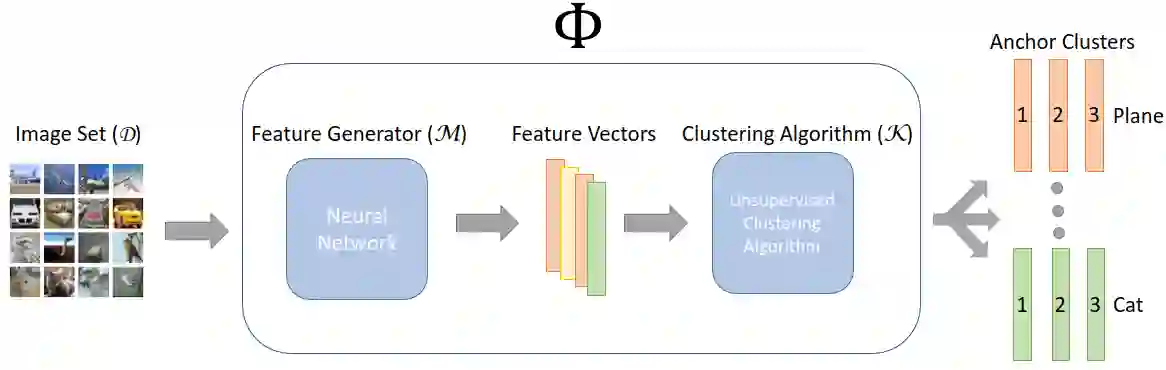
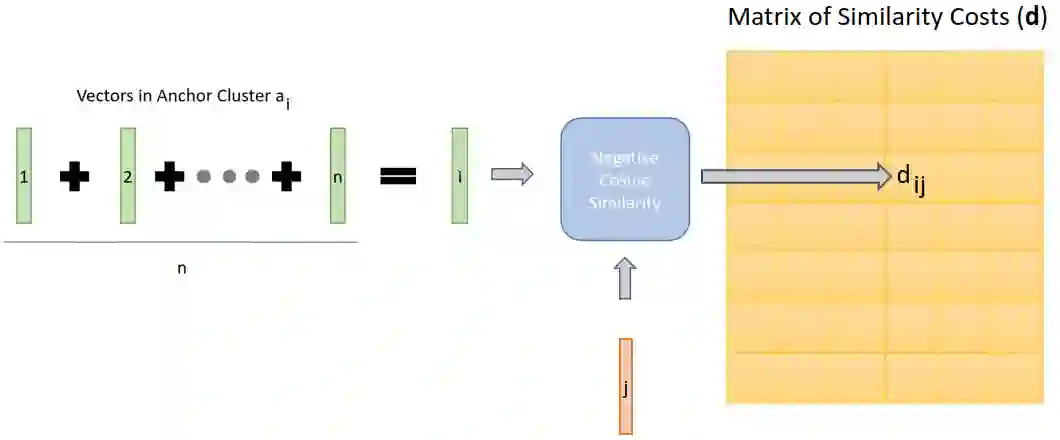
Unsupervised visual clustering has recently received considerable attention. It aims to explain distributions of unlabeled visual images by clustering them via a parameterized appearance model. From a different perspective, the clustering algorithms can be treated as assignment problems, often NP-hard. They can be solved precisely for small instances on current hardware. Adiabatic quantum computing (AQC) offers a solution, as it can soon provide a considerable speedup on a range of NP-hard optimization problems. However, current clustering formulations are unsuitable for quantum computing due to their scaling properties. Consequently, in this work, we propose the first clustering formulation designed to be solved with AQC. We employ an Ising model representing the quantum mechanical system implemented on the AQC. Our approach is competitive compared to state-of-the-art optimization-based approaches, even using of-the-shelf integer programming solvers. Finally, we demonstrate that our clustering problem is already solvable on the current generation of real quantum computers for small examples and analyze the properties of the measured solutions.
翻译:无监督视觉聚类最近受到了广泛关注,其目标是通过参数化外观模型对未标记的视觉图像进行聚类,从而解释其分布。从不同角度来看,聚类算法可视为分配问题,这类问题通常具有NP难度,在当前硬件上仅能精确解决小规模实例。绝热量子计算(AQC)为此提供了解决方案,因为它有望在多种NP难优化问题上实现显著加速。然而,现有聚类公式因扩展性限制不适用于量子计算。因此,本文首次提出了专为AQC求解设计的聚类公式。我们采用伊辛模型来表征AQC上实现的量子力学系统。即使使用现成的整数规划求解器,本方法也能与当前最先进的基于优化的方法相媲美。最后,我们证明在当今真实量子计算机上,该聚类问题已可针对小规模实例求解,并分析了测量解的特性。




相关内容




 微信扫码咨询专知VIP会员