

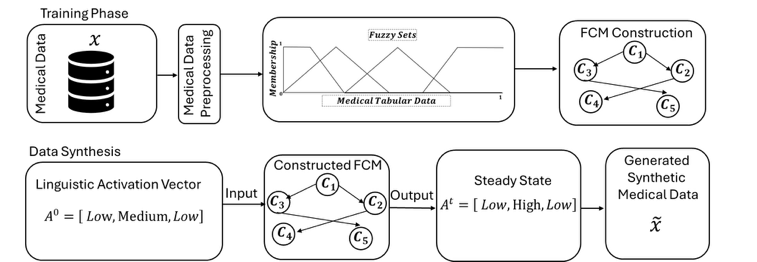
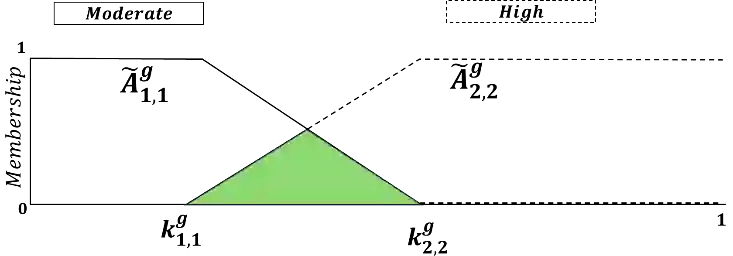
Synthetic medical tabular data generation has become essential for developing and validating computer-based medical systems (CBMSs) when real clinical data is restricted due to privacy, ethical, or data availability limitations. Existing probabilistic and deep generative models often lack interpretability and fail to preserve clinically meaningful dependencies, limiting their suitability for safety-critical applications. This paper proposes a novel application of Fuzzy Cognitive Maps (FCMs) in a framework for synthetic medical tabular data generation with explicit causality and privacy preservation. Clinical features are described using linguistically interpretable fuzzy sets, and inter-feature dependencies are encoded as FCM edge weights computed from fuzzy set intersections. Synthetic patient records are generated by propagating randomly initialized linguistic activation vectors through the FCM until convergence, followed by defuzzification to produce clinically coherent numerical values. The approach natively handles mixed data types, and domain constraints common in health records. Experimental evaluation on UCI medical benchmark datasets demonstrates competitive performance under a Train-on-Synthetic-Test-on-Real (TSTR) protocol. The proposed method achieves accuracy of up to 0.81 and AUROC of up to 0.90 on the Heart Disease dataset, matching or exceeding TVAE and Gaussian Copula baselines while running exclusively on CPU. Fidelity metrics including KS Complement (up to 0.91) and Correlation Similarity (up to 0.95) confirm strong statistical coherence, and DCR Baseline Protection scores consistently exceed those of TVAE, confirming adequate privacy guarantees. These results demonstrate that causally grounded, interpretable fuzzy modeling offers a computationally efficient and transparent alternative to deep generative models for trustworthy synthetic data generation in CBMSs.
翻译:暂无翻译


相关内容




 微信扫码咨询专知VIP会员