

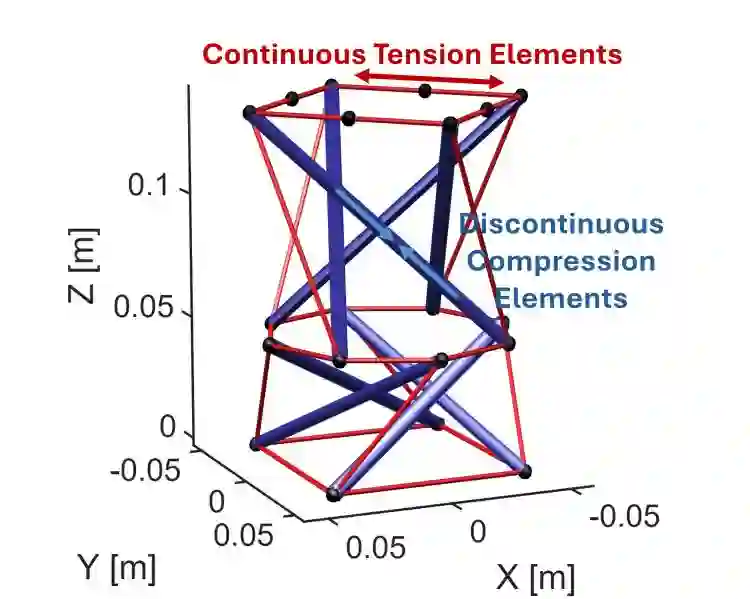
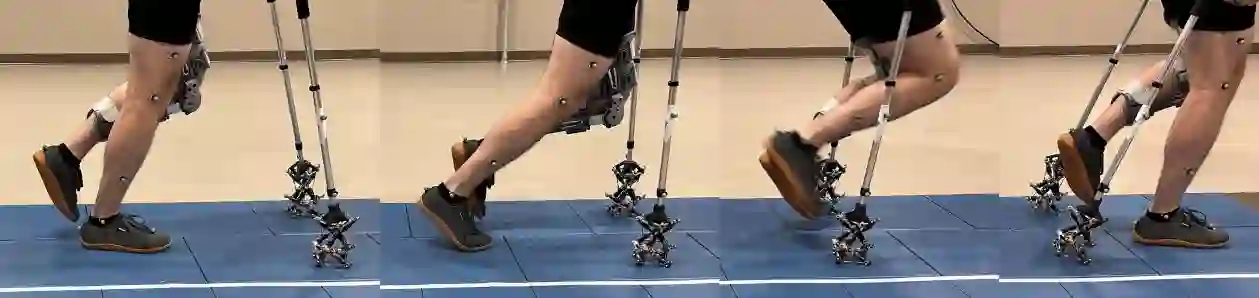
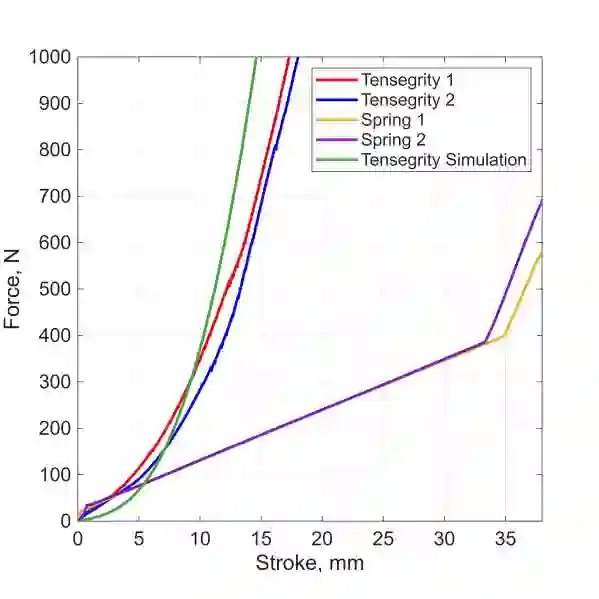
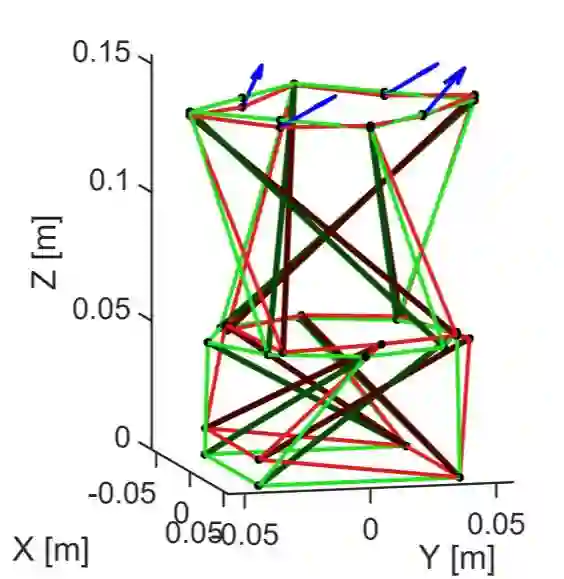
Purpose: Six million people use crutches as mobile aids in the US. Rigid designs with no axial mobility limit sensory feedback and lead to secondary injury on the upper joints. Spring-loaded designs offer compliance but may compromise stability. We designed a biologically inspired tensegrity crutch with a compliant module aiming to achieve favorable mechanical properties. The terminal module was a pre-stressed self-tensile two-cell tensegrity structure. We compared the tensegrity crutch to commercial rigid and spring-loaded crutches in mechanical tests using axial loading, in overground straight and turning walking, and in participant experience. Methods: In human trials, healthy young adults (N=18) with no recent lower-body injury performed straight walking and turning trials at a comfortable self-selected pace. A knee blocker simulated unilateral injury of the dominant leg. After using each type of crutch, participants reported their perceived levels of effort, comfort, pain, stability, and usability. Results: Compared to the rigid design, both spring-loaded and tensegrity conditions reduced peak loading rates. The tensegrity design improved effort, comfort, pain, and usability. Spring-loaded crutches reduced perceived stability and walking speed. Conclusion: The biologically inspired tensegrity crutches were an overall improvement to existing designs. Simulations and mechanical testing suggest that nonlinear stiffness, ground-following, and force feedback are among the beneficial mechanical properties that underlie this improvement.
翻译:目的:美国有600万人使用拐杖作为移动辅助工具。缺乏轴向移动能力的刚性设计限制了感觉反馈,并导致上肢关节继发性损伤。弹簧加载设计提供了柔顺性,但可能损害稳定性。我们设计了一种生物启发的张拉整体拐杖,内含柔顺模块,旨在实现有利的机械性能。终端模块是一个预应力自拉伸双细胞张拉整体结构。我们通过轴向加载的机械测试、地面直线行走和转弯行走实验以及参与者体验,比较了张拉整体拐杖与商用刚性及弹簧加载拐杖的性能。方法:在人体试验中,健康年轻成年人(N=18,近期无下肢损伤)以自选舒适速度进行直线行走和转弯测试。膝盖阻滞器模拟优势腿的单侧损伤。使用每种拐杖后,参与者报告其感知的用力、舒适度、疼痛、稳定性和可用性水平。结果:与刚性设计相比,弹簧加载和张拉整体条件均降低了峰值加载率。张拉整体设计改善了用力、舒适度、疼痛和可用性。弹簧加载拐杖降低了感知稳定性和行走速度。结论:生物启发的张拉整体拐杖总体上对现有设计进行了改进。模拟和机械测试表明,非线性刚度、地面跟随和力反馈是支撑这种改进的有益机械特性的一部分。




相关内容



 微信扫码咨询专知VIP会员