

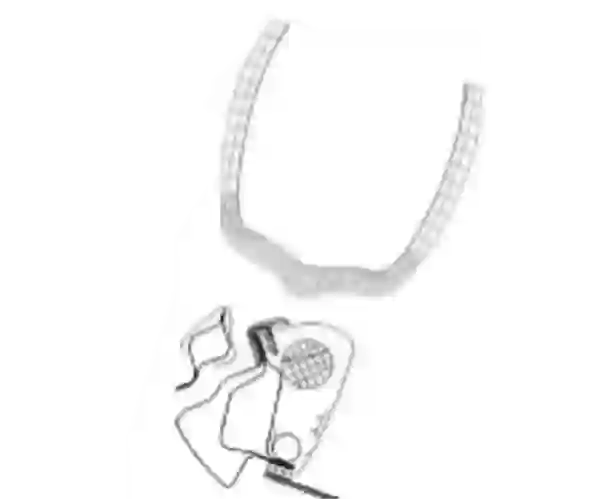
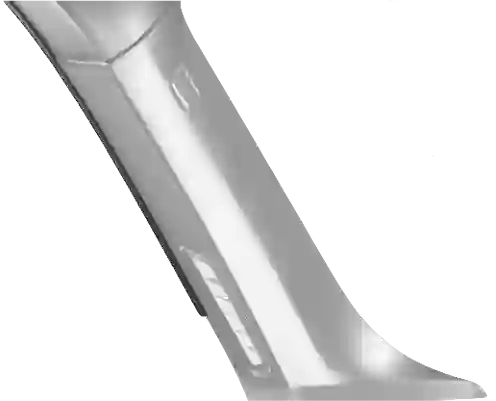
Generative Engineering Design approaches driven by Deep Generative Models (DGM) have been proposed to facilitate industrial engineering processes. In such processes, designs often come in the form of images, such as blueprints, engineering drawings, and CAD models depending on the level of detail. DGMs have been successfully employed for synthesis of natural images, e.g., displaying animals, human faces and landscapes. However, industrial design images are fundamentally different from natural scenes in that they contain rich structural patterns and long-range dependencies, which are challenging for convolution-based DGMs to generate. Moreover, DGM-driven generation process is typically triggered based on random noisy inputs, which outputs unpredictable samples and thus cannot perform an efficient industrial design exploration. We tackle these challenges by proposing a novel model Self-Attention Adversarial Latent Autoencoder (SA-ALAE), which allows generating feasible design images of complex engineering parts. With SA-ALAE, users can not only explore novel variants of an existing design, but also control the generation process by operating in latent space. The potential of SA-ALAE is shown by generating engineering blueprints in a real automotive design task.
翻译:由深度生成模型驱动的生成式工程设计方法已被提出用于促进工业工程流程。在此类流程中,设计通常以图像形式呈现,例如蓝图、工程图纸和CAD模型,具体取决于细节层级。深度生成模型已成功应用于自然图像(如动物、人脸和景观)的合成。然而,工业设计图像与自然场景存在根本性差异,因其包含丰富的结构模式和长程依赖关系,这对基于卷积的深度生成模型构成生成挑战。此外,深度生成模型驱动的生成过程通常基于随机噪声输入触发,其输出样本具有不可预测性,因此无法实现高效的工业设计探索。我们通过提出新型模型——自注意力对抗性潜在自编码器(SA-ALAE)来应对这些挑战,该模型能够生成复杂工程零件的可行设计图像。借助SA-ALAE,用户不仅可以探索现有设计的新型变体,还能通过潜在空间操作控制生成过程。通过在实际汽车设计任务中生成工程蓝图,展示了SA-ALAE的潜力。




相关内容





 微信扫码咨询专知VIP会员