

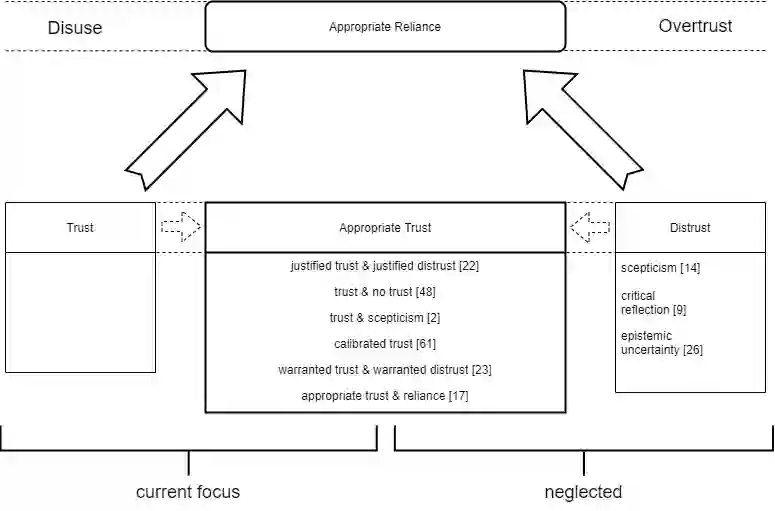
In recent years the use of Artificial Intelligence (AI) has become increasingly prevalent in a growing number of fields. As AI systems are being adopted in more high-stakes areas such as medicine and finance, ensuring that they are trustworthy is of increasing importance. A concern that is prominently addressed by the development and application of explainability methods, which are purported to increase trust from its users and wider society. While an increase in trust may be desirable, an analysis of literature from different research fields shows that an exclusive focus on increasing trust may not be warranted. Something which is well exemplified by the recent development in AI chatbots, which while highly coherent tend to make up facts. In this contribution, we investigate the concepts of trust, trustworthiness, and user reliance. In order to foster appropriate reliance on AI we need to prevent both disuse of these systems as well as overtrust. From our analysis of research on interpersonal trust, trust in automation, and trust in (X)AI, we identify the potential merit of the distinction between trust and distrust (in AI). We propose that alongside trust a healthy amount of distrust is of additional value for mitigating disuse and overtrust. We argue that by considering and evaluating both trust and distrust, we can ensure that users can rely appropriately on trustworthy AI, which can both be useful as well as fallible.
翻译:近年来,人工智能在越来越多领域的应用日益普及。随着AI系统被应用于医疗、金融等高风险领域,确保其可信赖性变得愈发重要。解释性方法的开发和应用着重解决了这一关切,这些方法旨在提升用户及更广泛社会的信任。尽管增加信任或许是可取的,但对不同研究领域文献的分析表明,仅关注提升信任可能并不合理。近期AI聊天机器人的发展便是一个很好的例证:这些系统尽管具有高度连贯性,却倾向于编造事实。本文探讨了信任、可信赖性及用户依赖等概念。为促进对AI的合理依赖,我们需同时防止对系统的弃用与过度信任。基于对人际信任、自动化信任及(可解释)AI信任的研究分析,我们识别出区分对AI的信任与怀疑的潜在价值。提出在信任之外,适度的怀疑对缓解弃用与过度信任具有额外价值。我们主张通过同时考量与评估信任与怀疑,能够确保用户合理依赖可信赖的AI——这种AI既可能实用,也可能存在缺陷。




相关内容




 微信扫码咨询专知VIP会员