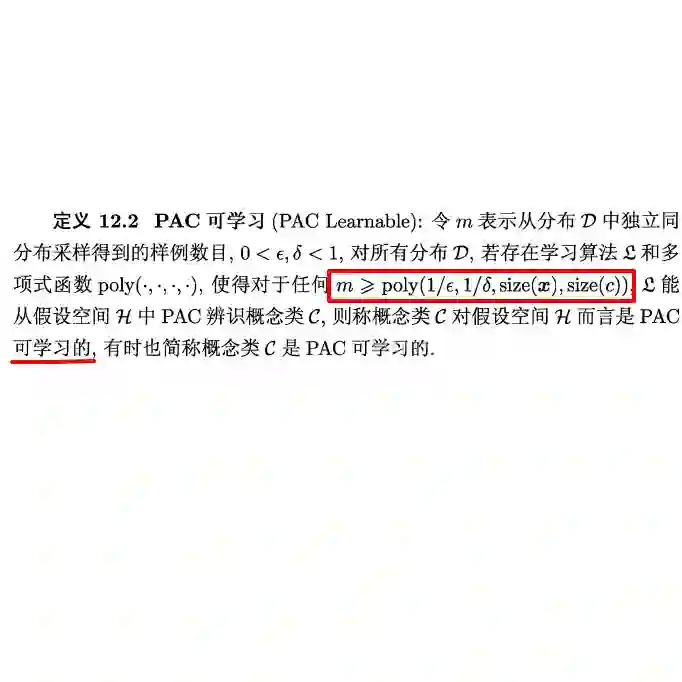
Whether quantum computation can reduce the amount of data required for conventional machine learning is a central problem in quantum machine learning. In probably approximately correct (PAC) learning, a learner receives training examples sampled from an unknown probability distribution. Quantum PAC learning extends this framework by allowing access to quantum examples, which are quantum states that coherently encode this distribution, or to unitaries that prepare quantum examples, with or without inverse access. When only copies of quantum examples are available, the optimal worst-case sample complexity asymptotically matches that of classical learning. In contrast, access to both a preparation unitary and its inverse can improve the accuracy dependence of query complexity. However, it has remained open whether access to the preparation unitary alone suffices for this improvement. In this work, we resolve this question by determining the optimal query complexity with forward-only access, taking the worst case over compatible preparation unitaries and their dimensions. In both realizable and agnostic PAC learning, this complexity matches, up to constant factors, the optimal sample complexity achievable with classical examples or copies of quantum examples. To prove these results, we construct, for any algorithm with forward-only access, a simulator that approximates the algorithm's Haar-averaged output state using as many copies of the prepared state as the algorithm makes queries. These results show that inverse access is essential for the known improvement in accuracy dependence in this worst-case setting. Beyond PAC learning, our reduction provides a general tool for transferring lower bounds for state copies to query lower bounds for forward-only access to the corresponding preparation unitaries.


翻译:暂无翻译

0
下载
关闭预览

相关内容

「连续学习Continual learning, CL」最新2022研究综述
专知会员服务
85+阅读 · 2022年6月26日
专知会员服务
17+阅读 · 2020年12月4日
【斯坦福大学】Gradient Surgery for Multi-Task Learning
专知会员服务
47+阅读 · 2020年1月23日
【文献综述】边缘计算与深度学习的融合综述论文
专知会员服务
170+阅读 · 2019年12月26日
Stabilizing Transformers for Reinforcement Learning
专知会员服务
61+阅读 · 2019年10月17日
强化学习扫盲贴:从Q-learning到DQN
夕小瑶的卖萌屋
52+阅读 · 2019年10月13日
Hierarchically Structured Meta-learning
CreateAMind
27+阅读 · 2019年5月22日
Transferring Knowledge across Learning Processes
CreateAMind
29+阅读 · 2019年5月18日
强化学习的Unsupervised Meta-Learning
CreateAMind
18+阅读 · 2019年1月7日
Unsupervised Learning via Meta-Learning
CreateAMind
44+阅读 · 2019年1月3日
A Technical Overview of AI & ML in 2018 & Trends for 2019
待字闺中
18+阅读 · 2018年12月24日
入门 | 通过 Q-learning 深入理解强化学习
机器之心
12+阅读 · 2018年4月17日
【论文】图上的表示学习综述
机器学习研究会
15+阅读 · 2017年9月24日
国家自然科学基金
2+阅读 · 2017年12月31日
国家自然科学基金
17+阅读 · 2015年12月31日
国家自然科学基金
0+阅读 · 2015年12月31日
国家自然科学基金
1+阅读 · 2015年12月31日
国家自然科学基金
12+阅读 · 2014年12月31日
国家自然科学基金
12+阅读 · 2014年12月31日
国家自然科学基金
0+阅读 · 2014年12月31日
国家自然科学基金
1+阅读 · 2014年12月31日
国家自然科学基金
12+阅读 · 2008年12月31日
VIP会员
最新内容
人工智能在军事教育中的应用:若干视角与经验
“星链”减速与不断适应的乌克兰
专知会员服务
1+阅读 · 11月6日
美国中期选举之后:帕兰提尔面临不确定性?
专知会员服务
2+阅读 · 11月6日
《面向国防领域的大语言模型基准测试与适配》
专知会员服务
17+阅读 · 10月28日
世界模型入门:从序贯决策到通用智能体
专知会员服务
19+阅读 · 10月24日
相关资讯
强化学习扫盲贴:从Q-learning到DQN
夕小瑶的卖萌屋
52+阅读 · 2019年10月13日
Hierarchically Structured Meta-learning
CreateAMind
27+阅读 · 2019年5月22日
Transferring Knowledge across Learning Processes
CreateAMind
29+阅读 · 2019年5月18日
强化学习的Unsupervised Meta-Learning
CreateAMind
18+阅读 · 2019年1月7日
Unsupervised Learning via Meta-Learning
CreateAMind
44+阅读 · 2019年1月3日
A Technical Overview of AI & ML in 2018 & Trends for 2019
待字闺中
18+阅读 · 2018年12月24日
入门 | 通过 Q-learning 深入理解强化学习
机器之心
12+阅读 · 2018年4月17日
【论文】图上的表示学习综述
机器学习研究会
15+阅读 · 2017年9月24日
相关基金
国家自然科学基金
2+阅读 · 2017年12月31日
国家自然科学基金
17+阅读 · 2015年12月31日
国家自然科学基金
0+阅读 · 2015年12月31日
国家自然科学基金
1+阅读 · 2015年12月31日
国家自然科学基金
12+阅读 · 2014年12月31日
国家自然科学基金
12+阅读 · 2014年12月31日
国家自然科学基金
0+阅读 · 2014年12月31日
国家自然科学基金
1+阅读 · 2014年12月31日
国家自然科学基金
12+阅读 · 2008年12月31日
Top
微信扫码咨询专知VIP会员