

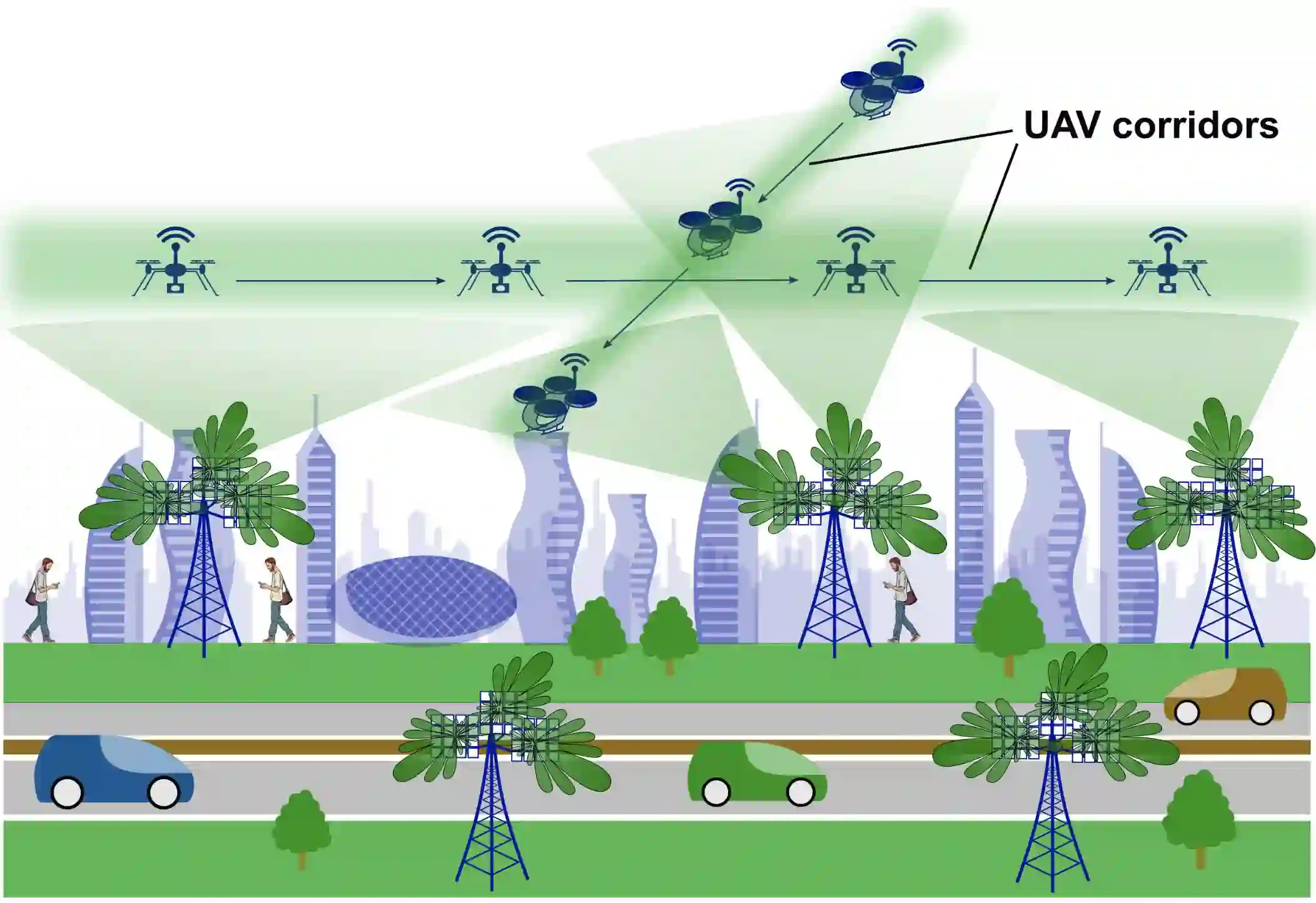
As traditional cellular base stations (BSs) are optimized for 2D ground service, providing 3D connectivity to uncrewed aerial vehicles (UAVs) requires re-engineering of the existing infrastructure. In this paper, we propose a new methodology for designing cellular networks that cater for both ground users and UAV corridors based on Bayesian optimization. We present a case study in which we maximize the signal-to-interference-plus-noise ratio (SINR) for both populations of users by optimizing the electrical antenna tilts and the transmit power employed at each BS. Our proposed optimized network significantly boosts the UAV performance, with a 23.4dB gain in mean SINR compared to an all-downtilt, full-power baseline. At the same time, this optimal tradeoff nearly preserves the performance on the ground, even attaining a gain of 1.3dB in mean SINR with respect to said baseline. Thanks to its ability to optimize black-box stochastic functions, the proposed framework is amenable to maximize any desired function of the SINR or even the capacity per area.
翻译:由于传统蜂窝基站(BS)针对二维地面服务进行了优化,为无人驾驶飞行器(UAV)提供三维连接需要对现有基础设施进行重新设计。本文提出了一种基于贝叶斯优化的蜂窝网络设计新方法,可同时服务地面用户和无人机走廊。我们通过案例研究展示了如何通过优化每个基站的电天线倾角和发射功率,最大化两类用户的信干噪比(SINR)。与全下倾角全功率基线相比,所提出的优化网络将无人机平均SINR提升了23.4dB,同时最优折中方案几乎保持了地面性能,甚至相对于该基线实现了1.3dB的平均SINR增益。由于该框架能够优化黑盒随机函数,因此适用于最大化任何期望的SINR函数甚至单位面积容量。





相关内容



 微信扫码咨询专知VIP会员