

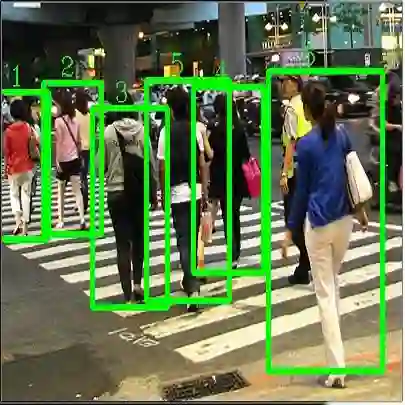
In recent years, deep neural networks have been widely used for building high-performance Artificial Intelligence (AI) systems for computer vision applications. Object detection is a fundamental task in computer vision, which has been greatly progressed through developing large and intricate deep learning models. However, the lack of transparency is a big challenge that may not allow the widespread adoption of these models. Explainable artificial intelligence is a field of research where methods are developed to help users understand the behavior, decision logics, and vulnerabilities of AI systems. Previously, few explanation methods were developed for object detection, based on the idea of random masks. However, random masks may raise some issues regarding the actual importance of pixels within an image. In this paper, we design and implement a black-box explanation method named Black-box Object Detection Explanation by Masking (BODEM) through adopting a hierarchical random masking approach for AI-based object detection systems. We propose a hierarchical random masking framework in which coarse-grained masks are used in lower levels to find salient regions within an image, and fine-grained mask are used to refine the salient regions in higher levels. Experimentations on various object detection datasets and models showed that BODEM can be effectively used to explain the behavior of object detectors. Moreover, our method outperformed Detector Randomized Input Sampling for Explanation (D-RISE) with respect to different quantitative measures of explanation effectiveness. The experimental results demonstrate that BODEM can be an effective method for explaining and validating object detection systems in black-box testing scenarios.
翻译:近年来,深度神经网络被广泛用于构建高性能计算机视觉应用的人工智能(AI)系统。目标检测作为计算机视觉中的基本任务,通过开发庞大而复杂的深度学习模型取得了显著进展。然而,这些模型缺乏透明度是一大挑战,可能阻碍其广泛采用。可解释人工智能是一个研究领域,旨在开发帮助用户理解AI系统行为、决策逻辑及漏洞的方法。此前,基于随机掩码思想,已有少数针对目标检测的解释方法被提出。但随机掩码可能引发关于图像中像素实际重要性的问题。本文设计并实现了一种名为“基于掩码的黑盒目标检测解释”(BODEM)的黑盒解释方法,通过采用分层随机掩码方法用于基于AI的目标检测系统。我们提出了一种分层随机掩码框架:在较低层级使用粗粒度掩码寻找图像中的显著区域,在较高层级使用细粒度掩码精炼这些显著区域。在多种目标检测数据集和模型上的实验表明,BODEM可有效解释目标检测器的行为。此外,我们的方法在解释有效性的不同定量指标上优于基于随机输入采样的检测器解释方法(D-RISE)。实验结果表明,BODEM可成为黑盒测试场景下解释和验证目标检测系统的有效方法。




相关内容




 微信扫码咨询专知VIP会员