

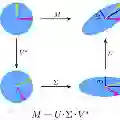
Physics-informed neural networks (PINNs) have proven a suitable mathematical scaffold for solving inverse ordinary (ODE) and partial differential equations (PDE). Typical inverse PINNs are formulated as soft-constrained multi-objective optimization problems with several hyperparameters. In this work, we demonstrate that inverse PINNs can be framed in terms of maximum-likelihood estimators (MLE) to allow explicit error propagation from interpolation to the physical model space through Taylor expansion, without the need of hyperparameter tuning. We explore its application to high-dimensional coupled ODEs constrained by differential algebraic equations that are common in transient chemical and biological kinetics. Furthermore, we show that singular-value decomposition (SVD) of the ODE coupling matrices (reaction stoichiometry matrix) provides reduced uncorrelated subspaces in which PINNs solutions can be represented and over which residuals can be projected. Finally, SVD bases serve as preconditioners for the inversion of covariance matrices in this hyperparameter-free robust application of MLE to ``kinetics-informed neural networks''.
翻译:物理信息神经网络(Physics-informed neural networks, PINNs)已被证明是求解逆常微分方程(ODE)和偏微分方程(PDE)的合适数学框架。典型的逆PINN被表述为具有多个超参数的软约束多目标优化问题。在本研究中,我们证明逆PINN可以基于最大似然估计量(MLE)进行表述,从而通过泰勒展开实现从插值到物理模型空间的显式误差传播,而无需超参数调整。我们探索了其在高维耦合ODE中的应用,这些ODE受微分代数方程约束,常见于瞬态化学和生物动力学。此外,我们表明,ODE耦合矩阵(反应化学计量矩阵)的奇异值分解(SVD)提供了降阶的不相关子空间,PINN解可在其中表示,残差也可在其上投影。最后,SVD基作为协方差矩阵求逆的预条件子,用于这种无超参数的鲁棒MLE在“动力学信息神经网络”中的应用。




相关内容


 微信扫码咨询专知VIP会员