

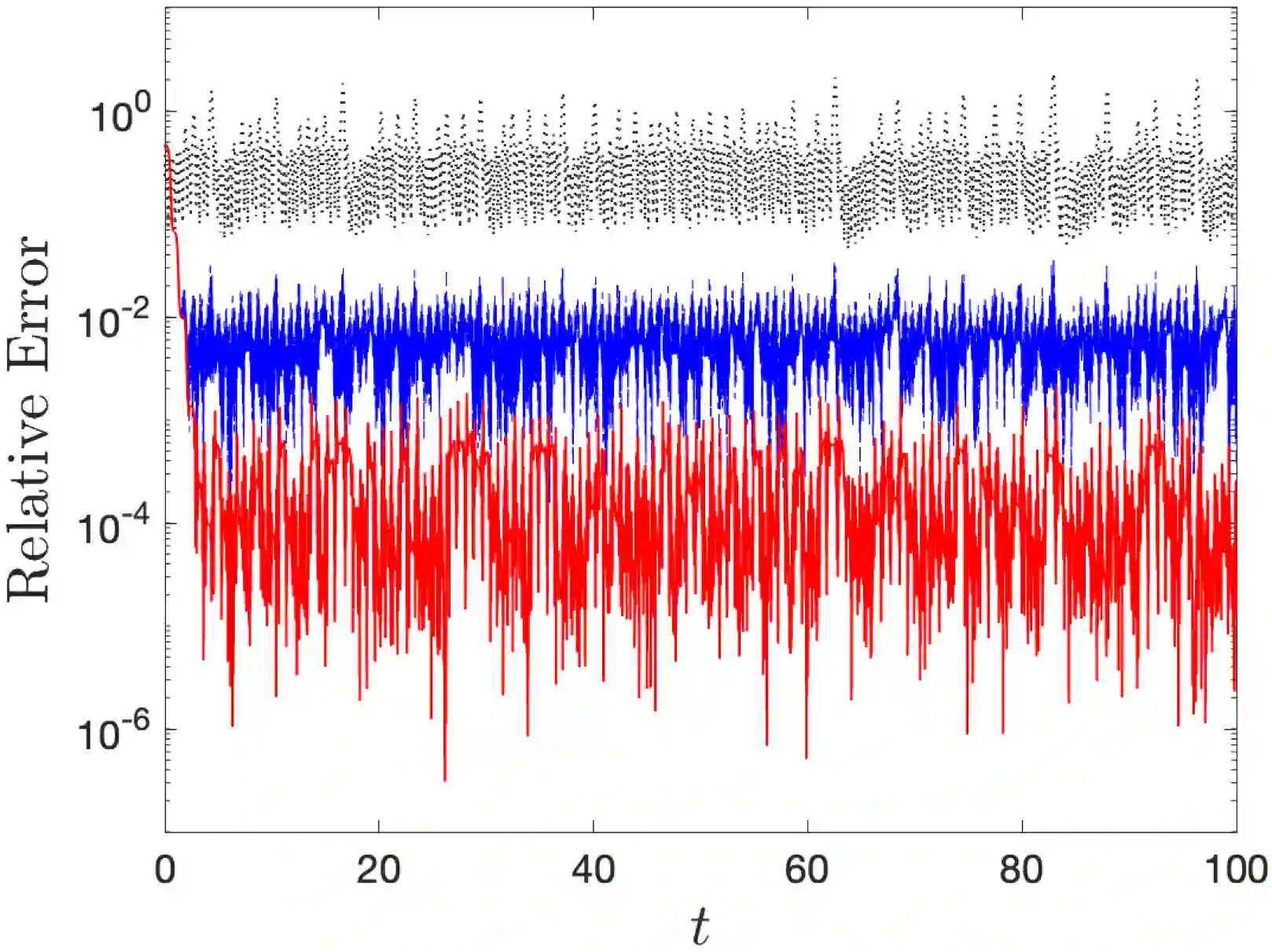
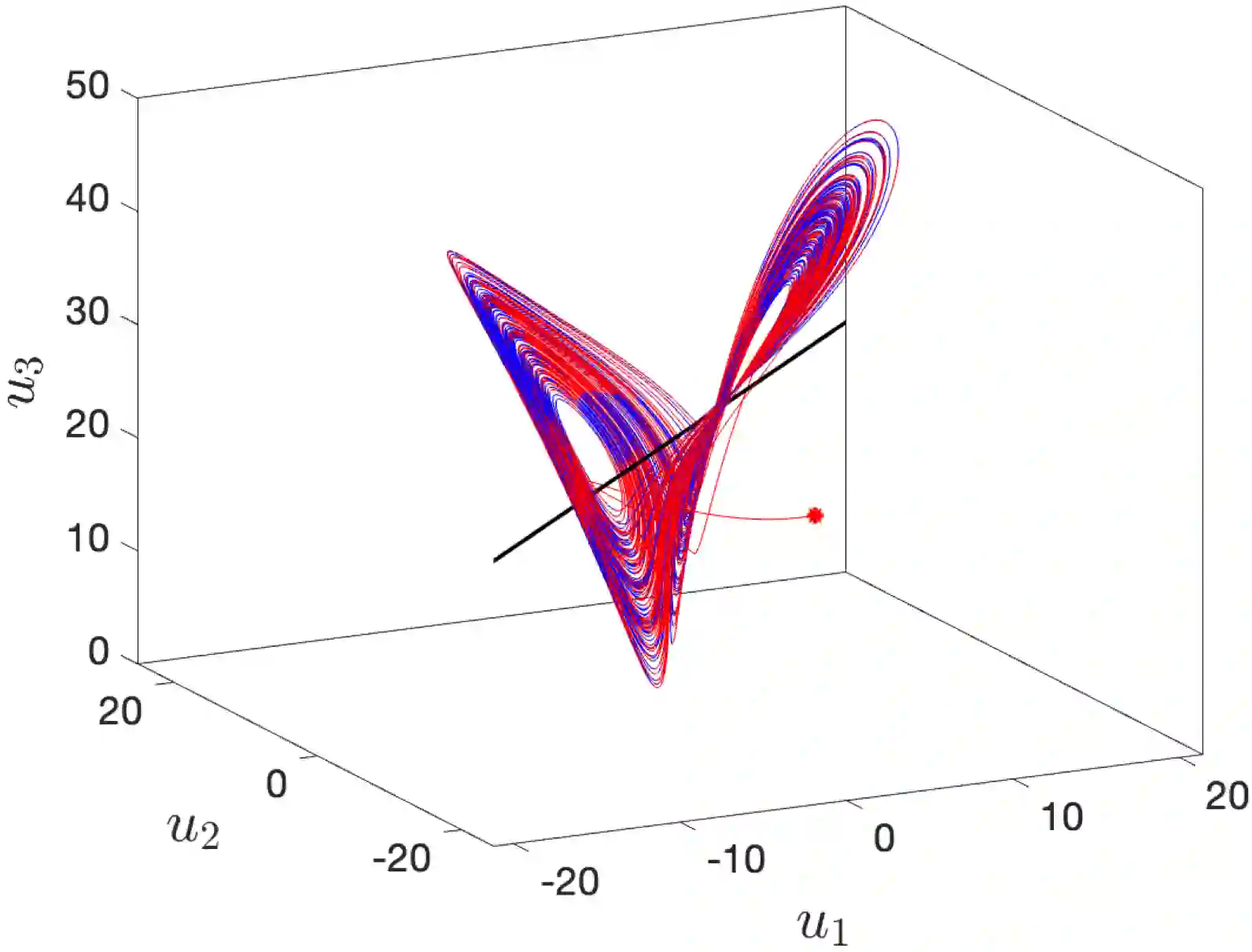
Discrete empirical interpolation method (DEIM) estimates a function from its incomplete pointwise measurements. Unfortunately, DEIM suffers large interpolation errors when few measurements are available. Here, we introduce Sparse DEIM (S-DEIM) for accurately estimating a function even when very few measurements are available. To this end, S-DEIM leverages a kernel vector which has been neglected in previous DEIM-based methods. We derive theoretical error estimates for S-DEIM, showing its relatively small error when an optimal kernel vector is used. When the function is generated by a continuous-time dynamical system, we propose a data assimilation algorithm which approximates the optimal kernel vector using observational time series. We prove that, under certain conditions, data assimilated S-DEIM converges exponentially fast towards the true state. We demonstrate the efficacy of our method on two numerical examples.
翻译:离散经验插值法(DEIM)通过不完整的点测量来估计函数。然而,当可用测量数据极少时,DEIM会存在较大的插值误差。本文提出稀疏DEIM(S-DEIM),即使在测量数据极少的情况下也能准确估计函数。为此,S-DEIM利用了一种在以往DEIM方法中被忽视的核向量。我们推导了S-DEIM的理论误差估计,证明了当使用最优核向量时其误差相对较小。当函数由连续时间动力系统生成时,我们提出一种数据同化算法,利用观测时间序列逼近最优核向量。我们证明,在一定条件下,经过数据同化的S-DEIM能够以指数速度收敛至真实状态。通过两个数值算例验证了该方法的有效性。







相关内容


 微信扫码咨询专知VIP会员