

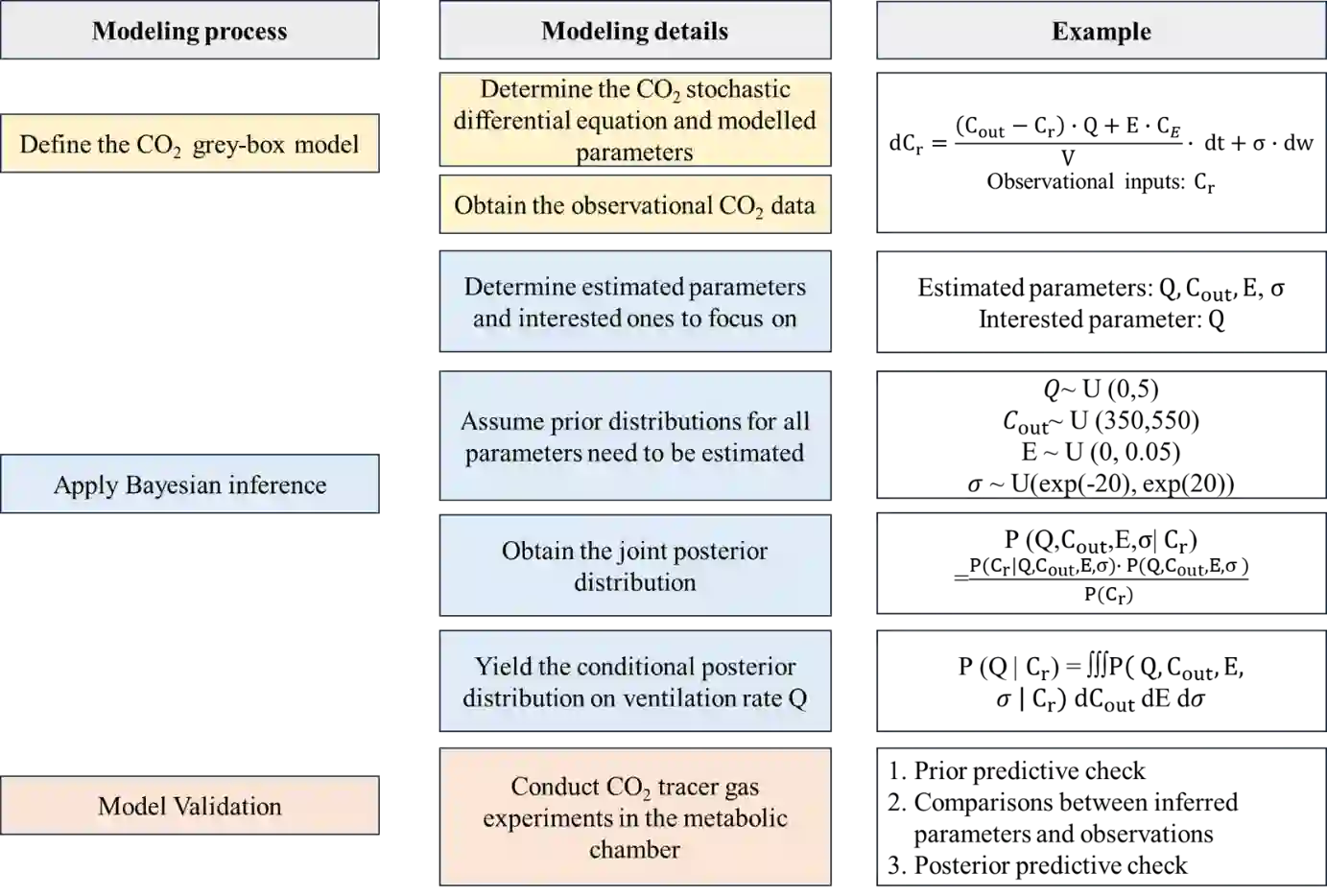
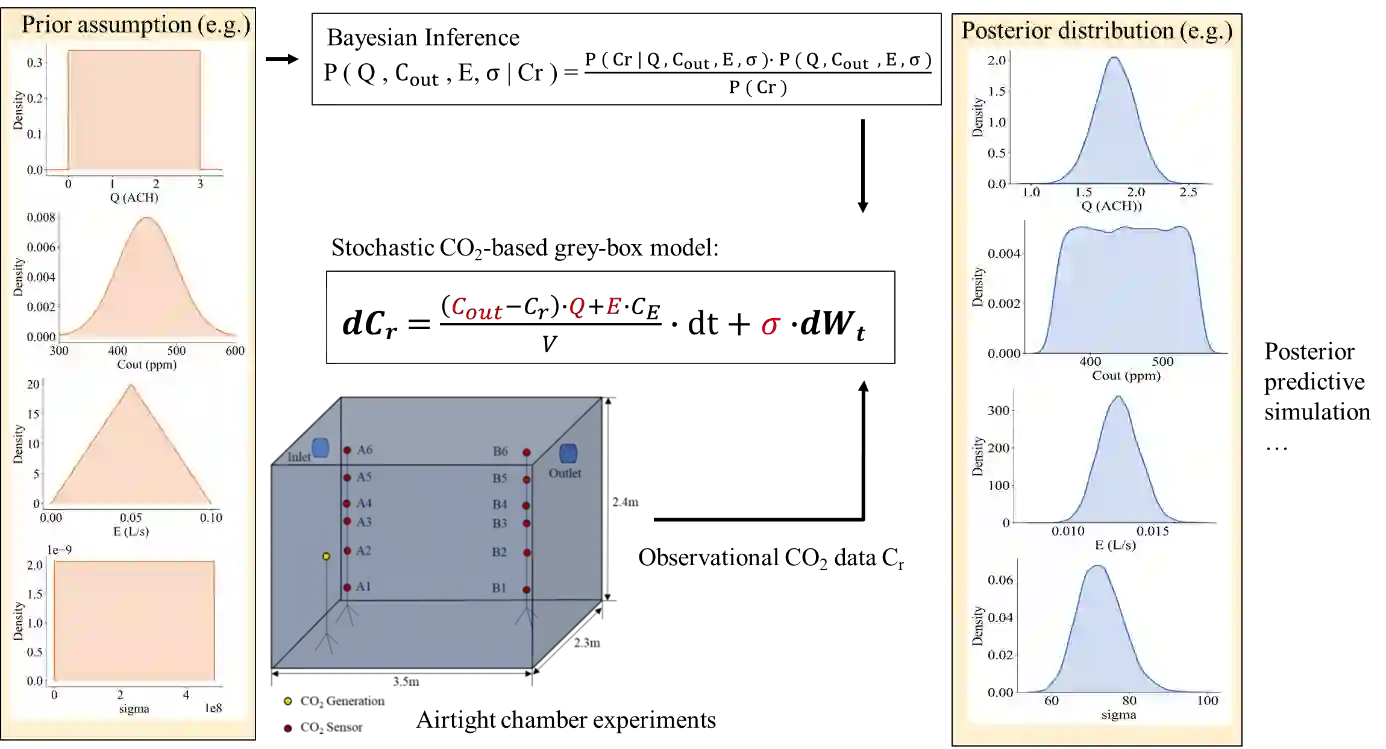
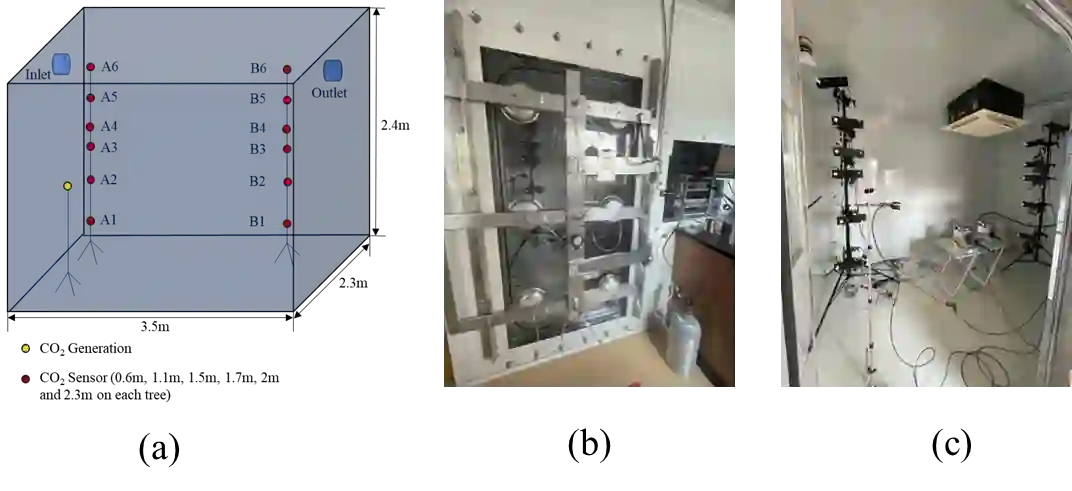
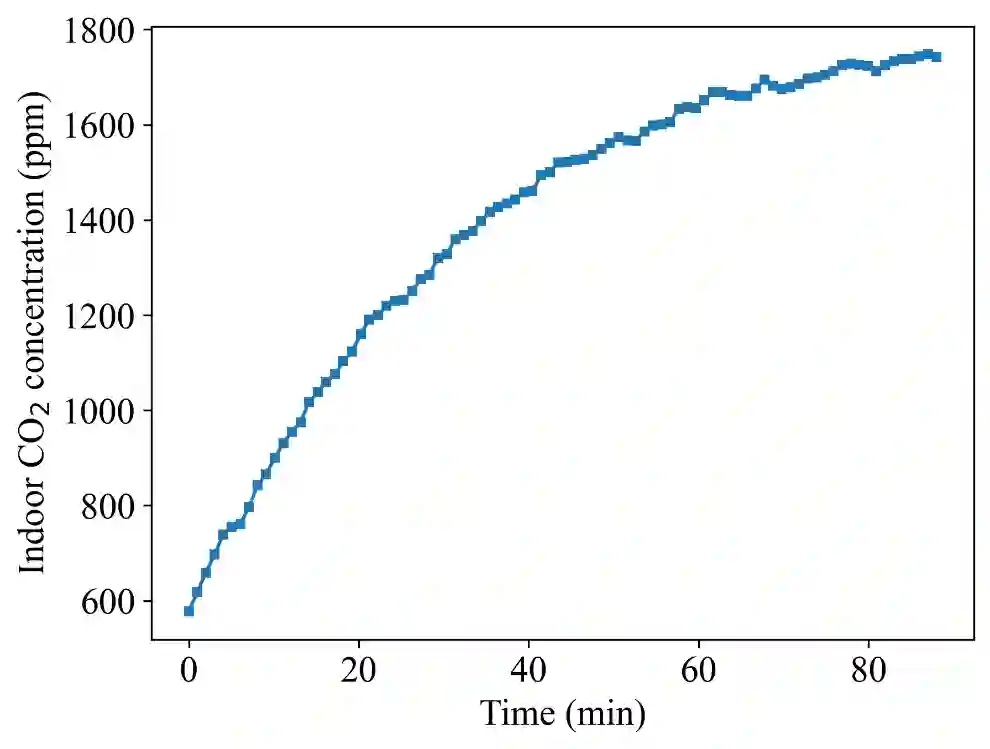
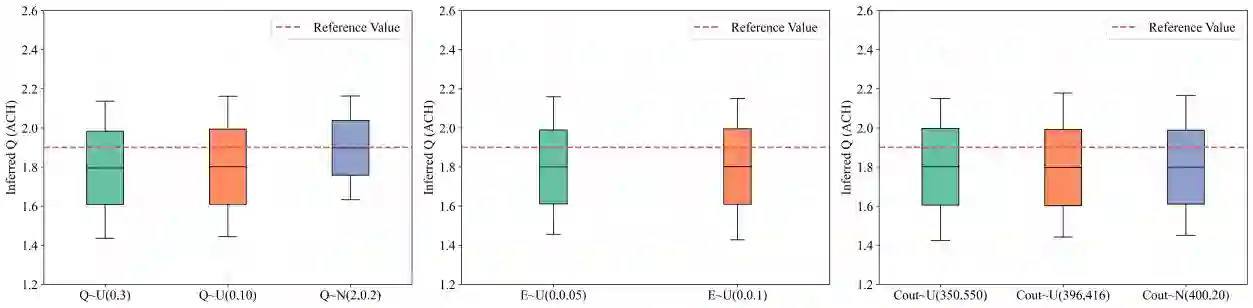
The COVID-19 pandemic brought global attention to indoor air quality (IAQ), which is intrinsically linked to clean air change rates. Estimating the air change rate in indoor environments, however, remains challenging. It is primarily due to the uncertainties associated with the air change rate estimation, such as pollutant generation rates, dynamics including weather and occupancies, and the limitations of deterministic approaches to accommodate these factors. In this study, Bayesian inference was implemented on a stochastic CO2-based grey-box model to infer modeled parameters and quantify uncertainties. The accuracy and robustness of the ventilation rate and CO2 emission rate estimated by the model were confirmed with CO2 tracer gas experiments conducted in an airtight chamber. Both prior and posterior predictive checks (PPC) were performed to demonstrate the advantage of this approach. In addition, uncertainties in real-life contexts were quantified with an incremental variance {\sigma} for the Wiener process. This approach was later applied to evaluate the ventilation conditions within two primary school classrooms in Montreal. The Equivalent Clean Airflow Rate (ECAi) was calculated following ASHRAE 241, and an insufficient clean air supply within both classrooms was identified. A supplement of 800 cfm clear air delivery rate (CADR) from air-cleaning devices is recommended for a sufficient ECAi. Finally, steady-state CO2 thresholds (Climit, Ctarget, and Cideal) were carried out to indicate when ECAi requirements could be achieved under various mitigation strategies, such as portable air cleaners and in-room ultraviolet light, with CADR values ranging from 200 to 1000 cfm.
翻译:新冠疫情使全球关注室内空气质量(IAQ),其与清洁空气更换率密切相关。然而,室内环境空气更换率的估算仍具有挑战性,主要源于空气更换率估算中的不确定因素,包括污染物生成率、天气与 occupancy 等动态变化,以及确定性方法在适应这些因素时的局限性。本研究在随机二氧化碳灰箱模型中引入贝叶斯推断,以推测模型参数并量化不确定性。通过密封舱室内二氧化碳示踪气体实验,验证了模型估算通风速率与二氧化碳排放速率的准确性和鲁棒性。同时开展先验预测检验(PPC)和后验预测检验,展示了该方法的优势。此外,通过维纳过程的增量方差{\sigma}量化真实场景中的不确定性。该方法随后应用于蒙特利尔两所小学教室的通风条件评估。依据ASHRAE 241标准计算等效清洁空气流量(ECAi),发现两间教室均存在清洁空气供应不足。建议补充800 cfm清洁空气输送率(CADR)的空气净化设备以满足ECAi要求。最终设定稳态二氧化碳阈值(Climit、Ctarget和Cideal),用于指示在便携式空气净化器、室内紫外线灯等缓解策略下(CADR值为200至1000 cfm)何时可达到ECAi要求。




相关内容




 微信扫码咨询专知VIP会员