

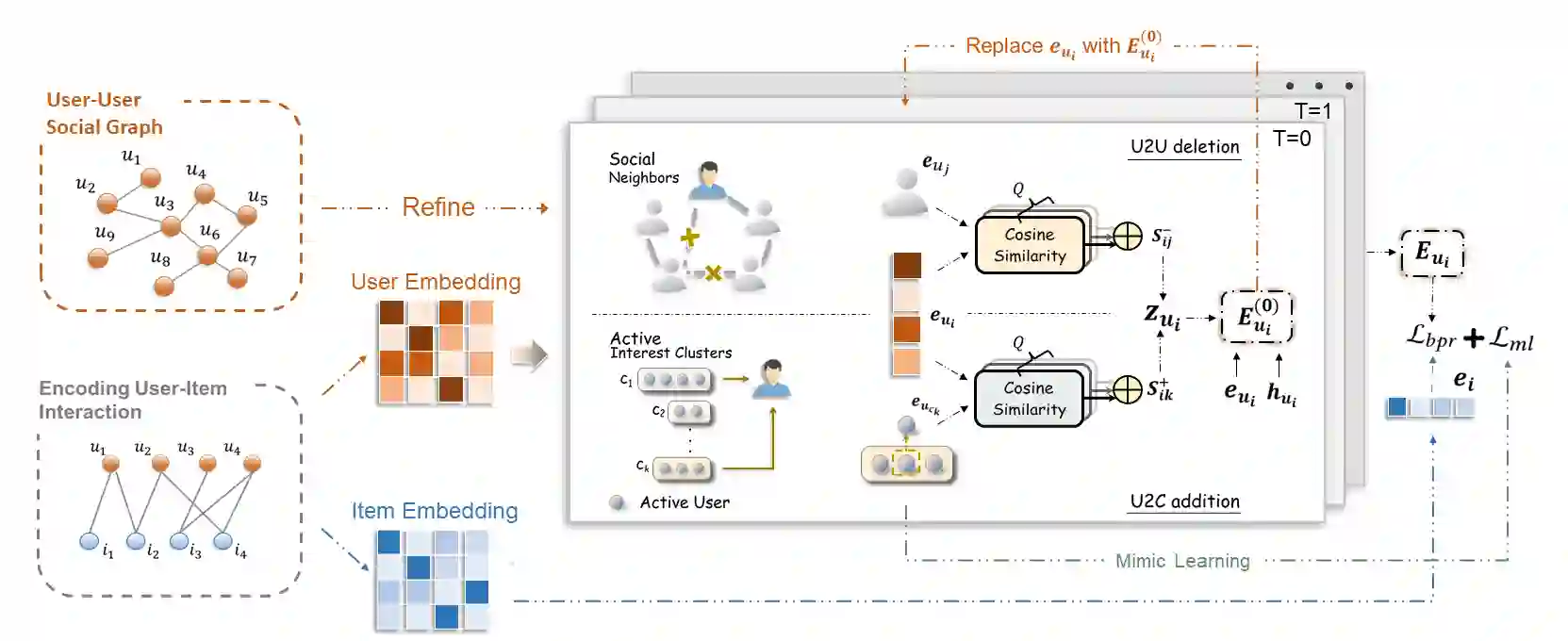
Social relations have been widely incorporated into recommender systems to alleviate data sparsity problem. However, raw social relations don't always benefit recommendation due to their inferior quality and insufficient quantity, especially for inactive users, whose interacted items are limited. In this paper, we propose a novel social recommendation method called LSIR (\textbf{L}earning \textbf{S}ocial Graph for \textbf{I}nactive User \textbf{R}ecommendation) that learns an optimal social graph structure for social recommendation, especially for inactive users. LSIR recursively aggregates user and item embeddings to collaboratively encode item and user features. Then, graph structure learning (GSL) is employed to refine the raw user-user social graph, by removing noisy edges and adding new edges based on the enhanced embeddings. Meanwhile, mimic learning is implemented to guide active users in mimicking inactive users during model training, which improves the construction of new edges for inactive users. Extensive experiments on real-world datasets demonstrate that LSIR achieves significant improvements of up to 129.58\% on NDCG in inactive user recommendation. Our code is available at~\url{https://github.com/liun-online/LSIR}.
翻译:社交关系已被广泛应用于推荐系统中以缓解数据稀疏性问题。然而,原始社交关系由于质量较低且数量不足,并不总能提升推荐效果,尤其对于交互记录有限的非活跃用户而言。本文提出一种名为LSIR(学习社交图谱以提升非活跃用户推荐效果)的新型社交推荐方法,该方法通过学习最优社交图谱结构来优化社交推荐,特别针对非活跃用户。LSIR通过递归聚合用户与物品嵌入,协同编码物品与用户特征。随后,采用图结构学习技术对原始用户-用户社交图谱进行优化,基于增强后的嵌入表示删除噪声边并添加新边。同时,在模型训练中引入模仿学习机制,引导活跃用户模仿非活跃用户行为模式,从而改进非活跃用户的新边构建过程。在真实数据集上的大量实验表明,LSIR在非活跃用户推荐任务中取得显著提升,NDCG指标最高提升达129.58%。代码已开源:\url{https://github.com/liun-online/LSIR}。




相关内容





 微信扫码咨询专知VIP会员