

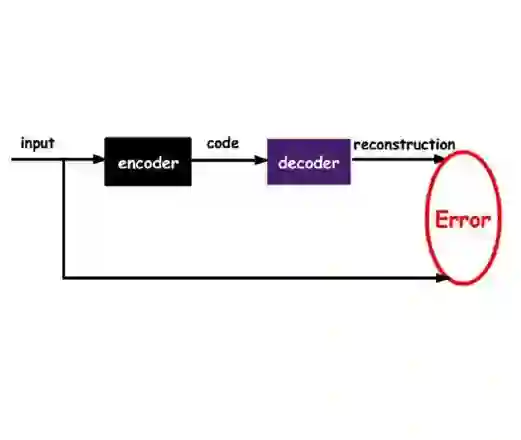
The continuity of life and its evolution, we proposed, emerge from an interactive group process manifested in networks of interaction. We term this process \textit{survival-of-the-fitted}. Here, we reason that survival of the fitted results from a natural computational process we term \textit{natural autoencoding}. Natural autoencoding works by retaining repeating biological interactions while non-repeatable interactions disappear. (1) We define a species by its \textit{species interaction code}, which consists of a compact description of the repeating interactions of species organisms with their external and internal environments. Species interaction codes are descriptions recorded in the biological infrastructure that enables repeating interactions. Encoding and decoding are interwoven. (2) Evolution proceeds by natural autoencoding of sustained changes in species interaction codes. DNA is only one element in natural autoencoding. (3) Natural autoencoding accounts for the paradox of genome randomization in sexual reproduction -- recombined genomes are analogous to the diversified inputs required for artificial autoencoding. The increase in entropy generated by genome randomization compensates for the decrease in entropy generated by organized life. (4) Natural autoencoding and artificial autoencoding algorithms manifest defined similarities and differences. Recognition of the importance of fittedness could well serve the future of a humanly livable biosphere.
翻译:生命的延续及其进化,我们认为产生于一个以交互网络形式呈现的互动群体过程。我们将这一过程称为"适存生存"。在此,我们论证了适存生存源自一个我们称之为"自然自编码"的自然计算过程。自然自编码通过保留重复发生的生物交互,同时使非重复交互消失来运作。(1) 我们通过物种的"物种交互代码"来定义物种,该代码由物种生物体与外部及内部环境之间重复交互的紧凑描述构成。物种交互代码是记录在生物基础设施中的描述,能够使重复交互得以实现。编码与解码相互交织。(2) 进化通过物种交互代码中持续变化的自然自编码进行。DNA仅是自然自编码中的一个要素。(3) 自然自编码解释了有性生殖中基因组随机化的悖论——重组基因组类似于人工自编码所需的多样化输入。基因组随机化产生的熵增补偿了有序生命活动带来的熵减。(4) 自然自编码与人工自编码算法表现出明确的相似性与差异性。认识到适存性的重要性,将有助于人类宜居生物圈的未来发展。




相关内容



 微信扫码咨询专知VIP会员