

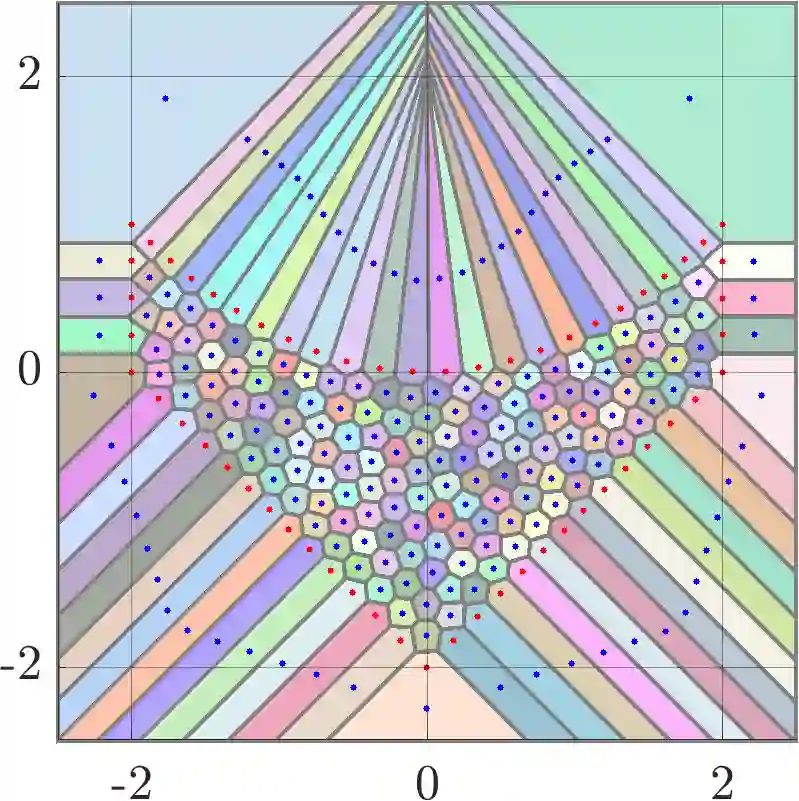
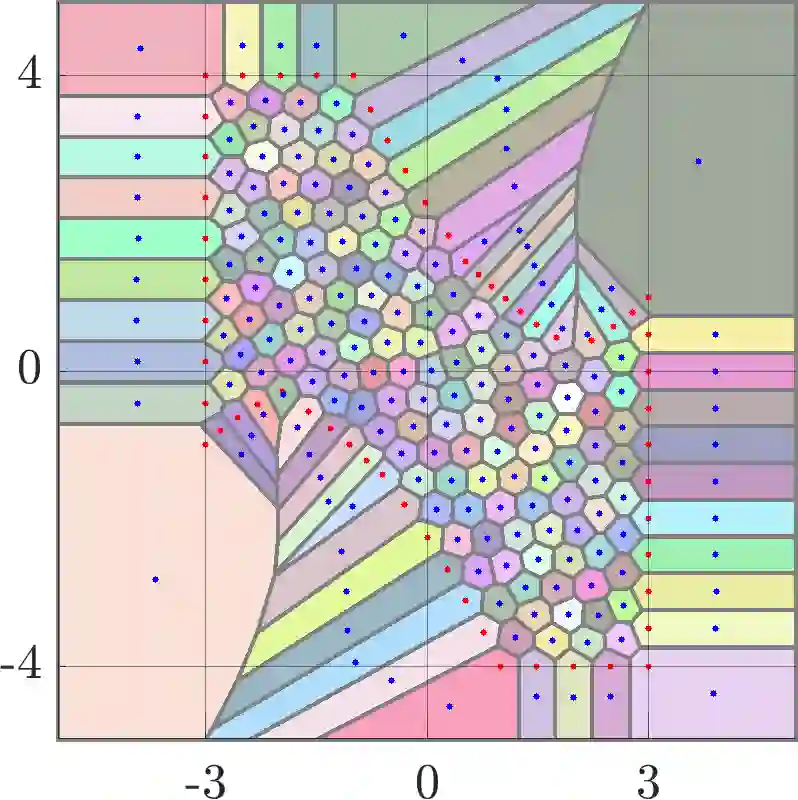
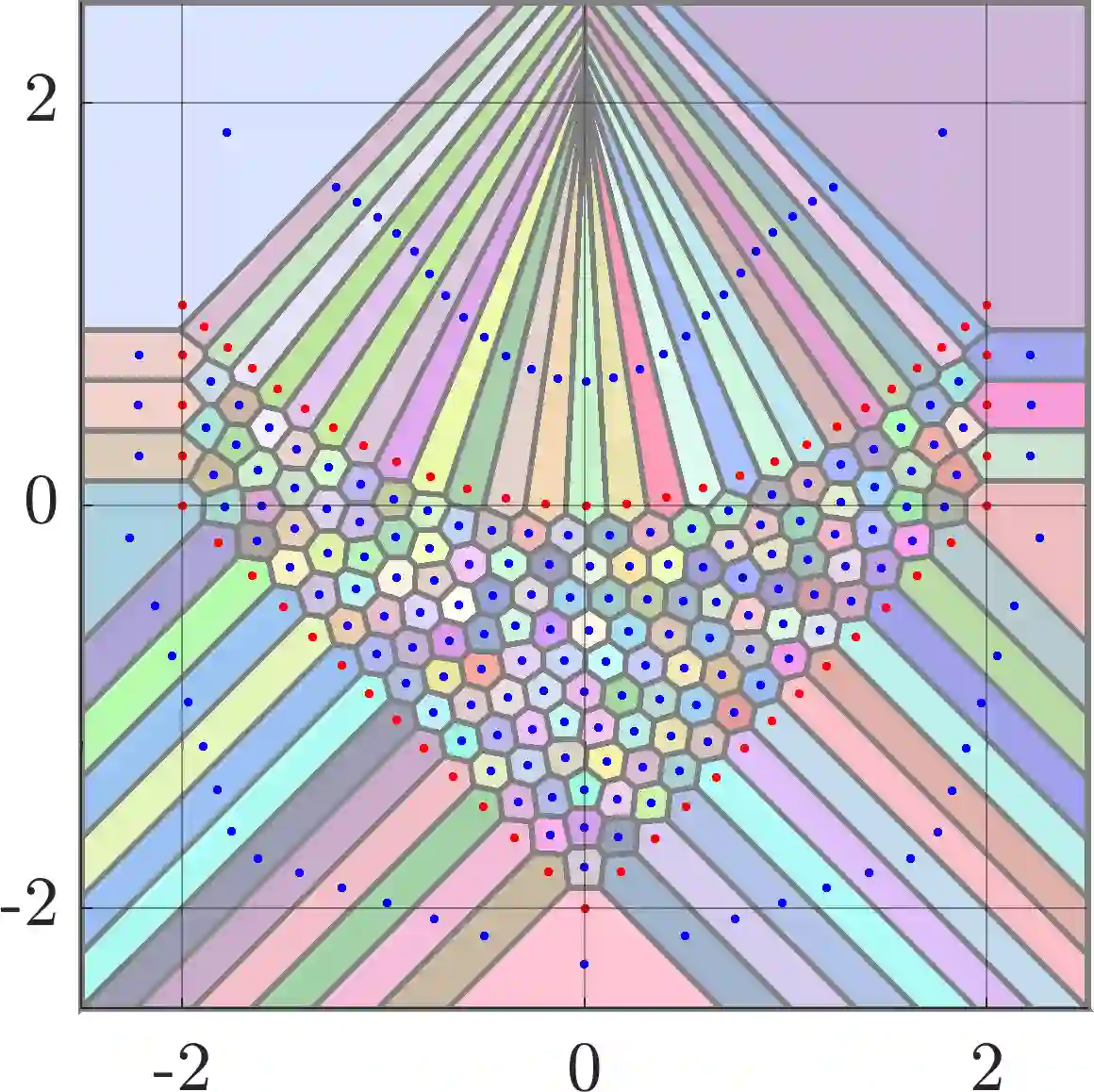
Identifying Blaschke-Santal\'o diagrams is an important topic that essentially consists in determining the image $Y=F(X)$ of a map $F:X\to{\mathbb{R}}^d$, where the dimension of the source space $X$ is much larger than the one of the target space. In some cases, that occur for instance in shape optimization problems, $X$ can even be a subset of an infinite-dimensional space. The usual Monte Carlo method, consisting in randomly choosing a number $N$ of points $x_1,\dots,x_N$ in $X$ and plotting them in the target space ${\mathbb{R}}^d$, produces in many cases areas in $Y$ of very high and very low concentration leading to a rather rough numerical identification of the image set. On the contrary, our goal is to choose the points $x_i$ in an appropriate way that produces a uniform distribution in the target space. In this way we may obtain a good representation of the image set $Y$ by a relatively small number $N$ of samples which is very useful when the dimension of the source space $X$ is large (or even infinite) and the evaluation of $F(x_i)$ is costly. Our method consists in a suitable use of {\it Centroidal Voronoi Tessellations} which provides efficient numerical results. Simulations for two and three dimensional examples are shown in the paper.
翻译:Blaschke-Santaló 图的识别是重要课题,其核心在于确定映射 $F:X\to{\mathbb{R}}^d$ 的像集 $Y=F(X)$,其中源空间 $X$ 的维度远大于目标空间维度。在形状优化等问题中,$X$ 甚至可能是无限维空间的子集。通常的蒙特卡洛方法通过在 $X$ 中随机选取 $N$ 个点 $x_1,\dots,x_N$ 并在目标空间 ${\mathbb{R}}^d$ 中绘制,往往会因 $Y$ 中产生极高和极低浓度区域而导致像集的数值识别较为粗糙。相反,我们的目标是以适当方式选择点 $x_i$,使目标空间呈现均匀分布。通过这种方式,我们可以用相对较少的 $N$ 个样本很好地表征像集 $Y$,这在源空间 $X$ 维度较大(甚至无限)且 $F(x_i)$ 评估成本高昂时尤为实用。我们的方法通过合理运用{\it 质心Voronoi镶嵌}获得了高效的数值结果。文中展示了二维和三维示例的仿真结果。




相关内容



 微信扫码咨询专知VIP会员