

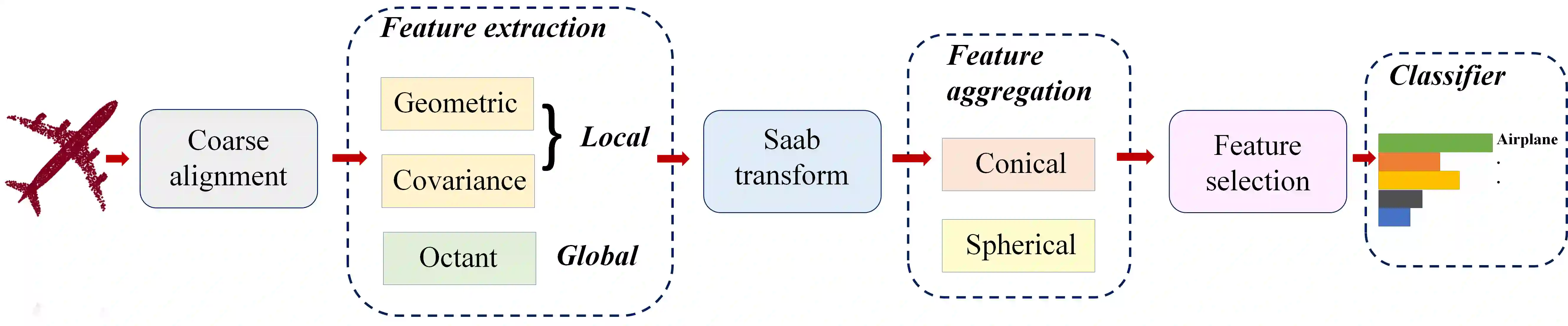
Many point cloud classification methods are developed under the assumption that all point clouds in the dataset are well aligned with the canonical axes so that the 3D Cartesian point coordinates can be employed to learn features. When input point clouds are not aligned, the classification performance drops significantly. In this work, we focus on a mathematically transparent point cloud classification method called PointHop, analyze its reason for failure due to pose variations, and solve the problem by replacing its pose dependent modules with rotation invariant counterparts. The proposed method is named SO(3)-Invariant PointHop (or S3I-PointHop in short). We also significantly simplify the PointHop pipeline using only one single hop along with multiple spatial aggregation techniques. The idea of exploiting more spatial information is novel. Experiments on the ModelNet40 dataset demonstrate the superiority of S3I-PointHop over traditional PointHop-like methods.
翻译:许多点云分类方法基于数据集中的所有点云均与标准坐标轴良好对齐的假设,从而利用三维笛卡尔点坐标进行特征学习。当输入点云未对齐时,分类性能会显著下降。本文聚焦于一种数学透明的点云分类方法PointHop,分析其因姿态变化导致性能失效的原因,并通过将其姿态相关模块替换为旋转不变模块解决该问题。所提出方法命名为SO(3)-不变PointHop(简称S3I-PointHop)。我们还通过仅使用单跳与多种空间聚合技术大幅简化PointHop流程。利用更多空间信息的思路具有创新性。在ModelNet40数据集上的实验表明,S3I-PointHop优于传统类PointHop方法。




相关内容





 微信扫码咨询专知VIP会员