

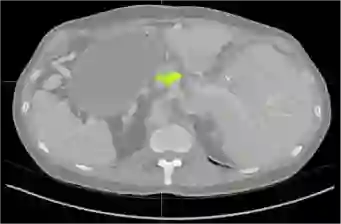
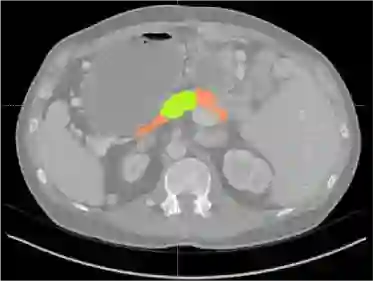
Creating large-scale and well-annotated datasets to train AI algorithms is crucial for automated tumor detection and localization. However, with limited resources, it is challenging to determine the best type of annotations when annotating massive amounts of unlabeled data. To address this issue, we focus on polyps in colonoscopy videos and pancreatic tumors in abdominal CT scans; both applications require significant effort and time for pixel-wise annotation due to the high dimensional nature of the data, involving either temporary or spatial dimensions. In this paper, we develop a new annotation strategy, termed Drag&Drop, which simplifies the annotation process to drag and drop. This annotation strategy is more efficient, particularly for temporal and volumetric imaging, than other types of weak annotations, such as per-pixel, bounding boxes, scribbles, ellipses, and points. Furthermore, to exploit our Drag&Drop annotations, we develop a novel weakly supervised learning method based on the watershed algorithm. Experimental results show that our method achieves better detection and localization performance than alternative weak annotations and, more importantly, achieves similar performance to that trained on detailed per-pixel annotations. Interestingly, we find that, with limited resources, allocating weak annotations from a diverse patient population can foster models more robust to unseen images than allocating per-pixel annotations for a small set of images. In summary, this research proposes an efficient annotation strategy for tumor detection and localization that is less accurate than per-pixel annotations but useful for creating large-scale datasets for screening tumors in various medical modalities.
翻译:创建大规模且高质量标注的数据集以训练人工智能算法,对于自动化肿瘤检测与定位至关重要。然而在资源有限的情况下,对海量未标注数据进行标注时,确定最佳标注类型极具挑战性。针对这一问题,本研究聚焦于结肠镜视频中的息肉和腹部CT扫描中的胰腺肿瘤——这两类应用由于数据的高维度特性(涉及时间维度或空间维度),像素级标注需要耗费大量人力与时间。本文提出一种名为"拖放标注"(Drag&Drop)的新型标注策略,将标注过程简化为拖放操作。相较于逐像素标注、边界框、涂鸦、椭圆和点标注等其他弱标注类型,该策略在处理时间序列和体积成像数据时效率更高。为充分利用Drag&Drop标注,我们基于分水岭算法开发了一种创新的弱监督学习方法。实验结果表明,该方法在检测与定位性能上优于其他弱标注方案,更重要的是,其性能可媲美基于详细逐像素标注训练的模型。有趣的是,研究发现当资源有限时,将弱标注分配给多样化的患者群体,比将逐像素标注分配给少量图像更能增强模型对未见图像的鲁棒性。综上所述,本研究提出了一种高效的肿瘤检测与定位标注策略,尽管其精度不及逐像素标注,但可为多种医学影像模态中的肿瘤筛查创建大规模数据集提供实用价值。







相关内容




 微信扫码咨询专知VIP会员