

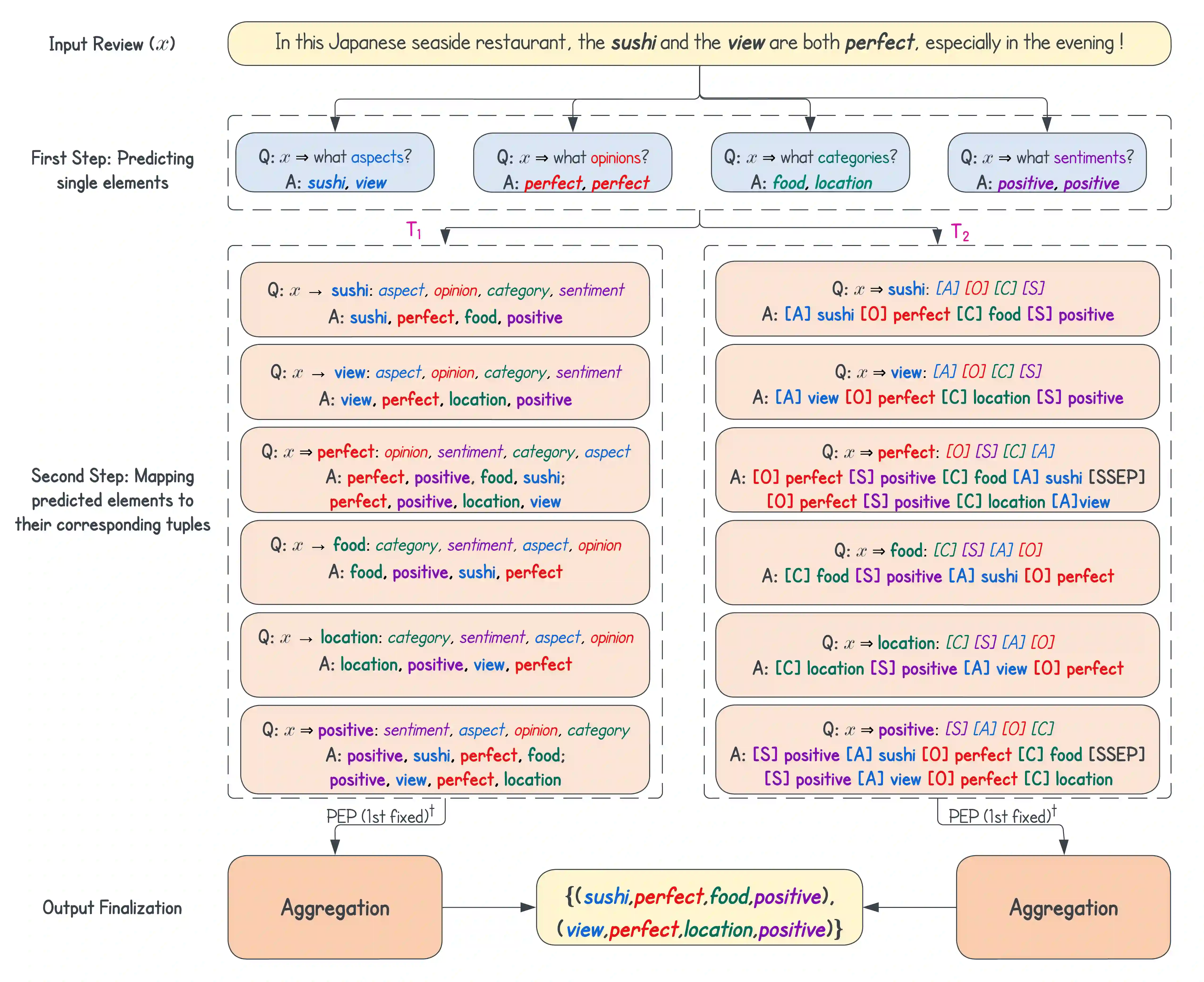
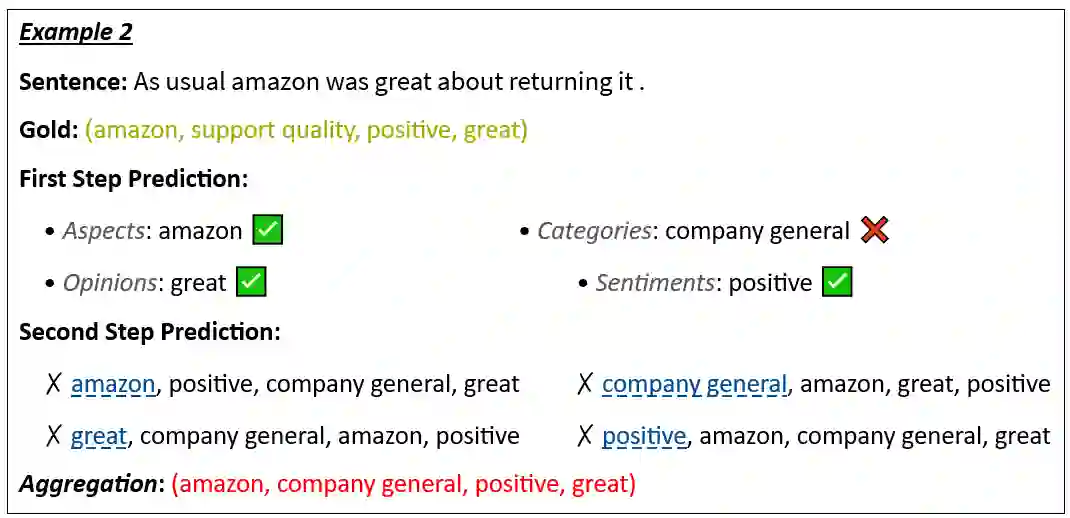
Generative approaches have significantly influenced Aspect-Based Sentiment Analysis (ABSA), garnering considerable attention. However, existing studies often predict target text components monolithically, neglecting the benefits of utilizing single elements for tuple prediction. In this paper, we introduce Element to Tuple Prompting (E2TP), employing a two-step architecture. The former step focuses on predicting single elements, while the latter step completes the process by mapping these predicted elements to their corresponding tuples. E2TP is inspired by human problem-solving, breaking down tasks into manageable parts, using the first step's output as a guide in the second step. Within this strategy, three types of paradigms, namely E2TP($diet$), E2TP($f_1$), and E2TP($f_2$), are designed to facilitate the training process. Beyond in-domain task-specific experiments, our paper addresses cross-domain scenarios, demonstrating the effectiveness and generalizability of the approach. By conducting a comprehensive analysis on various benchmarks, we show that E2TP achieves new state-of-the-art results in nearly all cases.
翻译:生成式方法显著影响了基于方面的情感分析(Aspect-Based Sentiment Analysis, ABSA),并引起了广泛关注。然而,现有研究通常整体性地预测目标文本成分,忽视了利用单一元素进行元组预测的优势。本文引入了从元素到元组提示(Element to Tuple Prompting, E2TP),采用两步架构。前一步专注于预测单一元素,后一步通过将这些预测元素映射到对应元组来完成流程。E2TP受人类问题解决方式启发,将任务分解为可管理的部分,并利用第一步的输出作为第二步的指导。在该策略下,设计了三种范式,即E2TP($diet$)、E2TP($f_1$)和E2TP($f_2$),以促进训练过程。除了领域内任务特定实验,本文还处理了跨领域场景,展示了该方法的效果和泛化能力。通过对多个基准进行全面分析,我们表明E2TP在几乎所有情况下均取得了新的最先进结果。




相关内容



 微信扫码咨询专知VIP会员