

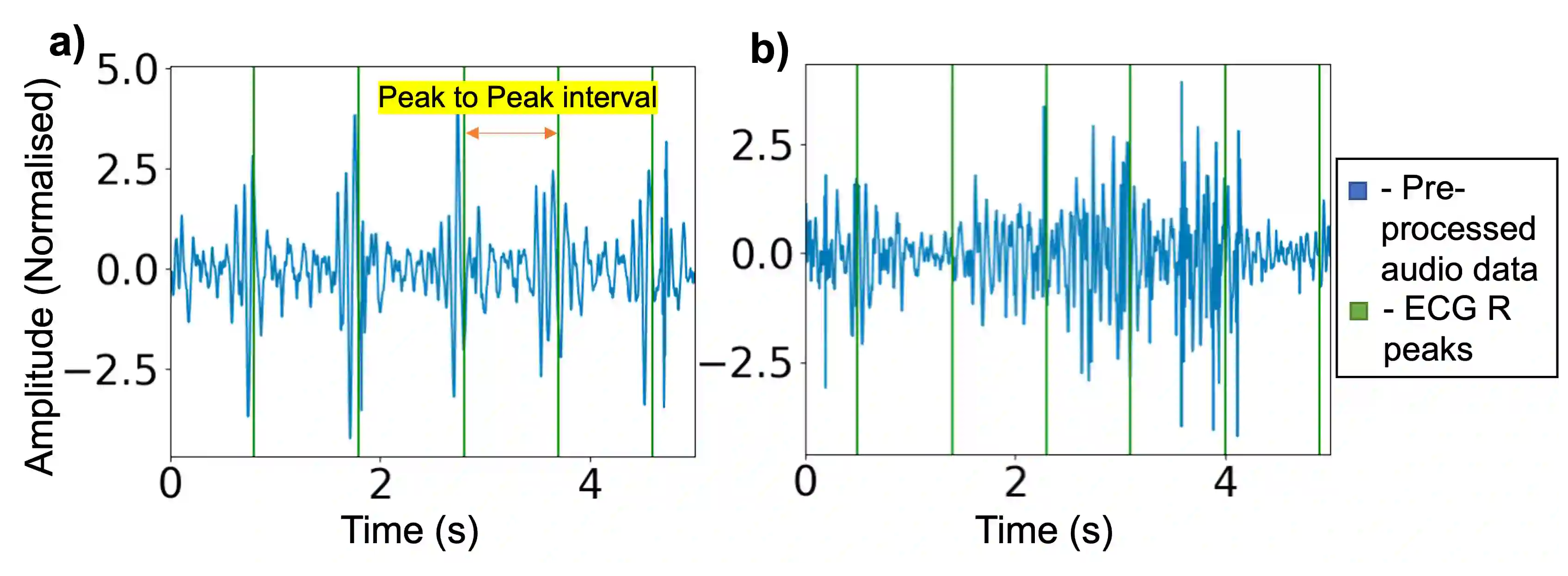
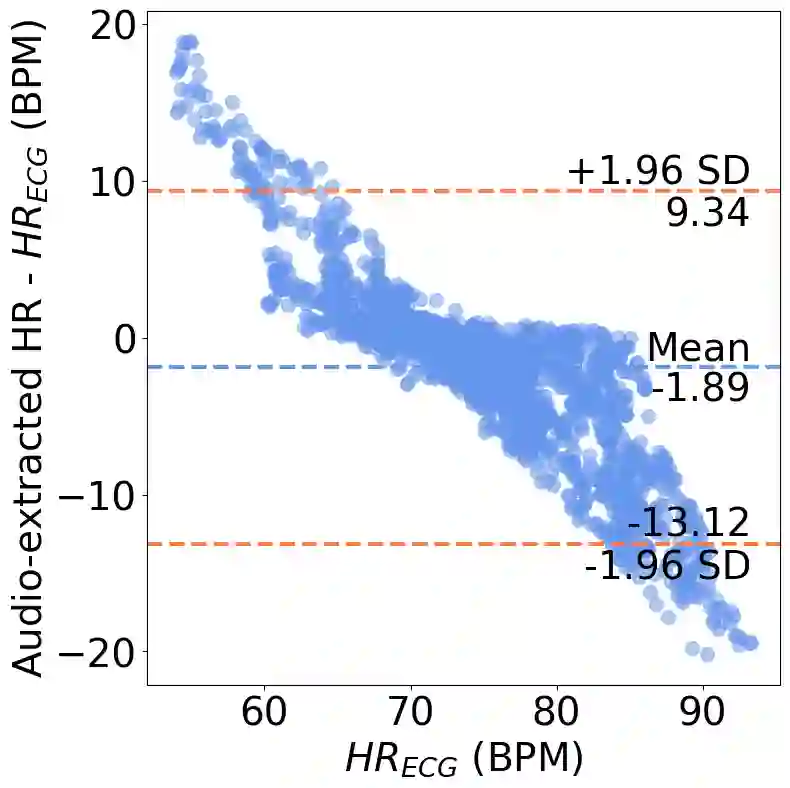
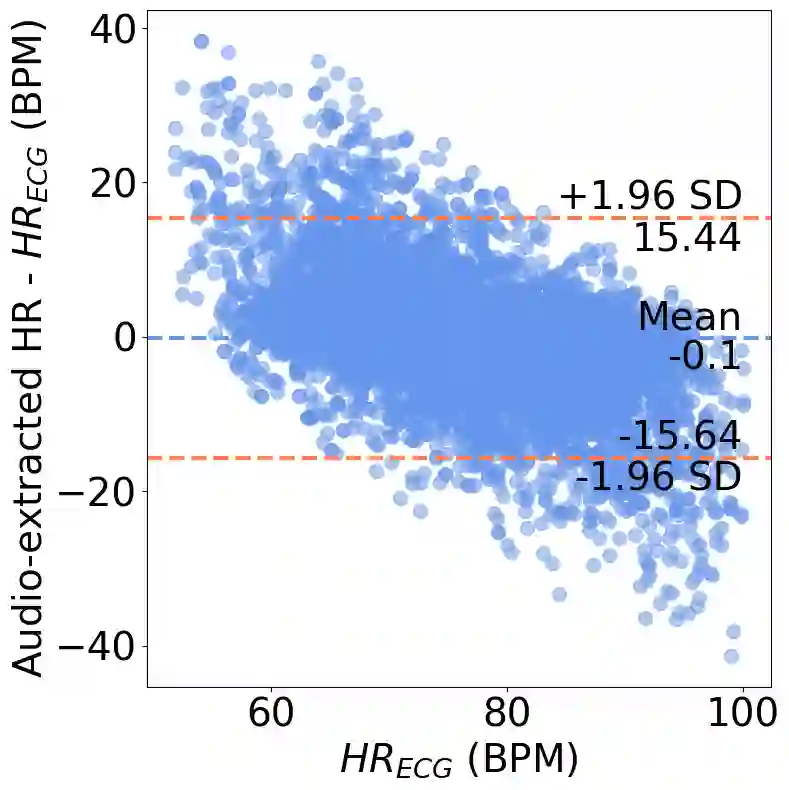
Abdominal sounds (ABS) have been traditionally used for assessing gastrointestinal (GI) disorders. However, the assessment requires a trained medical professional to perform multiple abdominal auscultation sessions, which is resource-intense and may fail to provide an accurate picture of patients' continuous GI wellbeing. This has generated a technological interest in developing wearables for continuous capture of ABS, which enables a fuller picture of patient's GI status to be obtained at reduced cost. This paper seeks to evaluate the feasibility of extracting heart rate (HR) from such ABS monitoring devices. The collection of HR directly from these devices would enable gathering vital signs alongside GI data without the need for additional wearable devices, providing further cost benefits and improving general usability. We utilised a dataset containing 104 hours of ABS audio, collected from the abdomen using an e-stethoscope, and electrocardiogram as ground truth. Our evaluation shows for the first time that we can successfully extract HR from audio collected from a wearable on the abdomen. As heart sounds collected from the abdomen suffer from significant noise from GI and respiratory tracts, we leverage wavelet denoising for improved heart beat detection. The mean absolute error of the algorithm for average HR is 3.4 BPM with mean directional error of -1.2 BPM over the whole dataset. A comparison to photoplethysmography-based wearable HR sensors shows that our approach exhibits comparable accuracy to consumer wrist-worn wearables for average and instantaneous heart rate.
翻译:腹部声音(ABS)传统上用于评估胃肠(GI)疾病。然而,这种评估需要训练有素的医疗专业人员多次进行腹部听诊,耗费大量资源且可能无法准确反映患者持续的胃肠健康状况。这激发了开发可穿戴设备用于连续采集腹部声音的技术兴趣,从而能够以更低的成本更全面地获取患者胃肠状态信息。本文旨在评估从这类腹部声音监测设备中提取心率(HR)的可行性。直接从这些设备中采集心率,可在获取胃肠数据的同时收集生命体征,无需额外佩戴其他可穿戴设备,从而进一步降低成本并提升通用性。我们使用了一个包含104小时腹部音频的数据集,这些音频通过电子听诊器从腹部采集,并以心电图作为基准。评估首次证明,我们能够成功从腹部可穿戴设备采集的音频中提取心率。由于从腹部采集的心音受到胃肠和呼吸道噪声的严重干扰,我们利用小波去噪技术改进了心跳检测。在整个数据集上,该算法对平均心率的平均绝对误差为3.4 BPM,平均方向误差为-1.2 BPM。与基于光电容积描记法的可穿戴心率传感器相比,我们的方法在平均心率和瞬时心率方面均展现出与消费级腕戴式设备相当的精度。





相关内容




 微信扫码咨询专知VIP会员