

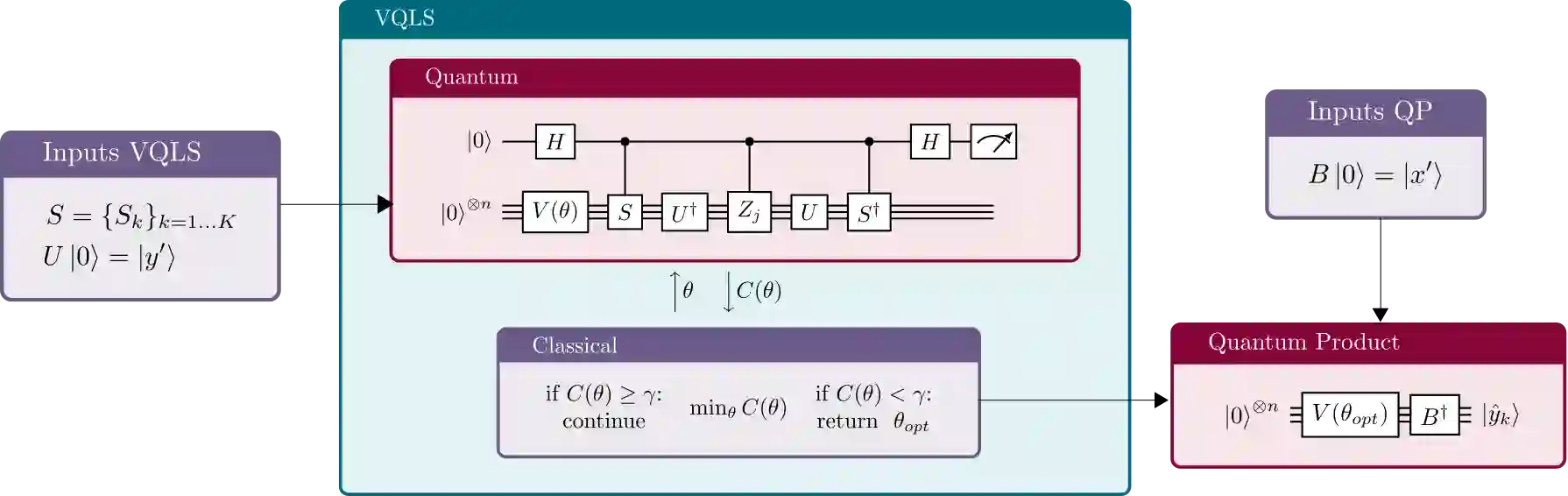
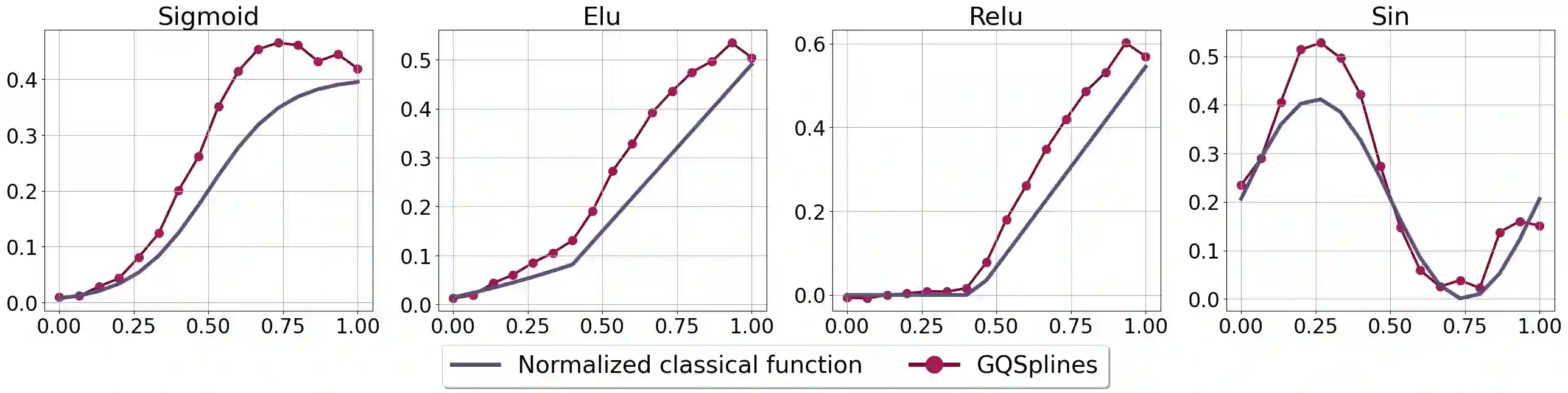
The postulates of quantum mechanics impose only unitary transformations on quantum states, which is a severe limitation for quantum machine learning algorithms. Quantum Splines (QSplines) have recently been proposed to approximate quantum activation functions to introduce non-linearity in quantum algorithms. However, QSplines make use of the HHL as a subroutine and require a fault-tolerant quantum computer to be correctly implemented. This work proposes the Generalised QSplines (GQSplines), a novel method for approximating non-linear quantum activation functions using hybrid quantum-classical computation. The GQSplines overcome the highly demanding requirements of the original QSplines in terms of quantum hardware and can be implemented using near-term quantum computers. Furthermore, the proposed method relies on a flexible problem representation for non-linear approximation and it is suitable to be embedded in existing quantum neural network architectures. In addition, we provide a practical implementation of GQSplines using Pennylane and show that our model outperforms the original QSplines in terms of quality of fitting.
翻译:量子力学公设仅允许对量子态施加酉变换,这严重限制了量子机器学习算法的能力。近期提出的量子样条(QSplines)通过近似量子激活函数,为量子算法引入非线性特性。然而,QSplines 依赖 HHL 作为子程序,并需要容错量子计算机才能正确实现。本研究提出广义量子样条(GQSplines),一种利用混合量子-经典计算近似非线性量子激活函数的新方法。GQSplines 克服了原始 QSplines 对量子硬件的苛刻要求,可在近期量子计算机上实现。此外,所提方法基于灵活的非线性近似问题表示,适用于嵌入现有量子神经网络架构。我们进一步使用 PennyLane 提供了 GQSplines 的实用实现,并证明该模型在拟合质量上优于原始 QSplines。




相关内容


 微信扫码咨询专知VIP会员