

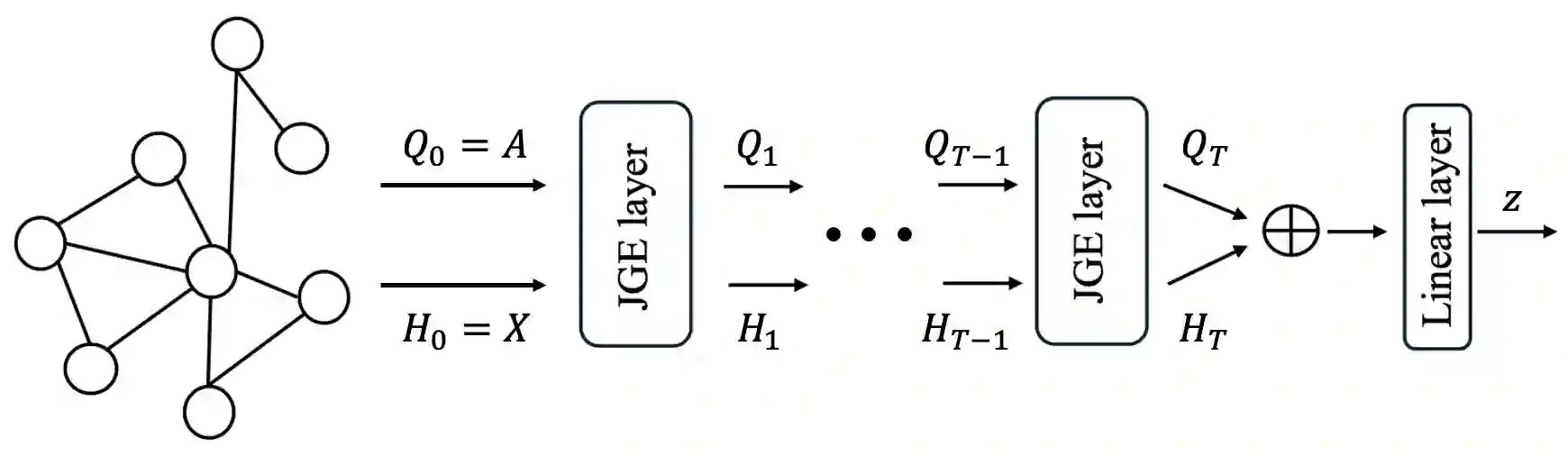
Graphs are central to modeling complex systems in domains such as social networks, molecular chemistry, and neuroscience. While Graph Neural Networks, particularly Graph Convolutional Networks, have become standard tools for graph learning, they remain constrained by reliance on fixed structures and susceptibility to over-smoothing. We propose the Spectral Preservation Network, a new framework for graph representation learning that generates reduced graphs serving as faithful proxies of the original, enabling downstream tasks such as community detection, influence propagation, and information diffusion at a reduced computational cost. The Spectral Preservation Network introduces two key components: the Joint Graph Evolution layer and the Spectral Concordance loss. The former jointly transforms both the graph topology and the node feature matrix, allowing the structure and attributes to evolve adaptively across layers and overcoming the rigidity of static neighborhood aggregation. The latter regularizes these transformations by enforcing consistency in both the spectral properties of the graph and the feature vectors of the nodes. We evaluate the effectiveness of Spectral Preservation Network on node-level sparsification by analyzing well-established metrics and benchmarking against state-of-the-art methods. The experimental results demonstrate the superior performance and clear advantages of our approach.
翻译:图是建模复杂系统的核心工具,广泛应用于社交网络、分子化学和神经科学等领域。尽管图神经网络,特别是图卷积网络,已成为图学习的标准工具,但它们仍受限于对固定结构的依赖以及易发生过平滑问题。我们提出了谱保持网络,这是一种用于图表示学习的新框架,能够生成作为原始图忠实代理的简化图,从而以较低的计算成本支持下游任务,如社区检测、影响力传播和信息扩散。谱保持网络引入了两个关键组件:联合图演化层和谱一致性损失。前者联合变换图的拓扑结构和节点特征矩阵,使结构和属性能够在各层之间自适应地演化,克服了静态邻域聚合的刚性。后者通过强制图谱特性与节点特征向量的一致性来正则化这些变换。我们通过分析成熟的指标并与最先进方法进行基准测试,评估了谱保持网络在节点级稀疏化方面的有效性。实验结果表明,我们的方法具有优越的性能和明显优势。




相关内容




 微信扫码咨询专知VIP会员