

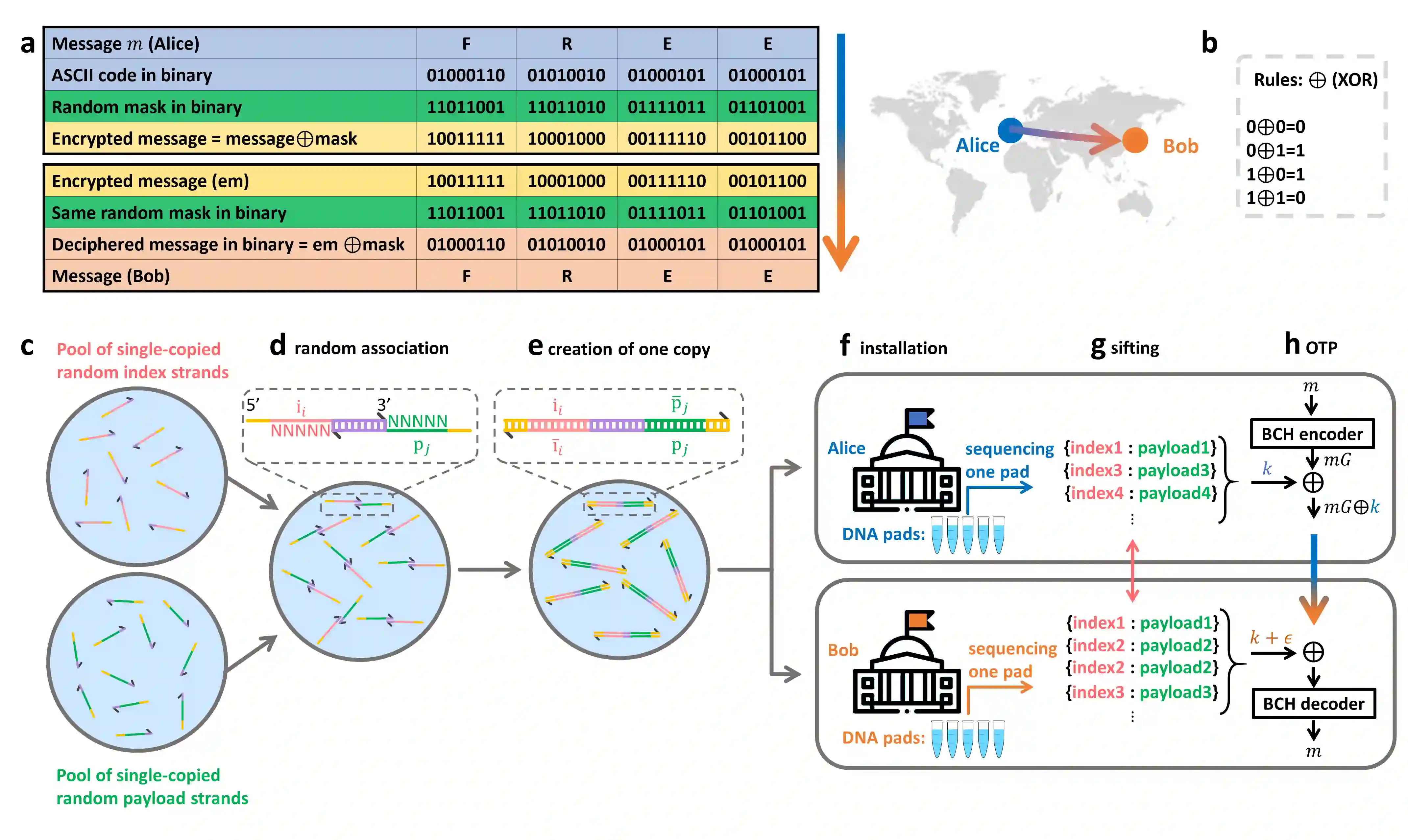
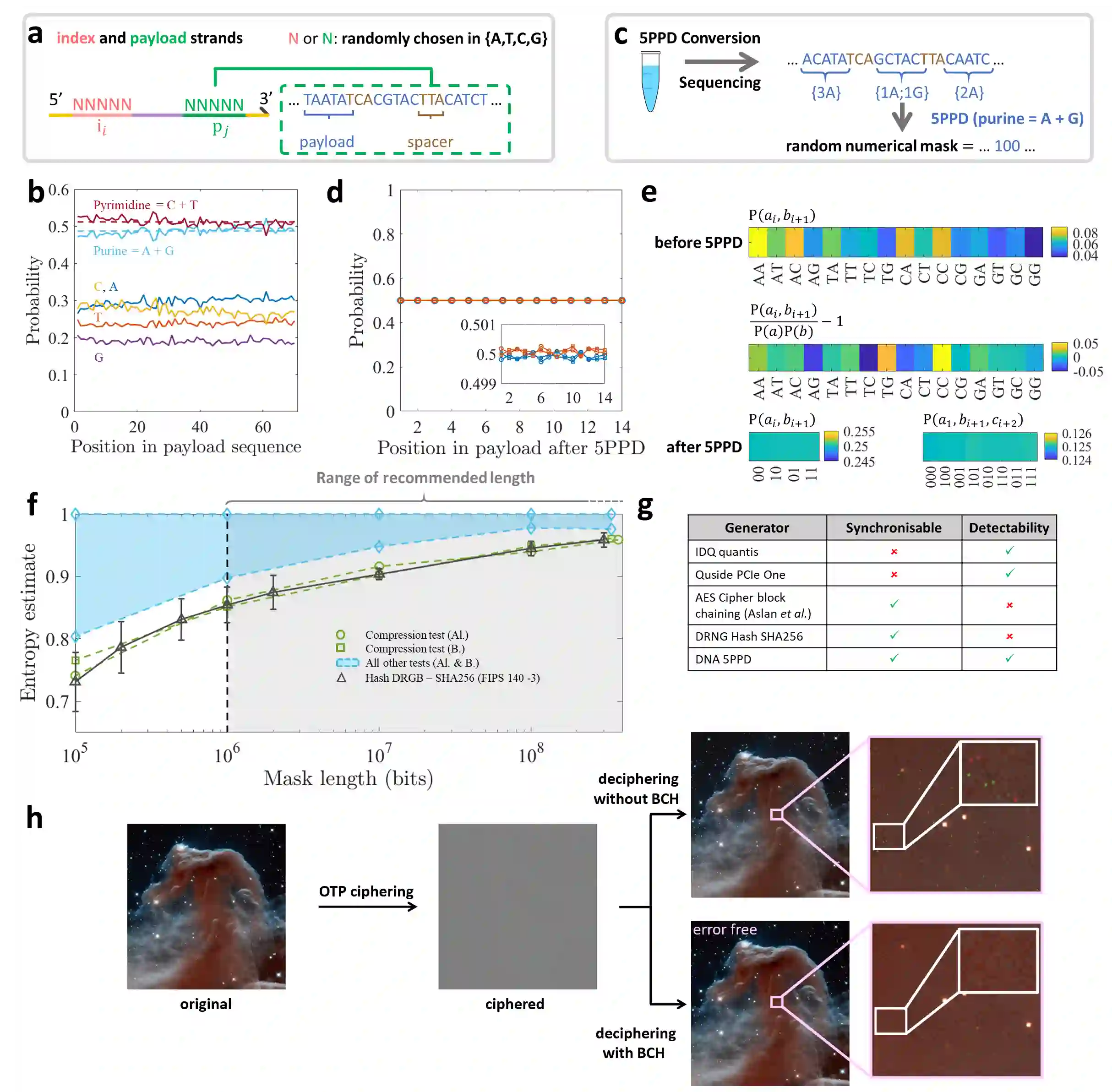
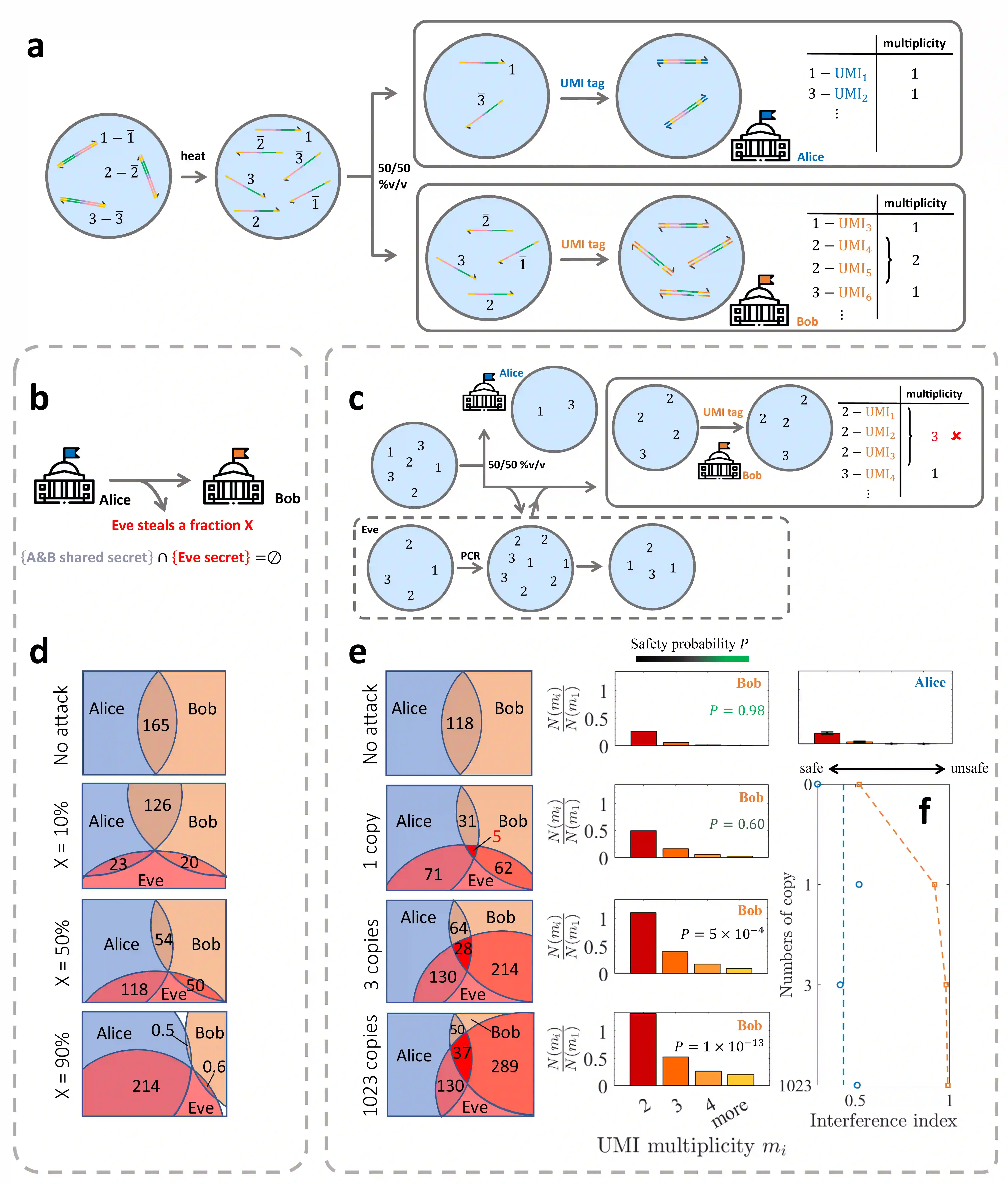
Secure communication is the cornerstone of modern infrastructures, yet achieving unconditional security -resistant to any computational attack- remains a fundamental challenge. The One-Time Pad (OTP), proven by Shannon to offer perfect secrecy, requires a shared random key as long as the message, used only once. However, distributing large keys over long distances has been impractical due to the lack of secure and scalable sharing options. Here, we introduce a DNA-based cryptographic primitive that leverages random pools of synthetic DNA to install a synchronized entropy source between distant parties. Our approach uses duplicated DNA molecules -comprising random index-payload pairs- as a shared secret. These molecules are locally sequenced and digitized to generate a common binary mask for OTP encryption, achieving unconditional security without relying on computational assumptions. We experimentally demonstrate this protocol between Tokyo and Paris, using in-house sequencing, generating a shared secret mask of $\sim$ 400 Mb with a residual error rate to achieve the usual overall decryption failure rate of $2^{-128}$. The min-entropy of the binary mask meets the most recent National Institute of Standards and Technology requirements (SP 800-90B), and is comparable to that of approved cryptographic random number generators. Critically, our system can resist two types of adversarial interference through molecular copy-number statistics, providing an additional layer of security reminiscent of Quantum Key Distribution, but without distance limitations. This work establishes DNA as a scalable entropy source for long-distance OTP, enabling high-throughput and secure communications in sensitive contexts. By bridging molecular biology and cryptography, DNA-based key distribution opens a promising new route toward unconditional security in global communication networks.
翻译:安全通信是现代基础设施的基石,然而实现无条件安全性——即抵御任何计算攻击——仍是一个根本性挑战。香农证明可实现完美保密性的一次性密码本(OTP)要求使用与消息等长且仅用一次的共享随机密钥。但由于缺乏安全且可扩展的共享方案,长距离分发大规模密钥一直不具备可行性。本文提出一种基于DNA的密码学原语,利用合成DNA的随机池在远距离双方之间建立同步熵源。我们的方法采用包含随机索引-载荷对的重复DNA分子作为共享密钥。这些分子在本地进行测序和数字化,生成用于OTP加密的公共二进制掩码,从而在不依赖计算假设的前提下实现无条件安全性。我们通过东京与巴黎之间的实验验证了该协议,利用自主测序技术生成了约400 Mb的共享密钥掩码,其残留误码率可满足常规整体解密失败率2^{-128}的要求。该二进制掩码的最小熵满足美国国家标准与技术研究院最新标准(SP 800-90B),且与已获认证的密码学随机数生成器相当。关键的是,我们的系统能通过分子拷贝数统计抵御两类对抗性干扰,提供了类似于量子密钥分发的额外安全层,且不受距离限制。本工作确立了DNA作为长距离OTP可扩展熵源的地位,为敏感场景下的高吞吐量安全通信提供了可能。通过融合分子生物学与密码学,基于DNA的密钥分发为全球通信网络的无条件安全性开辟了一条充满前景的新路径。




相关内容


 微信扫码咨询专知VIP会员